Project Gemini
ProgramWikipedia
101
MENTIONS
34
EPISODES
32
PODCASTS
Search complete. 101 mentions across 34 episodes found for "Project Gemini".
Sep 11, 2026

Rod PyleHOST
Now, you saw the Mercury capsule.
Rod PyleHOST
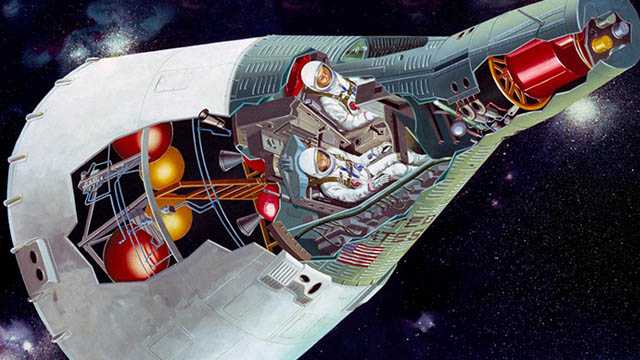
Did you ever see up, I'm sure you have, up close the Gemini capsule?
Michael OkudaGUEST
Uh, I've s- uh, I've seen, uh, one of the Gemini, I think it was Gemini VIII in, um, the California s- uh, Museum of Science and Industry.
Michael OkudaGUEST
Oh, a- and also there was one at the Air and Space Museum.
Rod PyleHOST
A- and I always, when I see the ca- the cabin of those things, and I got to sit in a simulator once years ago, I, I try to imagine spending two weeks in there without being able to even stretch out your legs-
Michael OkudaGUEST
And during our first season, we had, uh, a museum quality replica of the, of the Apollo command module-
Rod PyleHOST
Ah
Michael OkudaGUEST
... which according to the astronauts, it was much more spacious than the Mercury or, or Gemini, uh, capsules.

Mike MullaneGUEST
Mercury and Apollo had the tractor rocket on top of the capsule and pulled the capsule away from a failing booster and parachuted to safety.
Mike MullaneGUEST
Gemini had ejection seats.
Mike MullaneGUEST
But comes along the shuttle, nothing.
Mike MullaneGUEST
And all my life in the Air Force, I had sat in airplanes doing some very dangerous things, combat, other testing as a goose, a flight test engineer, except in Vietnam.
Andy PonirosHOST
And I thank you for sharing that because Most people don't share those kinds of things.
Andy PonirosHOST
And like you said, even yourself, you know, your heart's racing and you're on that launch pad.
Andy PonirosHOST
And, you know, I've had, I've talked to other astronauts from Gemini, Mercury, Apollo, and they all said that this, like you said, this fear and this joy together, it made them sharper.
Mike MullaneGUEST
Yeah.

Giles BrownHOST
The X-5, thank you.
Giles BrownHOST
And then they were all, you know, everybody in the Mercury or the Gemini projects were all, you said, fighter jocks, because they needed to be, because they were, what was it, spam in a can? I think it was that they were...
Giles BrownHOST
Yeah, that's
Peter BondGUEST
right.

Ron HowardGUEST
Wide shots would have to be wires, like, like 2001, and, and that was gonna be very limiting.
Ron HowardGUEST
To name-drop a little bit, one day I was talking, I was on the Universal lot, and Steven Spielberg said, "How are you gonna do the weightlessness?" And I said, "Well, we're kind of struggling with it." And, and he said, uh, "Well, you know, I saw some NASA footage once where they bolted the Gemini capsule down, and then they went up in this plane and created this sort of, uh, zero G, and the astronauts would open the hatch and practice EVAs." And, uh, he said, "Y- you know, that would be kind of interesting." So I went to Jim Lovell and I said, "Spielberg told me about this thing." He said, "Oh, yeah, the vomit comet." He said, "It's brutal.
Ron HowardGUEST
It's really brutal." He said, "But yeah, that, that works." NASA wasn't interested in us, you know, testing that idea, but there was a, a mothballed Russian [laughs] plane, uh, this is in '94, and we thought maybe we could charter that, but then we, we thought better of that, and insurance wouldn't cover it, and that was wise.
Ron HowardGUEST
And so then, so then Jim Lovell himself-

MagnumHOST
Within months, James Webb put Kenneth Kleinecht in charge of Project Mercury.
MagnumHOST
Kleinecht went on to be the deputy manager of Gemini and program manager for the Apollo command and service modules.
MagnumHOST
He was running all three of these things.
MagnumHOST
Kleineck's brother, C. Fred Kleineck, was Sovereign Grand Commander of the Supreme Council 33rd Degree.
MagnumHOST
And guess what? Their father also sat on the Supreme Council too.
MagnumHOST
So to put things differently...
MagnumHOST
The family that ran American Freemasonry for a period of time produced the same man who ran Mercury, Gemini, and Apollo programs at NASA.
MagnumHOST
Now, the astronauts follow a similar pattern as well at NASA.

speaker_0NARRATOR
The spacecraft sank, but Grissom was saved by a helicopter, insisting he had done nothing to detonate the explosives.
speaker_0NARRATOR
He was believed by NASA officials, and having cleared his name, Grissom was selected to be the command pilot for the Project Gemini mission in 1964.
speaker_0NARRATOR
Edward H.
speaker_0NARRATOR
White II was the senior pilot on board the Apollo 1.

David CowanHOST
We'll see where you go with this.
David CowanHOST
This feels very much like, you know, Mercury, Gemini, Apollo, the space shuttle, and now SpaceX.
David CowanHOST
It's like once upon a time we didn't even have the math to get out of Earth's, uh, gravitational pull, let alone orbit the Earth and then get to the moon.
David CowanHOST
We don't even know, we don't know what we don't know yet, and I think so many people are expecting answers and as if, oh, we've figured something out.

Daven HiskeyHOST
Using mechanical pencils solves some of these problems, but broken-off lead tips still have the potential to float behind control panels and short out vital electronic equipment.
Daven HiskeyHOST
As a result, by the time of the Gemini and Apollo programs, NASA had largely replaced mechanical pencils with grease pencils and felt-tip pens.
Daven HiskeyHOST
Nonetheless, the agency still desired a ballpoint pen that could work reliably in space.
Daven HiskeyHOST
Not only would such an instrument be more compatible with paper checklists and notebooks than grease pencils and felt pens, but the marks could be far more permanent.

Bob RogersGUEST
Spin-offs are those wonderful technologies that accidentally get co-produced when you're doing something else.
Bob RogersGUEST
So, coming out of the Mercury, Gemini and Apollo program, we got computers, we got cell phones, we got satellites, we got satellite imagery, we got satellite navigation systems, we got all of these incredible things that are now part of our everyday lives.
Bob RogersGUEST
And they don't impress anybody at this point.
Bob RogersGUEST
So we coined the phrase, the exploration of space is one of the great adventures of all time.

John DevGUEST
And these Saturn 1B rockets didn't just appear out of nowhere.
John DevGUEST
They were developed and used during, they were modified versions of rockets used in Project Gemini.
John DevGUEST
This was 10 missions that took place, crewed flights, all testing different aspects of flight that was required for a lunar landing.
John DevGUEST
They did things in low Earth orbit, such as rendezvous, docking spaceships together.
24 more episodes mention Project Gemini.
Create an account to see the whole feed, search across every transcript, and follow the entities you care about.