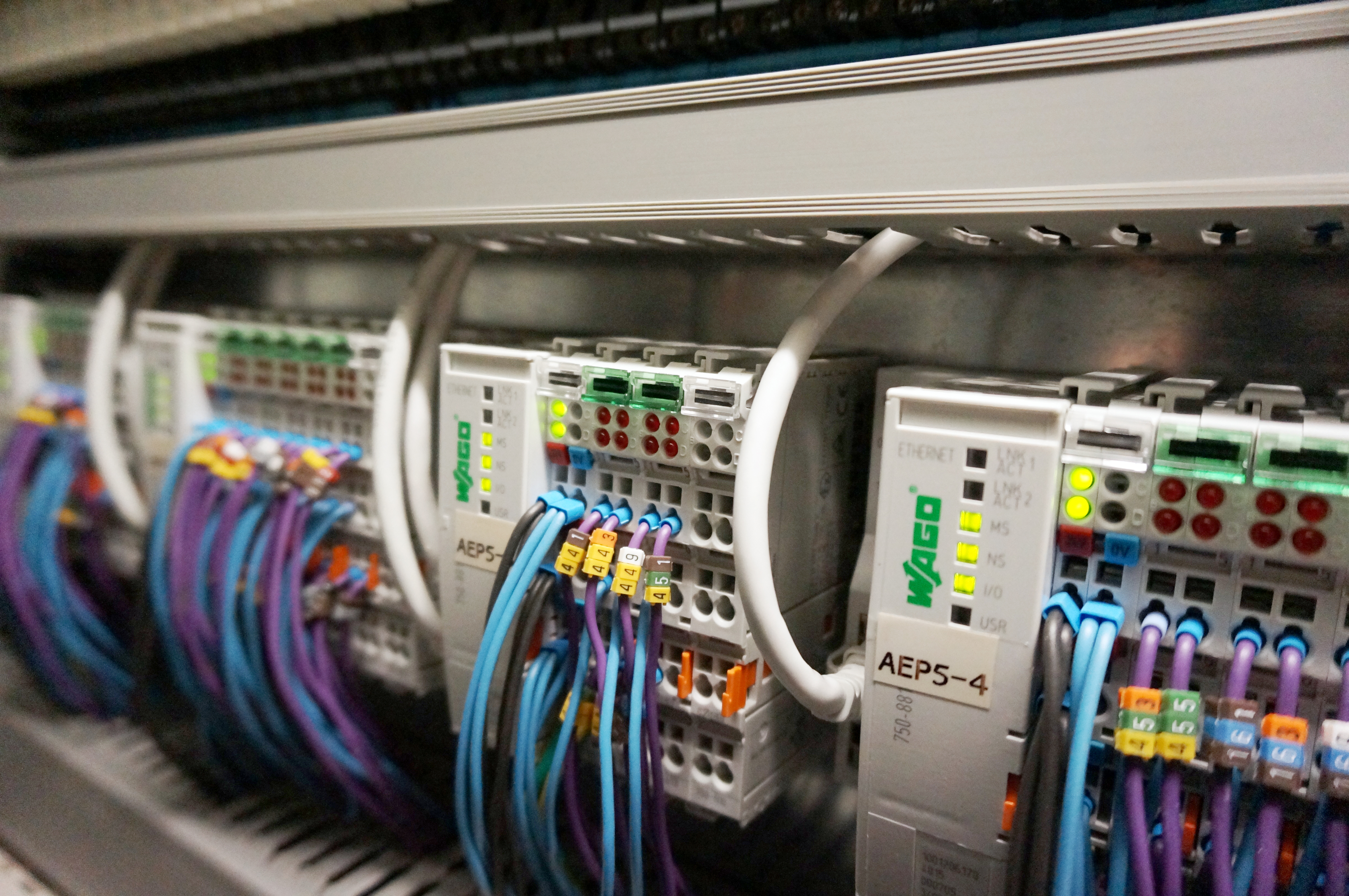
Programmable logic controller

Programmable logic controller

ComputerWikipedia

Search complete. 495 mentions across 83 episodes found for "Programmable logic controller".

Sep 10, 2026

Chris GrundemannGUEST
25:03
And so I was out, like I was working landscaping jobs.
Chris GrundemannGUEST
25:07
I ended up working at a concrete plant that had, where I was doing like PLC programming, which was kind of neat, basically like telling robots what to do in the concrete factory.
Chris GrundemannGUEST
25:17
And ended up working at a job where I was basically pulling cable.
Chris GrundemannGUEST
25:20
So this was during the housing boom of the 90s, I guess, late 90s, early 2000s in Colorado.
Chris GrundemannGUEST
25:03
And so I was out, like I was working landscaping jobs.
Chris GrundemannGUEST
25:07
I ended up working at a concrete plant that had, where I was doing like PLC programming, which was kind of neat, basically like telling robots what to do in the concrete factory.
Chris GrundemannGUEST
25:17
And ended up working at a job where I was basically pulling cable.
Chris GrundemannGUEST
25:20
So this was during the housing boom of the 90s, I guess, late 90s, early 2000s in Colorado.
Nikki GonzalesHOST
5:45
you're probably leapfrogging some of the competition out there quite a bit coming with this to market.
Nikki GonzalesHOST
5:51
I mean, the latest, I just wrote an article on somebody's claim of like the post PLC era about now using an AI controller instead for like motion planning and vision and all the things that you would typically see with a separate vision system, PLC, HMI.
Nikki GonzalesHOST
6:10
the traditional stack of controlling a robot deterministically.
Nikki GonzalesHOST
6:15
Now having an all-in-one AI controller with an onboard GPU.
Whitney DillsGUEST
6:36
Some people have.
Whitney DillsGUEST
6:37
There's three other companies who are really using active inference in their modeling.
Nikki GonzalesHOST
6:43
Yeah, but that still to me is like, okay, you're kind of just abstracting the PLC onto some CPU cores on an IPC.
Nikki GonzalesHOST
6:54
But it's still, I mean, you can call it a post-PLC era.
Vlad RomanovHOST
32:46
Then you're going to have to manually come in and convert all of them.
Vlad RomanovHOST
32:49
And wait, now there's more because the PLCs will no longer support the connection to the new factory talk view SC type of terminals and servers.
Vlad RomanovHOST
32:59
So now you're upgrading the PLCs.
Vlad RomanovHOST
33:01
Now you're looking at the networks that they're connected through, right? And in many cases, that's going to be data highway plus.
Vlad RomanovHOST
33:07
And so now there's, you know, a hundred different problems as a result of this easy migration type of a situation.
Vlad RomanovHOST
33:44
Now we're replacing new server.
Vlad RomanovHOST
33:45
We have like new servers coming in.
Vlad RomanovHOST
33:47
We have new PLCs coming in, new remote racks coming in, new IO coming in, new sensors coming in, new drives coming in, right? So it becomes very expensive on both the hardware software sides, but also on the integration side very quickly, right?
Liam FosterHOST
65:28
Okay, well, I can understand that because in my own experience, I have had the experience of traveling on a train, which was like a commuter train in Singapore that went from the city all the way to the airport.
Liam FosterHOST
65:45
And it was all under control of a PLC.
Liam FosterHOST
65:49
A what? Also, a previous experience I had was with gas turbine engines operating on offshore platforms, and there was no people on the platforms, but yet it was all these units were running.
Liam FosterHOST
66:15
Three or four of them were running.
Liam FosterHOST
66:17
They were all under the control of the PLC.
Liam FosterHOST
66:20
So the technology has been around for a considerable period of time.
Liam FosterHOST
66:26
The only area that I would feel a little apprehensive about is the roads, buses and cars and taxis and that.
Chris GrundemannGUEST
25:03
And so I was out, like I was working landscaping jobs.
Chris GrundemannGUEST
25:07
I ended up working at a concrete plant that had, where I was doing like PLC programming, which was kind of neat, basically like telling robots what to do in the concrete factory.
Chris GrundemannGUEST
25:17
And ended up working at a job where I was basically pulling cable.
Chris GrundemannGUEST
25:20
So this was during the housing boom of the 90s, I guess, late 90s, early 2000s in Colorado.
Colin RussHOST
15:53
Yeah, yeah, yeah.
Daniel Scott MitchellGUEST
15:53
W- we are starting to build PLC integration via the MTConnect protocol as an additional sensor feed into our platform that allows us to layer in information around the feeds and speeds of the machine, alongside the vibration and power to help give us an understanding.
Daniel Scott MitchellGUEST
16:08
But the challenge there with MTConnect is I walk into a shop, and not 100% of their machines on their shop floor give you this level of visibility.
Daniel Scott MitchellGUEST
16:18
Um-
speaker_2HOST
10:28
In many cases, yes.
speaker_2HOST
10:30
If that router is sitting between a central supervisory control system and a legacy programmable logic controller, a PLC, on a manufacturing line, pulling it offline halts the entire line instantly.
speaker_1HOST
10:42
Wow.
speaker_1HOST
10:43
I guess that would be a huge problem.
speaker_1HOST
10:51
Okay, but couldn't you just reboot it quickly, like a five-minute maintenance window?
speaker_2HOST
10:55
It is never that simple in OT.
speaker_2HOST
10:57
Legacy PLCs have very little tolerance for sudden operational friction.
speaker_2HOST
11:02
These are fragile digital ecosystems.
Shawn TierneyHOST
0:03
My name is Sean Tierney, Industrial Automation Instructor and Content Creator over at Insights in Automation.
Shawn TierneyHOST
0:09
And this week on the show, I have Sina J from Forge.io on to talk about their PLC Copilot, a true AI copilot to help you write PLC code.
Shawn TierneyHOST
0:18
I think you guys are going to really enjoy this episode.
Shawn TierneyHOST
0:20
But before we get to that, a couple of announcements.
Shawn TierneyHOST
0:56
I've just filled up November, September.
Shawn TierneyHOST
0:59
We're already halfway through September.
Shawn TierneyHOST
1:01
So if you know anybody who needs some custom training, maybe you've got a couple of guys or four or five, six guys who need to learn, maybe they got to learn just compact logics, or maybe they need to learn compact logics in panel view plus, or maybe they need to learn slick 500 PLC five compact logics, panel view plus, um, We can even do MicroLogix, Micro 800.
Shawn TierneyHOST
1:19
So if you have any custom training needs, maybe some of your technicians need to get trained this year, I still have time available in October.
Lauren EspinHOST
1:21
And another may have helped pack the delivery box that showed up on your doorstep.
Lauren EspinHOST
1:26
PLCs are everywhere in modern industry.
Lauren EspinHOST
1:29
Siemens makes a lot of them.
Lauren EspinHOST
1:31
In fact, about a third of the machines in the world are controlled by Siemens PLCs.
Lauren EspinHOST
1:37
And every one of those controllers needs to be programmed.
Lauren EspinHOST
1:41
That's the job of automation engineers.
Lauren EspinHOST
5:20
Siemens is investing $1 billion in AI capabilities and offerings over the next three years, building on decades of experience applying technology across industry and infrastructure.
Lauren EspinHOST
5:32
because the next chapter of ai won't be defined only by more powerful models it will also be defined by our ability to employ them in the real world with the industrial context and human expertise required to solve real problems and deliver measurable value That's a quieter kind of progress than a chatbot getting cleverer.

73 more episodes mention Programmable logic controller.

Create an account to see the whole feed, search across every transcript, and follow the entities you care about.

We value your privacy

We use cookies to understand how you use our platform and to improve your experience. Click “Accept All” to consent, or “Decline non-essential” to opt out of non-essential cookies. Read our Privacy Policy.