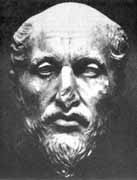
Proclus
Greek philosopherWikipedia
78
MENTIONS
36
EPISODES
32
PODCASTS
Search complete. 78 mentions across 36 episodes found for "Proclus".
Sep 26, 2026

Ben TuckerNARRATOR
And here, said the barber as he groped in his dusty and dark corner, are more translations by this same Taylor, who indeed seems to have been a very notable botcher of ancient doublets.
Ben TuckerNARRATOR
This is the Fragments of Ancient Pythagoreans, this Plato's Dialogues, and here we have the lost writings of Proclus, surnamed the Successor.
Ben TuckerNARRATOR
Pray, Master Licentiate, where do these successors live? For I know no family of that name.
Ben TuckerNARRATOR
You mistake, you mistake, Master Nicholas, said the priest, not without smiling.
Ben TuckerNARRATOR
This Proclus was the successor of Plato, and so he said the last link of the Hermeic chain.
Ben TuckerNARRATOR
But let us have done with him, for I see on the shelf the triumphal chariot of Antimony by Basilius Valentinus, with Anima Magica Abscondita, and Lumen de Lumine by Thomas Vaughan, called an Alchemy Eugenius Philandlethis.
Ben TuckerNARRATOR
And just beyond is the victorious Philosophical Stone, and by St. Chrysostom, the Comte de Gabalis.

Joel ChristensenGUEST
Well, we have summaries of many of the other myths and, uh, stories around Troy, um, in very short form, right? Something like, um, the, the library of Apollodorus, which gives a, a history of Greek myth or equivalent Latin version of Hyginus.
Joel ChristensenGUEST
Um, and we have summaries from a guy named Proclus.
Joel ChristensenGUEST
Um, but the dangerous thing about most of these, um, accounts is that they've been preserved in order to flesh out the details around the Iliad and the Odyssey.
Joel ChristensenGUEST
Um, which means they've been selected from all the possible narratives.

Julia SchifiniHOST
So the philosopher Crantor, for example, often has had his writing be referenced as one of the reasons that later writers think that Atlantis was historical rather than fictional.
Julia SchifiniHOST
This isn't helped by the writing of Proclus in the fifth century AD, who claimed that Crantor's depiction of Atlantis came from the fact that he had traveled to Egypt and heard the story firsthand from priests there, as well as claiming to have seen hieroglyphics that seemingly confirmed the story.
Amanda McLoughlinHOST
Okay, my man.
Julia SchifiniHOST
So here's what Proclus proclaims.
Julia SchifiniHOST
He says, quote, "As for the whole of this account of the Atlanteans, some say that it is unadorned history, such as Crantor, the first commentator on Plato.
Julia SchifiniHOST
Crantor also says that Plato's contemporaries used to criticize him jokingly for not being the inventor of his republic." But copying the institutions of the Egyptians.

Arnie HortonNARRATOR
We were all lions and recherchés.
Arnie HortonNARRATOR
There was a modern Platonist; he quoted Porphyry, Iamblichus, Plotinus, Proclus, Hierocles, Maximus Tyrius, and Syrianus.
Arnie HortonNARRATOR
There was a human perfectibility man; he quoted Turgot, Price, Priestley, Condorcet, Destutt de Tracy, and the ambitious student in ill health.
Arnie HortonNARRATOR
There was Sir Positive Paradox; he observed that all fools were philosophers, and that all philosophers were fools.

Justin SledgeGUEST
But I'm like, I see, you know, when I read Iamblichus and I read, you know, Justin Martyr and Tertullian and Clement of Alexandria, I'm like, these guys are really, really close.
Justin SledgeGUEST
uh and I think that's why they dislike each other so much it's like the narcissism of minor difference like you know no one no you don't ever you don't dislike anyone more than the people like you and it's you know it's always struck me that when I read yamblichus or Proclus I'm like this just really reads like John like John philoponus and stuff and I can see why they really disliked each other so much because I think they were much more similar than than they were willing to admit
Filip HolmGUEST
Didn't Justin even, like the emperor Justin, recognize that and say, well, this Yamblican stuff is kind of a response to, it's similar to what the Christians are doing, but from a sort of pagan.
Justin SledgeGUEST
No, I think the Yamblicus and Porphyry are both, they're both in, you know, they're in direct competition.
Filip HolmGUEST
Yeah.
Justin SledgeGUEST
Yeah, I think that's why, I think that's, again, I think that it was like a rear guard move.
Justin SledgeGUEST
Iamblichus was a rear guard move and Proclus too.
Justin SledgeGUEST
And I think that by the time that they made the move, I think that already the Catholics or the Christians had already outflanked them.

Joanna FarrarGUEST
And there's a quote that is from one of the ancient writers, and it is terrible that I'm blanking right now on which one of them it is.
Joanna FarrarGUEST
Was it Proclus? Who said that the Lord Apollo, he essentially always...
Joanna FarrarGUEST
He gives a sign.
Joanna FarrarGUEST
He does not give an exact answer, but he does give a sign.

Bowen YangADVERTISER
Kewpie, the original Japanese mayonnaise.
Patty CunninghamNARRATOR
It is true that Proclus, writing in the 5th century after Christ, tells us of stones and columns in Egypt on which the history of the island of Atlantis was engraved.
Patty CunninghamNARRATOR
The statement may be false.
Patty CunninghamNARRATOR
There are similar tales about columns set up by the Canaanites whom Joshua drove out, Procopius.
Patty CunninghamNARRATOR
Probably in the Alexandrian age, when Egypt had ceased to have a history and began to appropriate the legends of other nations, many such monuments were to be found of events which had become famous in that or other countries.
Patty CunninghamNARRATOR
The oldest witness to the story is said to be Crantor, a Stoic philosopher who lived a generation later than Plato, and therefore may have borrowed it from him.
Patty CunninghamNARRATOR
The statement is found in Proclus, but we require better assurance than Proclus can give us before we accept this or any other statement which he makes.
Patty CunninghamNARRATOR
Secondly, passing from the external to the internal evidence, we may remark that the story is far more likely to have been invented by Plato than to have been brought by Solon from Egypt.

speaker_5NARRATOR
Aelian, in his Varia Historia, Book 3, Chapter 18, states that Theopampus, 400 BC, recorded an interview between the king of Phrygia and Silenus, in which the latter referred to the existence of a great continent beyond the Atlantic, larger than Asia, Europe, and Libya together.
speaker_5NARRATOR
Proclus quotes an extract from an ancient writer who refers to the islands in the sea beyond the pillars of Hercules, Straits of Gibraltar, and says that the inhabitants of one of these islands had a tradition from their ancestors of an extremely large island called Atlantis, which for a long time ruled over all the islands of the Atlantic Ocean.
speaker_5NARRATOR
Marcellus speaks of seven islands in the Atlantic and states that their inhabitants preserve the memory of a much greater island, Atlantis, which had for a long time exercised dominion over the smaller ones.
speaker_5NARRATOR
Diodorus Siculus relates that the Phoenician discovered a large island in the Atlantic Ocean beyond the pillars of Hercules, several days' sail from the coast of Africa.

BrandonHOST
i love it let's hit the orphic into that let's start there so here
Danielle LayneGUEST
uh orphism for me is the best way into platonic um mysticism and understanding um one of uh Platonisms all the way from Plato to the Neoplatonists like Iamblichus, uh, and Proclus, uh, this is the, uh, they called, uh, Orpheus, uh, the hierophant, right? Because he had gone farther than the philosophic.
Danielle LayneGUEST
He had leaped into this poetic, uh, that we can see liminally, right? That the songs that Orpheus sings or the poet sings and Milton sings that, that They, unlike the philosopher who, you know, is getting the theory of things.
Danielle LayneGUEST
These are the people.

Jonathan HarrisGUEST
Yeah, I don't know they would care if they took their term, though, because they weren't the only ones using it, right? This is a feature.
Jonathan HarrisGUEST
I mean, even as you get later into the, as neoplatonic thought comes along, you've got Plotinus and Porphyry, and then especially in Amplicus and Proclus, you get this development of the...
Jonathan HarrisGUEST
this triad even, right? Yeah, something that many have even argued is a precursor to the Trinity, but the logos is a feature of that in some articulations.
Jonathan HarrisGUEST
More commonly, it's the one in intellect, nous.
26 more episodes mention Proclus.
Create an account to see the whole feed, search across every transcript, and follow the entities you care about.