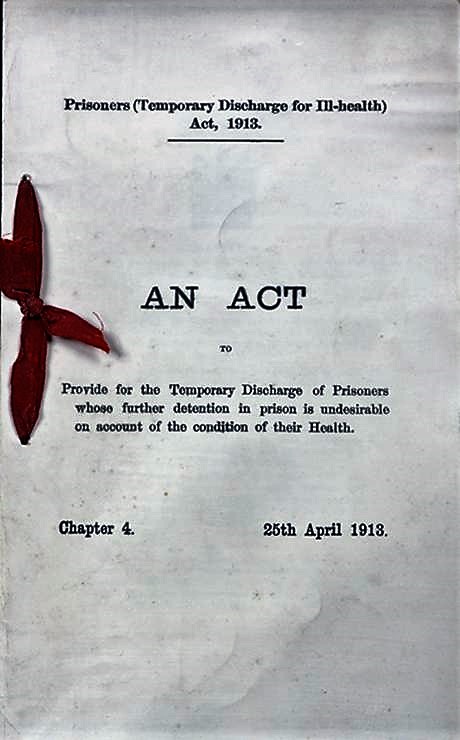
Prisoners (Temporary Discharge for Ill-Health) Act 1913
3
MENTIONS
2
EPISODES
2
PODCASTS
Search complete. 3 mentions across 2 episodes found for "Prisoners (Temporary Discharge for Ill-Health) Act 1913".
Sep 14, 2026

Brigitte DaleGUEST
And then over and over, we see different ways that each group is reacting and evolving and changing.
Brigitte DaleGUEST
And Later, the government passed what was known as the Cat and Mouse Act, where once the suffragettes published these letters describing what they experienced being force-fed, there was public outcry.
Brigitte DaleGUEST
It was so, so inhumane what these women were enduring in jail.
Brigitte DaleGUEST
And so it did not make the government look particularly good in the eyes of the public.
Brigitte DaleGUEST
And then after a few days on hunger strike, the suffragettes would be released.
Brigitte DaleGUEST
And then as soon as they were recovered, they would be rearrested to serve out their sentence.
Brigitte DaleGUEST
So that was the cat and mouse act.
Brigitte DaleGUEST
And it just made a jail sentence almost interminable because you go on a hunger strike, you leave, you come back over and over this endless cycle.

speaker_3NARRATOR
To address the ongoing issue of hunger strikes without releasing prisoners permanently, the government passed the Prisoners Temporary Discharge for Ill Health Act in nineteen hundred and thirteen.
speaker_3NARRATOR
This law became widely known as the Cat and Mouse Act.
speaker_3NARRATOR
It allowed the authorities to release hunger-striking women when their health became dangerously poor, but only temporarily.
speaker_3NARRATOR
Once the women had recovered their strength, they were required to return to prison to complete their original sentences.