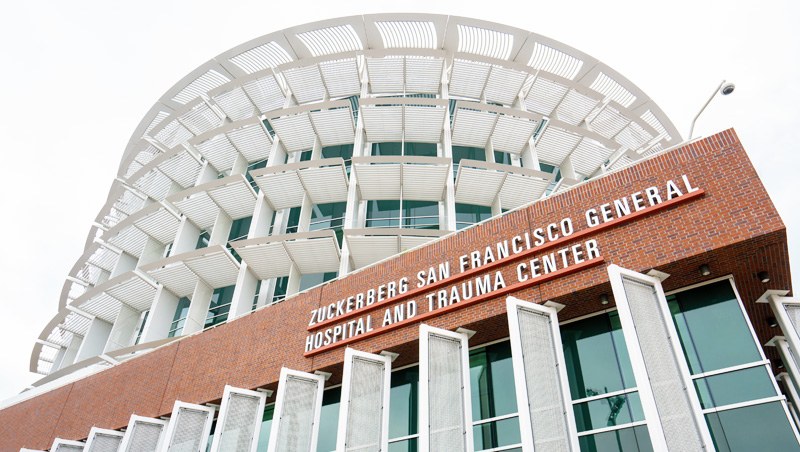
Priscilla Chan and Mark Zuckerberg San Francisco General Hospital and Trauma Center
Hospital in San Francisco, CaliforniaWikipedia
24
MENTIONS
16
EPISODES
14
PODCASTS
Search complete. 24 mentions across 16 episodes found for "Priscilla Chan and Mark Zuckerberg San Francisco General Hospital and Trauma Center".
Sep 10, 2026

Lisa GarrHOST
I'd love you to mention some of those, I mean, really.
Larry DosseyGUEST
Well, the one that really got my attention was the most famous prayer study in the 20th century, which was done at the University of California San Francisco School of Medicine in the coronary care unit at San Francisco General Hospital.
Larry DosseyGUEST
And this was the study in which Dr. Randolph Byrd recruited prayer for patients in the coronary care unit who had heart attack.
Larry DosseyGUEST
This is what we call one of those double-blind things where nobody knows who's receiving the prayer and who isn't.

Anthony DiGiorgioHOST
yeah.
Vinay PrasadGUEST
What he's not saying is that Anthony and I both work at San Francisco General Hospital for many years together.
Vinay PrasadGUEST
And it was really only patients.
Vinay PrasadGUEST
It's like 90% Medicaid.
Vinay PrasadGUEST
yeah.
Vinay PrasadGUEST
What he's not saying is that Anthony and I both work at San Francisco General Hospital for many years together.
Vinay PrasadGUEST
And it was really only patients.
Vinay PrasadGUEST
It's like 90% Medicaid.

Mary CainGUEST
And then I landed here and I went immediately into working in the HIV AIDS kind of workforce there.
Mary CainGUEST
worked on the ward at San Francisco General, worked in an AIDS case management program, and kind of from there stayed in the public health space, went to school and got an MPH, and then continued to work in, frankly, employer-based programs, employer-based healthcare programs, and have done a lot of work in chronic disease management building, and now love, love, love doing the quality work and the population health work.
Mary CainGUEST
It's very satisfying to see.
Mary CainGUEST
to see and measure and kind of feel the, the, the, the direct application of what we do in the, in the outcomes that we, um, in the outcomes that we, we see.

Ricardo MuñozGUEST
And Both in Palo Alto and Oregon, the people I was working with were almost entirely white people with good education and good salaries and so on.
Ricardo MuñozGUEST
And then I came to San Francisco General Hospital.
Ricardo MuñozGUEST
I had grown up in the Mission District.
Ricardo MuñozGUEST
I immigrated from Peru when I was 10 to the Mission District in San Francisco.
Ricardo MuñozGUEST
And I was very lucky to get a job as a professor at the medical school at UC San Francisco.
Ricardo MuñozGUEST
based at San Francisco General Hospital, which works with very low-income people.
Ricardo MuñozGUEST
And their reality, their day-to-day reality was totally different from people in Palo Alto or Eugene, Oregon, which is, you know, it's a college town, basically.
Ricardo MuñozGUEST
And so I had to change the way I was thinking about cognitive behavioral approaches.

Marie McNeelyHOST
Listeners, Cara is a professor in the Department of Laboratory Medicine at the University of California, San Francisco.
Marie McNeelyHOST
She is also co-director of the Core Clinical Laboratory at San Francisco General Hospital, overseeing chemistry and toxicology.
Marie McNeelyHOST
And she is director of chemistry at UCSF Children's Hospital Oakland.
Marie McNeelyHOST
And today, listeners, we're looking forward to discussing Kara's career and her research.
Kara LynchGUEST
I think the nice thing about the work that I do is that it all informs, like my clinical work informs my research and my research informs my clinical work.
Kara LynchGUEST
And a part of that is also teaching and mentoring, which is actually one of my favorite parts of the work that I do.
Kara LynchGUEST
And being a director of two different chemistry labs, my main lab that I'm at is at San Francisco General Hospital, which is a safety net hospital for the city and county of San Francisco.
Kara LynchGUEST
And we get a lot of unique cases here where we serve a predominantly underserved patient population.

Andy HawthorneHOST
He said, after much prayer, the idea came to me that over a 10-month period...
Andy HawthorneHOST
I would assign 393 patients in the coronary care unit at San Francisco General Hospital to one of two groups.
Andy HawthorneHOST
The first group would be prayed for by home prayer groups.
Andy HawthorneHOST
The second group was not remembered in prayer.

Concerned CitizenHOST
A third victim who had been shot in the leg had sought shelter in the Carl's Jr. across the street, as did a fourth person who had suffered an ankle injury during the escape.
Concerned CitizenHOST
The gunshot victims were taken to San Francisco General Hospital and Trauma Center, where they were treated and later released.
Matt RogersADVERTISER
[static] Um, yeah, we, uh, we responded to a report of an active shooter here at about, uh, quarter to one this afternoon.
Matt RogersADVERTISER
Um, we, uh, pursuant to our protocol, we immediately, uh, entered and searched the building.

Mina KimHOST
The newest version, Rethinking Drinking, will be released next month and incorporates the latest research and social trends.
Mina KimHOST
Munoz is distinguished professor of clinical psychology emeritus at Palo Alto University, an emeritus professor of psychology at the UCSF School of Medicine, where he was chief psychologist at San Francisco General Hospital for 25 years.
Mina KimHOST
Miller is an emeritus distinguished professor of psychology and psychiatry at the University of New Mexico in Albuquerque.
Mina KimHOST
He's known for originating motivational interviewing and also for his work on alcohol use disorders.

speaker_1NARRATOR
He said, "...after much prayer, the idea of what to do came to me.
speaker_1NARRATOR
Over a 10-month period, a computer assigned 393 patients in the coronary care unit at San Francisco General Hospital to one of two groups." The first group was prayed for by home prayer groups.
speaker_1NARRATOR
The second group was not remembered in a prayer.
speaker_1NARRATOR
The home prayer groups were from various Christian denominations.
6 more episodes mention Priscilla Chan and Mark Zuckerberg San Francisco General Hospital and Trauma Center.
Create an account to see the whole feed, search across every transcript, and follow the entities you care about.