Prince William Sound
94
MENTIONS
39
EPISODES
18
PODCASTS
Search complete. 94 mentions across 39 episodes found for "Prince William Sound".
Nov 1, 2026

speaker_0NARRATOR
Welcome to Field Notes, a production of the Prince William Sound Science Center.
Haley HooverHOST
Infectious and parasitic diseases are suspected of limiting the recovery of Pacific herring at Prince William Sound.
Haley HooverHOST
Because herring are schooling fish, when there are carriers of the disease in the group, the disease can sweep through the population quickly, causing irreparable damage.
Haley HooverHOST
These disease outbreaks are known as epizootics.
Haley HooverHOST
Paul Hershberger, Maureen Purcell, and Maya Groner are leading a team of researchers in exploring the prevalence and intensity of diseases and how they are transmitted in Prince William Soundherring.
Haley HooverHOST
Of particular interest are viral hemorrhagic septicemia virus, viral arthritic necrosis, and ichthyophonous parasite.
Haley HooverHOST
Hi, this is Haley Hoover with Field Notes, and today I'll be talking with you about how these diseases are affecting the prunesium sound herring population.
Haley HooverHOST
VHS epizootics didn't occur after confinement into the lab tanks, and this conclusion was again supported by the measurement taken upon capture with detectable levels of neutralizing antibodies occurring between 13 and 43%.

Stephen CollectorGUEST
I mean, it was so cool.
Stephen CollectorGUEST
My son, James, who actually was the— The catalyst for me writing the book had spent a summer working as a deckhand in Prince William Sound, I think it was, and told me, Dad, I can't believe you haven't been to Alaska.
Stephen CollectorGUEST
So when he got back, he sent me a round-trip ticket to force my hand.
Stephen CollectorGUEST
He made me go.

speaker_0NARRATOR
Eighty-one feet of snow in one winter.
speaker_0NARRATOR
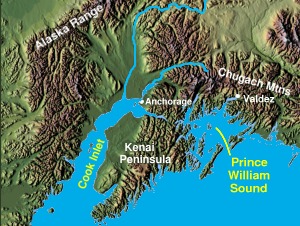
The weight of that snow compresses into the glaciers that flow down from the Chugach peaks, and those glaciers, in turn, carve into Prince William Sound and the coastal fjords, dropping house-sized chunks of ice into water that is 38 degrees Fahrenheit and will kill an unprotected human in about 15 minutes.
speaker_0NARRATOR
Beyond the Chugach, Cook Inlet opens toward the Gulf of Alaska, a body of water known for some of the most extreme tidal variations in the world, tides that can swing 35 feet between high and low, exposing miles of mudflats that look like solid ground but behave like quicksand, trapping anyone who steps onto them and holding them in place while the tide comes back in at a pace that can outrun a person on foot.
speaker_0NARRATOR
To the north of the Alaska Range, the interior stretches toward the Brooks Range and the Arctic.
16 MINS LATER
speaker_0NARRATOR
He knew the route.
speaker_0NARRATOR
He had flown it many times.
speaker_0NARRATOR
The flight plan took them southeast from Anchorage over Prince William Sound and through the coastal mountains, a route that threads between the peaks of the Chugach Range and follows the coastline toward Juneau, a route that requires navigating through mountain passes and over glaciers and along fjords where the weather can change from clear to zero visibility in minutes.
speaker_0NARRATOR
The weather that day was deteriorating.

BaileyCORRESPONDENT
And we are going to continue to track pretty strong winds throughout the morning hours.
BaileyCORRESPONDENT
But even on our radar, very heavy rainfall, especially in the Gulf, just outside of Prince William Sound.
BaileyCORRESPONDENT
And again, that is going to continue through the day today.
BaileyCORRESPONDENT
Now, even just tracking our strong winds so far, up to 63 mile per hour winds in areas like Palmer, And I know there have been power outages in areas like Eagle River due to these very strong winds up to 47 mile per hour winds in Anchorage and down in Homer, only 17 mile per hour winds.
13 MINS LATER
BaileyCORRESPONDENT
We don't typically get that kind of heavy rainfall at this time of year.
BaileyCORRESPONDENT
But we are today, so that's kind of interesting to see that.
BaileyCORRESPONDENT
Now, as we track some of our rainfall that we are expecting to see, areas like Seward into Prince William Sound, especially Cordova and Whittier, will collect a few inches of rainfall through the day today.
BaileyCORRESPONDENT
Meanwhile, areas like Anchorage up to about two-tenths of an inch or so, and even into the Mat-Su Valley, areas like Wasilla likely to see about half an inch of rain.

Karen SmithHOST
Let's talk for a minute about how difficult it was for workers to build this railway.
Karen SmithHOST
The Copper River and Northwestern Railway was built between 1907 and 1911 to carry ore from Kennecott to Cordova on Prince William Sound.
Karen SmithHOST
The copper was hauled there and then shipped south to smelters in Tacoma, Washington.
Karen SmithHOST
This railroad spanned a massive glacier.

JoshHOST
Another huge story from our childhood.
JoshHOST
On March 24th, the Exxon Valdez oil tanker ran aground in Alaska's Prince William Sound, spilling approximately 11 million gallons of crude oil.
PhilHOST
That's good.
PhilHOST
That's real good.

Will ReitzHOST
Bly Reef.
Will ReitzHOST
in Prince William Sound, Alaska, spilling an estimated 11 million gallons, approximately 260,000 barrels, of crude oil into the pristine marine environment.
Will ReitzHOST
So this doesn't hold a candle next to the Deepwater Horizon disaster or the Persian Gulf spill, but just the area where the oil spilled, it was just such a disaster.
Will ReitzHOST
It was such a beautiful, pristine area of this world that was just then covered with oil.

speaker_0HOST
So let's go even further and check the other earthquake out and see if anything crazy happened there.
speaker_0HOST
1964, the second largest earthquake ever recorded, located in Prince William Sound, Alaska.
speaker_0HOST
It's a weird name.
speaker_0HOST
Let's keep going because this is just mind blowing how spot on we are.
speaker_0HOST
Do you remember what the Rand Corporation did in episode 138? Do you see which location is number one on this map? The exact same map that we were showing detailing the perfect geographical areas for possible underground installation sites.
speaker_0HOST
Number one is Prince William Sound.
speaker_0HOST
Something is there.
speaker_0HOST
Based on my research, this was all found.
speaker_3NARRATOR
Eighty-one feet of snow in one winter.
speaker_3NARRATOR
The weight of that snow compresses into the glaciers that flow down from the Chugach peaks, and those glaciers, in turn, carve into Prince William Sound and the coastal fjords, dropping house-sized chunks of ice into water that is thirty-eight degrees Fahrenheit and will kill an unprotected human in about fifteen minutes.
speaker_3NARRATOR
Beyond the Chugach, Cook Inlet opens toward the Gulf of Alaska, a body of water known for some of the most extreme tidal variations in the world, tides that can swing thirty-five feet between high and low, exposing miles of mudflats that look like solid ground but behave like quicksand, trapping anyone who steps onto them and holding them in place while the tide comes back in at a pace that can outrun a person on foot.
speaker_3NARRATOR
To the north of the Alaska Range, the interior stretches toward the Brooks Range and the Arctic.
16 MINS LATER
speaker_3NARRATOR
He knew the route.
speaker_3NARRATOR
He had flown it many times.
speaker_3NARRATOR
The flight plan took them southeast from Anchorage over Prince William Sound and through the coastal mountains, a route that threads between the peaks of the Chugach range and follows the coastline toward Juneau, a route that requires navigating through mountain passes and over glaciers and along fjords where the weather can change from clear to zero visibility in minutes.
speaker_3NARRATOR
The weather that day was deteriorating.

Avery ElfeltCORRESPONDENT
also still a lot of uncertainty around how to tell for sure that a slope is about to fail or to warn people if it does.
Avery ElfeltCORRESPONDENT
For now, on-the-ground monitoring and warning work largely focuses on just one landslide in Prince William Sound.
Avery ElfeltCORRESPONDENT
But Staley says applying that work elsewhere could take years, if not decades.
Dennis StaleySOUNDBITE_SPEAKER
So there are things that we could do, but there's no one simple answer and none of it's easy and all of it takes time.
29 more episodes mention Prince William Sound.
Create an account to see the whole feed, search across every transcript, and follow the entities you care about.