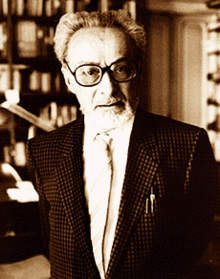
Primo Levi
Italian chemist and essayistWikipedia
67
MENTIONS
37
EPISODES
33
PODCASTS
Search complete. 67 mentions across 37 episodes found for "Primo Levi".
Nov 3, 2026

Suzanne CopeGUEST
And so I was able to give more of a breadth of what the women were doing.
Eleanor SlyHOST
In your book, you mentioned several famous anti-fascists that I think people, our listeners will probably have heard of Primo Levi, potentially Olivetti, who helped produce typewriters that were exported around the world.
Eleanor SlyHOST
And also Natalia Ginzburg, who wrote a very famous book, Family Sayings, amongst others.
Eleanor SlyHOST
They obviously have travelled outside of Italy.

John TurturroGUEST
And one of my mom's friends... you know, call the police.
John TurturroGUEST
While I was away, far away, I was doing this Primo Levi film in the Ukraine, The Truce.
John TurturroGUEST
And it was very hard.
John TurturroGUEST
you know, to navigate all this.

Andrea CapraGUEST
extremely and truly horrifying by a number of the population of Naples in one of the, you know, novels that he wrote, one of the wartime novels that are also in part memoirs that he wrote entitled The Skin, while at the same time being perceived as, you know, exactly the opposite by another set of people that are in exactly the same setting.
Andrea CapraGUEST
In that chapter, I also talk about the figure of Primo Levi.
Andrea CapraGUEST
Primo Levi was someone who you know, was imprisoned in a German concentration camp during World War II.
Andrea CapraGUEST
And there he has this really, in one of his texts about that time of his life, he is very careful in distinguishing how, you know, the laggers, the concentration camps experience of the inmates was extremely different from the one of the guards, of the German guards that are there.
Andrea CapraGUEST
So the idea that there is something profoundly subjective and context dependent about horror is an idea that I unpack all throughout the book.

Jake HargroveHOST
Do you know who I'm talking
MattHOST
about, guys? Primo Levi, I believe, said that.
MattHOST
Is that Primo Levi?
Jake HargroveHOST
I
MattHOST
believe.
William BanksGUEST
Yeah.
MattHOST
Sorry, quick fact check on me.
MattHOST
It was not Primo Levi.

Simon WhistlerHOST
He survived because he was a chemist.
Simon WhistlerHOST
He was named Primo Levi, and he would become one of the most important writers of the 20th century.
Simon WhistlerHOST
you Primo Levi was born in Turin, northern Italy, on the 31st of July 1919 to Jewish parents, Esther and Cesare.
Simon WhistlerHOST
Primo inherited from Cesare a love for reading, for science, for exploring the whys of life.
Simon WhistlerHOST
But as he entered puberty, the studious and introverted Primo found himself in conflict with his more outgoing father.
22 MINS LATER
Simon WhistlerHOST
Another controversial claim is that the ordeal at Monowitz did not worsen Primo's depression.
Simon WhistlerHOST
On the contrary, it honed his survival skills and intellect.
Simon WhistlerHOST
Primo Levi confirmed this to American writer Philip Roth.

Francesca AlbaneseGUEST
And this is why I think this would be disgrace, this would be laughable, if it was because it makes me think of how much importance is given to the freedom of expression in theory, and recognizing the trauma of the other in theory, And how tragic is the reality? So I have to take the side of the victim and I, because they're left alone.
Francesca AlbaneseGUEST
And again, Gabor was saying, was talking to the Jewish community, but I'm not the only one who, I mean, I have a vivid memory of Primo Levi's recollection of what was, what it meant for, for him to talk about the Holocaust and the concentration camps and whatever he had seen within it soon after the Holocaust.
Francesca AlbaneseGUEST
When he returned to his civilized life, people wouldn't believe him.
Francesca AlbaneseGUEST
And even in Germany, people were rejecting it, saying that he was exaggerating.

David FrumHOST
He has now told the full story in his own words in a new book, Mosul Eye, A Scholar's Clandestine War Against ISIS, published by Skyhorse Press.
David FrumHOST
It is, in my opinion, a work of literature about the human spirit to stand on the shelf with Primo Levi and Cheslam Milos, a witness to the extremes of human cruelty, oppression, and endurance.
David FrumHOST
Omar Mohammed, thank you so much for joining me today on The David Frum Show.
Omar MohammedGUEST
David, thank you for having me, and I'm humbled by the words you said about me and about the book.
9 MINS LATER
David FrumHOST
My colleague at the Atlantic, Anne Applebaum, a great scholar of the Stalinist and communist oppression in Eastern Europe, wrote in the preface, I'm going to now forget which of her books she wrote this, I think it was maybe her book on the gulag, the Soviet gulag.
David FrumHOST
She said, I write this book I'm quoting from memory, not so that it will never happen again, but because it will happen again.
David FrumHOST
And I think one of the things I am reminded of by you and by the other, as I say, the other people I imagine you standing beside on the shelf, Primo Levi and Shaslam Yilash, are just these horrors occur again and again and again.
David FrumHOST
And the only remedy against them, not the remedy, the way of beginning a remedy is through unceasing remembrance.

speaker_6NARRATOR
Over the next year and a half, this team under Wolff oversaw the arrest of a substantial proportion of Italy's Jewish people and their deportation to Auschwitz, where many died.
speaker_6NARRATOR
One of those who survived was Primo Levi.
speaker_6NARRATOR
The Jewish-Italian chemist and writer, whose books, particularly If This is a Man, later described the situation for Italy's Jews after Wolf became head of the security forces in the country.
speaker_6NARRATOR
In all, about 20% of Italy's Jewish people died in the Holocaust, most as a direct result of Wolf's activities.

Eliana DuthieGUEST
And I was always very well read and academically versed for my age.
Eliana DuthieGUEST
So at nine, I was reading Survival in Auschwitz by Primo Levi, other crazy intense biographies.
Eliana DuthieGUEST
I
speaker_3UNKNOWN
think
27 more episodes mention Primo Levi.
Create an account to see the whole feed, search across every transcript, and follow the entities you care about.