Predictive coding
52
MENTIONS
9
EPISODES
8
PODCASTS
Search complete. 52 mentions across 9 episodes found for "Predictive coding".
Sep 10, 2026

Cathi SpoonerHOST
And that's the route that we want to get to to get that healing.
Cathi SpoonerHOST
We're going to talk about the role of neuroscience and that predictive processing to better understand the behavior.
Cathi SpoonerHOST
This is where our case conceptualization comes in because we're using a theoretical lens to make sense of what's going on in the playroom.
Cathi SpoonerHOST
And then that's going to influence what we do.
8 MINS LATER
Cathi SpoonerHOST
It doesn't mean you're a failure.
Cathi SpoonerHOST
It doesn't mean parents necessarily are failures and it doesn't mean the kid is bad.
Cathi SpoonerHOST
So now the next thing we wanna do is we're looking at what does the neuroscience tell us? If we're using a neuroscience and attachment lens, which I think we can apply to pretty much every play therapy, seminal and historical play therapy model, But if we're looking at this from a neuroscience standpoint, then what we're looking at predictive processing and what does that mean? So we're thinking about the brain as a kind of a predictive meaning-making machine that allocates resources based on where it's predicting there's a need.
Cathi SpoonerHOST
And so- When we're thinking about it that way, we're conceptualizing that the brain is taking experiences that have happened in the past.

Cambria EvansHOST
But I think the question might be too small because a more useful question really is, what kinds of therapy can we actually do on ourselves? and what kinds of healing require relationship with material that isn't fully accessible alone.
Cambria EvansHOST
This episode is about EMDR, brain spotting, art, IFS, predictive processing, psychedelics, intensives, and something that sits underneath all of them, which is access.
Cambria EvansHOST
Not technique, not effort, but access.
Cambria EvansHOST
So yes, people already do a lot of therapy on themselves.
Cambria EvansHOST
And thank God it does, right? So difficulty accessing material is not necessarily resistance.
Cambria EvansHOST
It may be internal protection organizing our experience.
Cambria EvansHOST
Trying that on feels so much lighter and it makes sense, doesn't it? Let's talk about predictive processing.
Cambria EvansHOST
What does it tell us about this question of doing EMDR on ourselves? It tells us that the brain is managing prediction and not just memory, okay? Predictive processing gives us another lens and it's important.

Xavier BonillaHOST
So, yeah, you can just I'll just give you the main concept here and you can riff as much as you want.
Xavier BonillaHOST
But you can hit here, which we've already done a bit, but you can go deeper on predictive processing, Bayesian concepts.
Xavier BonillaHOST
And yeah, tell us about Friston's free energy principle and active interference.
Xavier BonillaHOST
You know, this is very, very easy, light topics, but just go with it as you want.
Romain BretteGUEST
So what they are trying to explain, what everyone is trying to explain, is anticipation.
Romain BretteGUEST
But anticipation is very difficult to explain.
Romain BretteGUEST
One of the common confusion that is made, and you mentioned predictive processing, is to equate anticipation and prediction.
Romain BretteGUEST
And in fact, a very superficial notion of prediction which is numerical prediction um like what's the next image what's the next sensor input that's what you have in predictive processing but in your examples it's much more subtle than that so for example one way in which we anticipate that you mentioned is by changing our posture right that's not a prediction of what's going to happen next right it's One example that I give in the book, but it's related to your tennis example, is with runners in the starting blocks.

EricHOST
Like, how does an intangible process overpower physical anatomy?
speaker_1HOST
Well, to understand that, we have to look at a concept called predictive coding.
EricHOST
Predictive coding.
EricHOST
OK.
speaker_1HOST
Yeah.
EricHOST
A projector.
speaker_1HOST
Yes.
speaker_1HOST
Predictive coding suggests that the brain generates a constant stream of expectations and predictions about the world, and it projects those downward.

Seiara ImanovaHOST
before kind of producing a response, right? So the brain kind of first receives information from the outside world and then kind of figures out what that means.
Seiara ImanovaHOST
Whereas, you know, predictive processing or, you know, FEP, the free energy principle, if I understood, works almost in the other direction, saying that, you know, the brain first makes like the best guess of like what's happening and then uses sensory information.
Seiara ImanovaHOST
Would that be a fair characterization of the separation of the two, or...?
Karl FristonGUEST
Yes, again, you've taken the words out of my mouth.
Karl FristonGUEST
So the outside sort of impresses information on the brain.
Karl FristonGUEST
The brain somehow extracts it, performs cognitive operations, and then decides what to do.
Karl FristonGUEST
And that is the exact opposite of the current 21st century predictive processing perspective, that in fact the brain, the processing in question, is very much an inside-out process.
Karl FristonGUEST
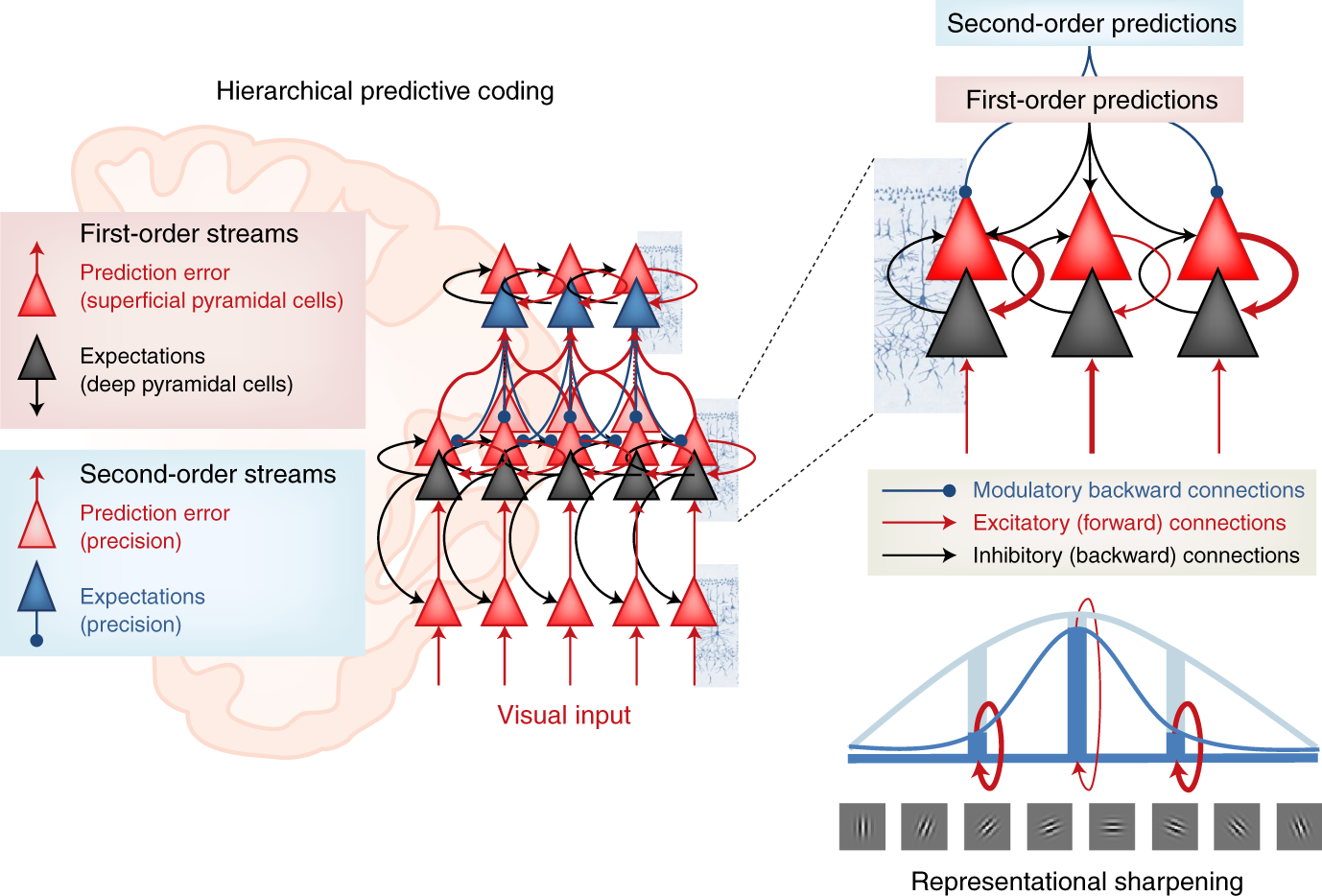
And that literally can be sort of modelled or simulated in terms of the... counter streams of predictions and prediction errors so you're just a bit of bit of flesh on your nice description um if it is the case that my brain is generating predictions of what's going on and i imagine my brain to have some hierarchical depth so i get sort of um layers of an onion, such that I can now regard my brain as having a separation of levels of abstraction, very much in the spirit of the hierarchical depth implicit in deep learning models, for example.

Sabrina ZoharHOST
Discernment is being able to say, "I like this person, but they might not have the bandwidth, the tools, the capabilities, the capacity, and all the things that I need in order to have a real relationship." You're not fucking kidding yourself to create a fantasy that doesn't exist.
Sabrina ZoharHOST
So my friends, one of you guys had asked, "Could anxiety be disguised as discernment?" So there was a study done called Predictive Processing and Prediction Error, and what they found was that the brain predicts threats when information is uncertain.
Sabrina ZoharHOST
That's why we might say, "Oh, I'm being discerning," when no, I'm just being anxious because I don't have a clear answer.
Sabrina ZoharHOST
I don't know what's going on, and my brain wants to try to close the loop.

Marco FacchinGUEST
Then we have embodied cognition, and that was a revolution.
Marco FacchinGUEST
Uh, then there was, hmm, 10 years ago or something, predictive processing, and that seemed to, uh, solve the mind a- and provide us a, a sort of complete way to observe the mind, brain, and everything, uh, living system, and so on and so forth.
Paul MiddlebrooksHOST
Don't, don't forget the, uh, Bayesian brain.
Paul MiddlebrooksHOST
That was big when I was coming up, you know.
Marco FacchinGUEST
Uh, yes.
Marco FacchinGUEST
It, I, it was sort of sn- sneaked in in predictive processing for me, but they are different.
Paul MiddlebrooksHOST
Yeah.
Paul MiddlebrooksHOST
Yeah.