Power take-off
37
MENTIONS
22
EPISODES
20
PODCASTS
Search complete. 37 mentions across 22 episodes found for "Power take-off".
Nov 3, 2026

Katherine WheelerHOST
What is
Kurt LanningGUEST
it? So what you're hearing is a PTO-driven manure spreader, but it's not spreading manure.
Monica SandreschiHOST
Of course.
Monica SandreschiHOST
Of course.

Jay SetchellGUEST
But farming was the most dangerous profession in the United States for decades.
Jay SetchellGUEST
And I lost two of my cousins who have died, one in a PTO accident, one going up on top of a grain bin, got a pant leg caught in the drive shaft that ran the auger up into the top of the grain bin and kills them.
Brad H. HillHOST
Yeah, it's no joke.
Brad H. HillHOST
You got to give farmers a lot of credit.
22 MINS LATER
Jay SetchellGUEST
It was called New Idea.
Jay SetchellGUEST
We got a flail manure spreader.
Jay SetchellGUEST
It ran off a PTO shaft and it moved the manure to the back and it would flail it.
Jay SetchellGUEST
And we bought a new one, but we got it shipped to us and we put it together ourselves in the garage.

Candace WiersbowskiHOST
Heidi Reed, a Penn State Extension agronomy educator in Lancaster County, has a safety warning as harvest winds down.
Candace WiersbowskiHOST
She says this fall has had plenty to worry about, with blodged corn to broken down combines, but the most dangerous thing she saw was a farmer in a hurry stepping over a spinning PTO shaft to save a few seconds.
Eric HarlockHOST
That's a bigger risk than it looks.
Eric HarlockHOST
At full speed, a PTO shaft turns 9 to 16 times every second.
Eric HarlockHOST
If it catches a boot lace, a pant leg, a sleeve, or long hair, it can pull a person in faster than anyone can react.
Eric HarlockHOST
Penn State has documented cases on Pennsylvania farms where that led to a badly injured leg, an arm torn from its socket, and the death of a young child who slipped off a tractor.
Candace WiersbowskiHOST
So Reed's advice is to walk around the tractor, never over the shaft.
Candace WiersbowskiHOST
Before you clean, clog, or adjust a machine, shut off the PTO and the engine and wait for everything to stop.

John HopkinsHOST
It's a routine task, something he's done a thousand times before.
John HopkinsHOST
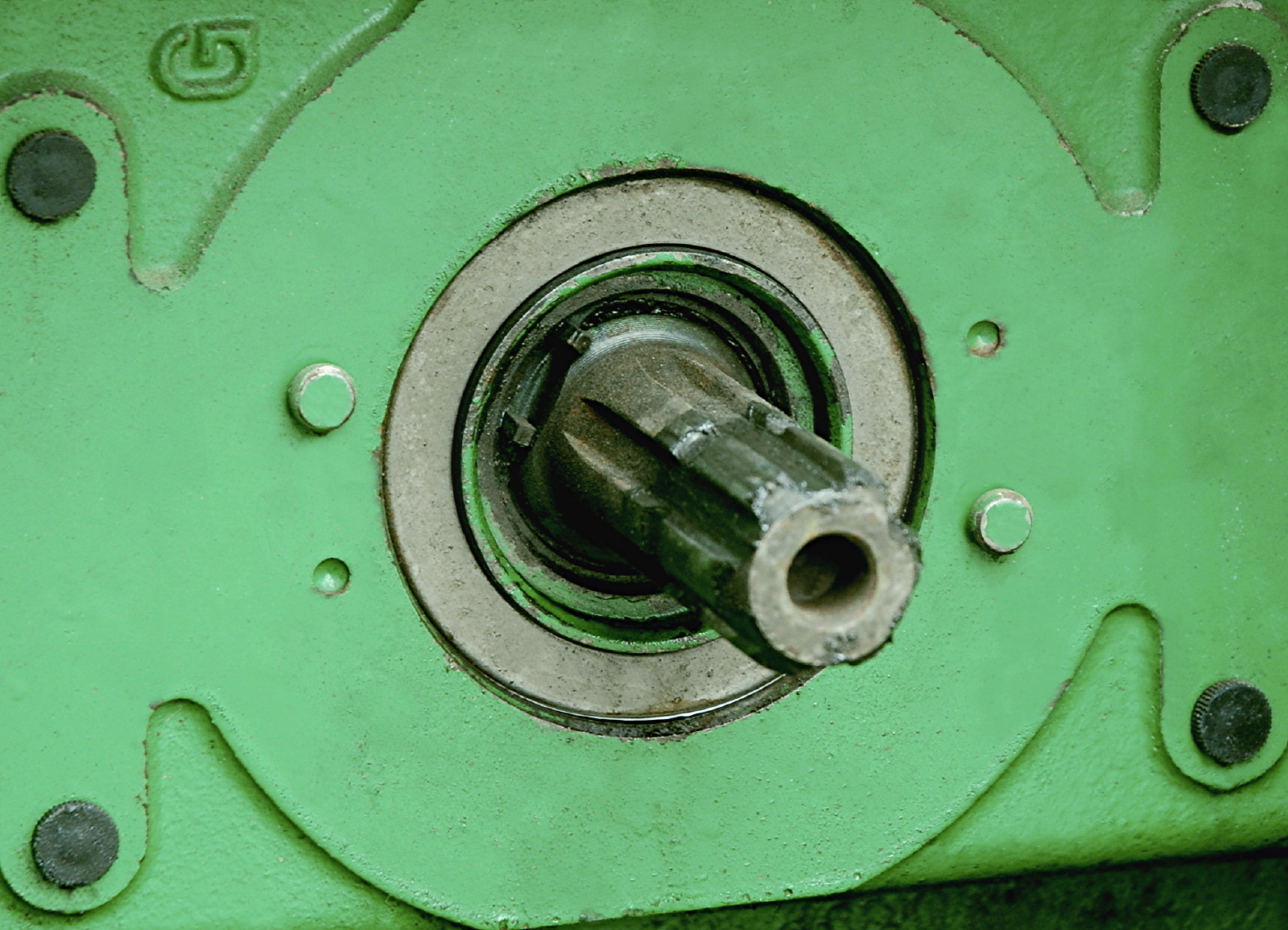
John connects the auger to a tractor using a PTO shaft, a short steel cylinder that transfers power from the tractor's engine.
John HopkinsHOST
When the engine's on, the shaft spins and the auger turns.
John HopkinsHOST
John starts the tractor's engine and the PTO shaft begins rotating rapidly, about 1,000 rotations per minute.
John HopkinsHOST
Ordinarily, PTO shafts are encased in a plastic safety shield, but times are hard on the Thompson's
John ThompsonGUEST
farm.
John ThompsonGUEST
It was a very tough life and we couldn't afford everything.
John HopkinsHOST
He yawns and scratches his chin.

Evan LindmanHOST
And, um, you know, like thinking back of the show we did with Justin the other day, he told us that the Walker mowers have no belts.
Evan LindmanHOST
The deck is, uh, Gear driven off a PTO shaft with shear pins to protect the gearboxes.
Evan LindmanHOST
Guys, would you trust that over a belt driven deck long term? Greg, I had no idea that that type of walker mower had that.
Evan LindmanHOST
I was basically clueless.
Evan LindmanHOST
video of
Greg DurbinHOST
it, though.
Evan LindmanHOST
Oh, a PTO generator.
Evan LindmanHOST
That's unique.

LukeHOST
You take the deck off, and you could put a blade on it.
LukeHOST
You could put a snowblower on the front of it because it's PTO-driven for the front deck.
Chase HarrisGUEST
Yeah.
LukeHOST
I saw that.

Glenn DanuserGUEST
So we introduced the first postal digger that connected to the rear of tractors in 1945.
Glenn DanuserGUEST
American-made gearbox, American-made components, even American-made PTO.
Glenn DanuserGUEST
And for years, we ran with that, and people knew us in the industry as the Cadillac of augers.
Glenn DanuserGUEST
And so then Grandpa realized for the Postal Digger, he needed a few items called ball joints and click pins.
Justin RisingerGUEST
Um, there's a, there's some belts, um, you know, you've got the motor and then there's belts that run the drive.
Justin RisingerGUEST
Well, they run the blower and then yeah, it runs a PTO shaft that goes to the deck.
Justin RisingerGUEST
And then there, so there is a PTO, uh, shaft that's spinning gearboxes on the deck that spin the blades so that's how that works but so they can run a little smaller motor because it's all so compact and the debris takes a much shorter path and more direct path to the hopper on the back which actually works really really well the blower itself can be smaller um and it's it's in the mower so you're not sticking out the side of your deck and you don't have the big hose to deal with and all those things.
Justin RisingerGUEST
It really is, to me, an impressive system.
Justin RisingerGUEST
It does suck up leaves really, really well.
8 MINS LATER
Justin RisingerGUEST
Right.
Justin RisingerGUEST
It's just all gear driven.
Justin RisingerGUEST
There's a PTO shaft spinning gearboxes and that's how it spins the blades.

Ray BohaczHOST
It's governed, all right, to that speed.
Ray BohaczHOST
And so the thing is that what happens is that on a steady-state engine of any type, whether it's a Briggs & Stratton or on a lawnmower, a Tecumseh on a snowblower or what have you, an engine on a seed tender, is that just like you'll have a PTO, you have PTO-operated equipment, and for the most part, most of them are designed to operate the most efficiently at 540 miles pto rpm so if you have a mower you have a anything that's designed to run will it run below 540 and above 540 yes but it's the most efficient at 540 rpm and the same thing happens with a steady state engine so what they actually do so let's use that ford engine as an example but what they'll actually do is they'll design the cam profile they may design on an older engine that's carbureted, they would design the carburetor, the CFM of the carburetor, the metering circuits of the carburetor, and they would design everything around having the optimum efficiency at a given RPM, whereas on a transient engine, you cannot do that.
Ray BohaczHOST
So on a transient engine, you are going to try to get, as I said, so you can't have an optimized camshaft profile.
Ray BohaczHOST
You can't have an optimized intake manifold design.

Glenn BoblitzGUEST
And then you end up with all these canes, and you run it through this mill.
Glenn BoblitzGUEST
Now, this mill is driven by a tractor, the PTO, but it used to be driven by a mule.
Glenn BoblitzGUEST
And he would walk in a circle like you'd see in these old movies of grinding grains for a grinding flour with the same principle.
Glenn BoblitzGUEST
And that's what they do.
Glenn BoblitzGUEST
Don't be telling secrets.
Glenn BoblitzGUEST
So I don't have that type.
Glenn BoblitzGUEST
I have a newer version that was probably in the early 1900s, which was hooked to a PTO of a tractor, and it does a wonderful job.
Glenn BoblitzGUEST
I'll probably do some videos of all of us coming over.
12 more episodes mention Power take-off.
Create an account to see the whole feed, search across every transcript, and follow the entities you care about.