Poverty Point
Historical place in West Carroll Parish, LouisianaWikipedia
70
MENTIONS
7
EPISODES
6
PODCASTS
Search complete. 70 mentions across 7 episodes found for "Poverty Point".
Sep 16, 2026

Gregory L. LittleGUEST
Okmulgee, Georgia, National Park.
Gregory L. LittleGUEST
There are loads of smaller sites, but in the top five would be Poverty Point, Louisiana.
Gregory L. LittleGUEST
Poverty Point, Louisiana dates to at least 2000 B.C.
Gregory L. LittleGUEST
Seems to have come from nowhere.
Gregory L. LittleGUEST
It's an anomaly.
Gregory L. LittleGUEST
That's what they've always said, although now it probably dates to 35, 3600 B.C.
Gregory L. LittleGUEST
But Poverty Point.
Gregory L. LittleGUEST
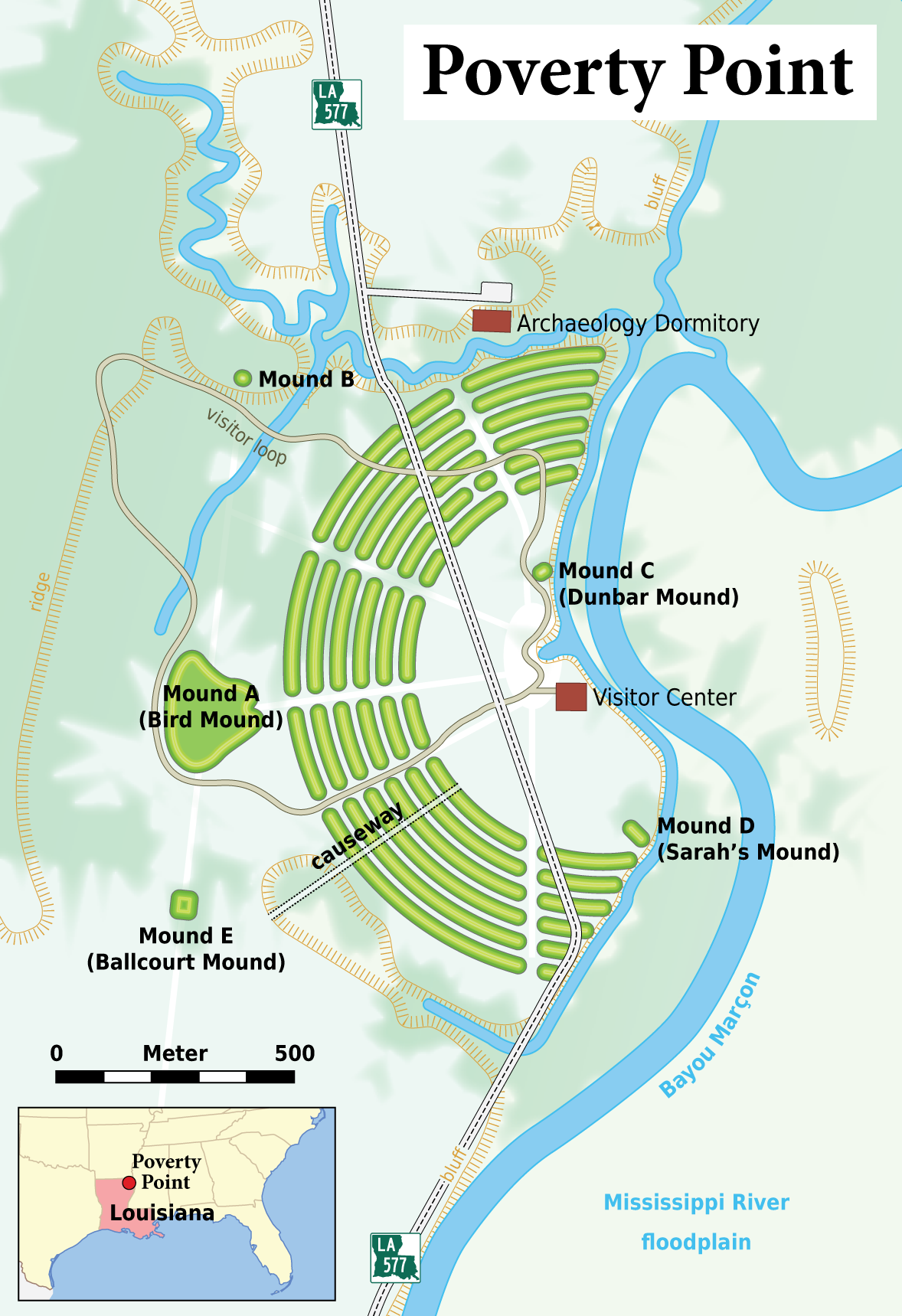
has these it's like a half an octagon half an octagon formed out of eight lines of piled earth that people lived on and it focuses upon a gigantic effigy of an eagle The eagle is laying on its back with its wings spread out.

speaker_8NARRATOR
More than one of those ideas may contain part of the truth.
speaker_8NARRATOR
but the druid story endures because it offers certainty it gives us a neat answer archaeology gives us something harder and more honest stonehenge was built by neolithic communities whose beliefs have largely vanished they were capable of planning across generations organizing immense labor and turning a stretch of open ground into a place that still commands attention five thousand years later they did not need magical powers they did not need roman era priests arriving from the future they needed conviction the kind of conviction that makes people build for descendants they will never meet and stonehenge is not the only ancient monument whose true builders were obscured by later myths across the atlantic another vast ceremonial landscape rose from earth rather than stone built by people whose achievements were also underestimated for generations number eight poverty point earthworks united states across the atlantic in what is now northeastern louisiana the monument was not built from towering blocks of stone there were no pyramids no carved columns no walls left standing against the sky instead the builders reshaped the land itself they moved earth huge amounts of it and they turned a natural rise above the mississippi river flood plain into one of the most extraordinary ancient landscapes in north america poverty point was already taking shape around seventeen hundred b c e that makes it older than many of the civilisations people instinctively associate with large-scale monuments it was rising while parts of the bronze age world were transforming across egypt mesopotamia and the eastern mediterranean but this was louisiana thousands of miles away in a world with its own histories its own networks and its own ideas about what a monumental place could be for a long time outsiders had trouble seeing it from ground level poverty point can be strangely easy to miss the earthworks are broad low and softened by more than three thousand years of weather farming roots rain and erosion they do not announce themselves the way stonehenge does you do not walk toward a ring of giant stones and immediately understand that something impossible happened here poverty point reveals itself slowly then you see the plan at its centre is an enormous open plaza roughly thirty-seven hectares or more than ninety acres Around it curve a series of massive concentric ridges shaped like a giant sea opening toward the bayou landscape to the west.
speaker_8NARRATOR
there were originally six of these ridges they stretch across an area so large that the scale becomes hard to hold in your head if you stood in the central plaza the outer ridges would have extended far into the distance forming great arcs around you not a wall not a fortification in any simple sense more like an immense carefully formed amphitheatre made from the earth beneath people's feet the ridges were not natural they were built generations of people carried soil in baskets containers skins or whatever materials their world provided load after load step after step a person can move dirt A family can move more, but moving enough earth to create ridges hundreds of metres long requires something beyond a few individuals working on a quiet afternoon.
speaker_8NARRATOR
It requires planning, it requires persistence, and it requires a shared reason to keep going when the work is exhausting, repetitive, and too large for any single person to see finished.
speaker_8NARRATOR
The place organised human life.
speaker_8NARRATOR
It told people where the centre was.
speaker_8NARRATOR
where the edges were where gatherings might happen where movement was directed where an individual household fit into a much larger pattern and then there are the mounds poverty point has several major mounds each with its own form and unanswered questions some are conical one is shaped more like a bird in flight with a central body and projecting wings but the largest is the one that makes almost every first-time visitor stop and reconsider what they thought they knew it is called mound a to-day mound a rises about seventy-two feet or twenty-two metres above the surrounding ground it is more than seven hundred feet long in shape it has often been compared to a giant bird or a massive earthen platform it is not a small burial hill built over centuries by accident it is an engineered landform constructed from an astonishing volume of soil estimates suggest the builders moved hundreds of thousands of cubic metres of earth to create it think about that for a second no metal shovels no draft animals pulling wagons no cranes no engines no written construction schedules surviving to tell us how labour was organised just human hands human backs baskets and an idea powerful enough to make an enormous mound rise from a river valley for decades people assumed such projects had to be the product of a familiar kind of society a city with rulers giving orders a state collecting taxes a settled agricultural population producing enough surplus food to support full-time labourers and elite planners poverty point does not fit comfortably into that old formula But before we get to what makes its society so difficult to categorize, there is another clue scattered across the site, not in the shape of the ridges, not in the height of the mounds, in the materials people left behind.
speaker_8NARRATOR
Poverty Point was connected to places far beyond Louisiana.
speaker_11NARRATOR
you need to prevent conflicts between groups who might be traditional rivals that means social protocols probably elaborate rituals and ceremonies designed to maintain peace this is sophisticated social organization this is complexity at a level we associated only with agricultural civilizations and the evidence for these seasonal gathering sites is showing up everywhere In Northern Europe, archaeologists have found concentration points where dozens of hunter-gatherer groups converge during annual fish runs.
speaker_11NARRATOR
In North America, sites like Poverty Point in Louisiana show massive earthwork construction by pre-agricultural societies.
speaker_11NARRATOR
In Australia, Aboriginal songline routes created networks that connected communities across entire continents.
speaker_11NARRATOR
These weren't random wanderings.

Martin VauxHOST
What, what, what?
Eleanor ConlonHOST
Another very cool mound is Poverty Point.
Eleanor ConlonHOST
That's also in present-day Louisiana.
Eleanor ConlonHOST
And that dates from 1730 to 1350 BC.
Eleanor ConlonHOST
So archaeologists think that homes would have been built along those ridges for up to a thousand inhabitants.
Eleanor ConlonHOST
So it's the largest settlement of its time in North America that has been discovered anyway.
Eleanor ConlonHOST
But finds that they've made at poverty points suggest a really complex society with a functional ceremonial religion.
Eleanor ConlonHOST
One of the mounds is actually an effigy mound.

Brad StaggsGUEST
Yeah.
Brad StaggsGUEST
Poverty Point.
Brad StaggsGUEST
Are you familiar with it?
Keith MalinakHOST
No, I'm not.
Brad StaggsGUEST
Poverty Point is in...
Brad StaggsGUEST
Gosh, I want to say... shouldn't i've been there it is it's a mound site louisiana
Keith MalinakHOST
hang on a second i
Brad StaggsGUEST
it's uh yes it's uh louisiana it's just across it's into louisiana from texas and it is an ancient site they have mounds there and when you start looking into the mound situation their mounds are all across this country.

Jason HewlettHOST
There are no photographs, no recordings, no eyewitnesses, perhaps not even written records, only fragments, archeological remains, objects, the landscape itself.
Jason HewlettHOST
Dan and George h- George have explored whether pendulum dowsing can somehow provide additional information about places such as Poverty Point, Louisiana, a site dating back thousands of years, and pre-European pueblos in parts of Arizona and Utah.
Jason HewlettHOST
Now, that's where the skeptic in the room quietly raises an eyebrow, because how could a pendulum possibly tell us what life was like 4,000 years ago? And that question is fair.
Jason HewlettHOST
In fact, it's essential, because paranormal investigation becomes much more interesting when we allow ourselves to ask both questions at the same time.