Potsdam Conference
ConferenceWikipedia
25
MENTIONS
18
EPISODES
17
PODCASTS
Search complete. 25 mentions across 18 episodes found for "Potsdam Conference".
Nov 20, 2026

Edward LucasGUEST
Kaliningrad is the northern part of what used to be the old German territory of East Prussia.
Edward LucasGUEST
And after the defeat of 1945 at the Potsdam Conference, the northern half of this, with basically a crude straight line going from east to west, was given to the Soviet Union and the bottom southern half was given to Poland.
Edward LucasGUEST
And interestingly, this is the only straight line border in all of Europe.
Edward LucasGUEST
You see straight line borders all over Africa and North America and so on.

Cameron AbadiHOST
Yeah, I guess to finish off, there's one other aspect of the history that I was curious how it lines up with today.
Cameron AbadiHOST
And yeah, famously, the Yalta conference was followed up by the Potsdam conference.
Cameron AbadiHOST
And this was kind of... phase in which the deal struck in Yalta began to come apart as it was trying to implement it.
Cameron AbadiHOST
And I'm curious if that's a kind of like structural phenomenon, like any time there would be a Yalta style agreement, kind of a broad strokes agreement among various powers, that there would inevitably have to be a follow up implementation phase.
Cameron AbadiHOST
I suppose we'll see.
Cameron AbadiHOST
I mean, exactly.
Cameron AbadiHOST
The Potsdam conference was obviously attended by Truman.
Cameron AbadiHOST
So, you know, I guess in this analogy would be J.D. Vance at whatever next

Alex DohertyHOST
Yes, and for anyone who doesn't know the geography and the history, Kaliningrad is about 85 square miles, very far from the Russian border, about 350 miles away, and sandwiched between Poland and Lithuania.
Alex DohertyHOST
The territory was granted to the Soviet Union towards the end of World War II at the Potsdam Conference.
Richard SeymourGUEST
Yeah, and that's why it's incredibly important to Russia.
Richard SeymourGUEST
NATO members have been proposing what amounts to a blockade of Kaliningrad.

John RothmannHOST
And England, well, it was just trying to hang on because its fortune had been expended during the war.
John RothmannHOST
And as you all know, the Potsdam Conference and the days that followed caused the dissolution of the British Empire.
John RothmannHOST
The empire became the Commonwealth.
John RothmannHOST
They gave up Palestine.

Vago MuradianHOST
Indeed, speaking of global security, so we have the president of the United States, Xi Jinping, and Vladimir Putin are going to be meeting in Shenzhen.
Vago MuradianHOST
And Putin's aides have said it's time for a new Yalta or Potsdam conference, which is exactly what worries you if you're worried.
Vago MuradianHOST
you know, in Europe or maybe anywhere else.
Vago MuradianHOST
You know, Washington has asked Beijing for help to end the Iran war.

speaker_0NARRATOR
With the ebb and flow of the conflict, a German advance followed by retreat in the face of the Red Army, sections of track were regaged numerous times.
speaker_0NARRATOR
And towards the end of the war, Stalin was able to travel to the Potsdam Conference in Germany aboard a Russian train.
speaker_0NARRATOR
Stalin was afraid of flying.
speaker_3SOUNDBITE_SPEAKER
The German attack on Russia in 1941 was held back by the fact that there wasn't sufficient railways to actually support the advance, and it slowed down the advance and the idea of getting to Moscow by Christmas.

speaker_1NARRATOR
So on the afternoon of the 15th of July, 1945, three C-54 transport planes land at the British military airfield in Gatow.
speaker_1NARRATOR
On board, they have the American delegation that the US president is taking to the Potsdam conference.
speaker_1NARRATOR
It is four times the size of the delegation that had traveled to Yalta in February.
speaker_1NARRATOR
The notorious prosecutor of the Stalinist show trials, Andrei Vyshinsky, and Soviet ambassador, Andrei Gromyko, greet US Secretary of State, James Burns.
6 MINS LATER
speaker_1NARRATOR
At the meeting, US Secretary of State Burns casually asks the Soviet dictator if he knows anything about Hitler's whereabouts.
speaker_1NARRATOR
Stalin claims Hitler is still alive and hiding in Spain or Argentina.
speaker_0NARRATOR
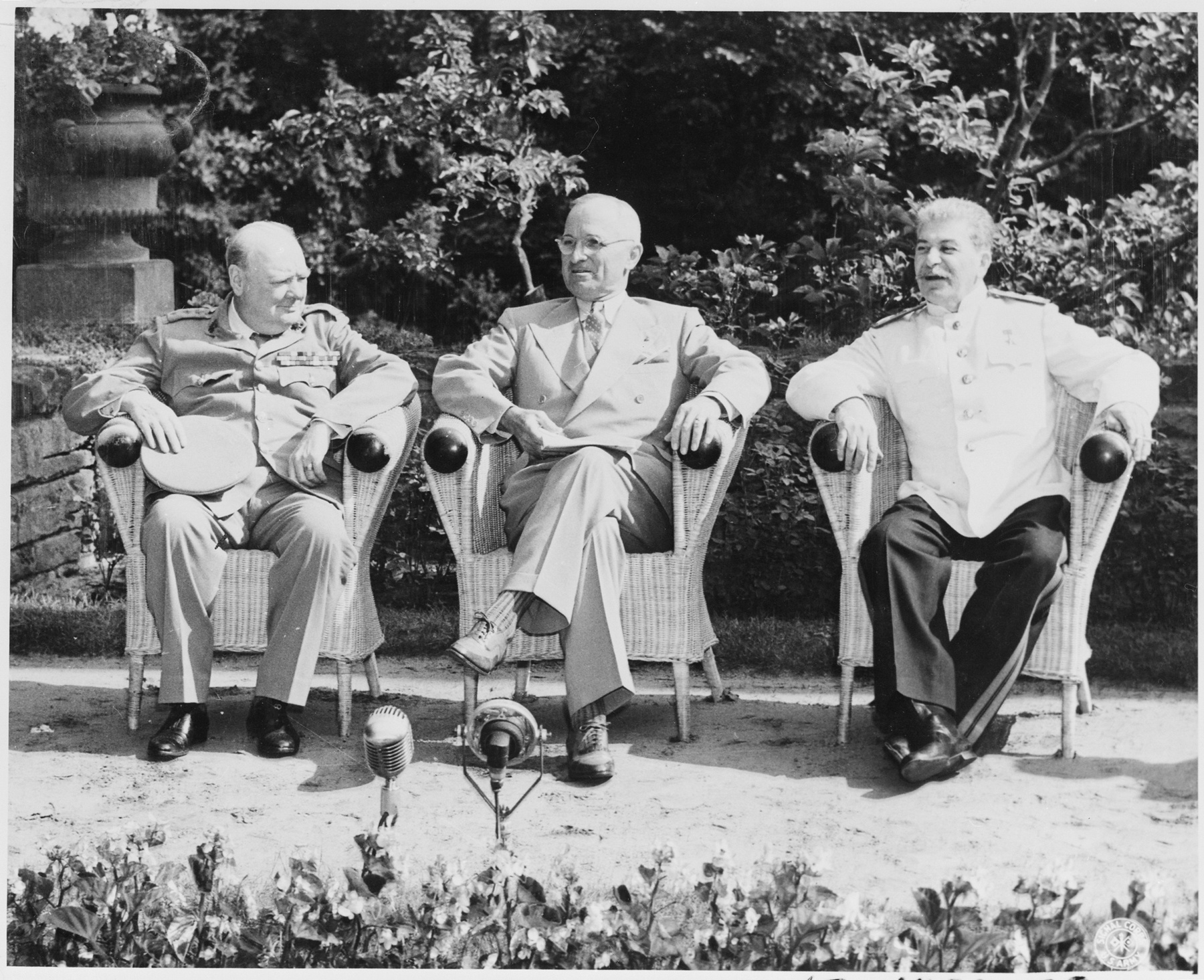
The venue for the Potsdam conference is Cecilienhof Palace, where the German crown prince and his family resided before 1918.
speaker_0NARRATOR
Lawton is allowed to film from the gallery.

Klaus LarresGUEST
He wants to go back 30 years, essentially.
Klaus LarresGUEST
And he has said that he wants to go back before 1997, before all the Central and Eastern European countries And one of his lieutenants today or yesterday said that it might be good to have another Yalta or Potsdam conference like in 1945 in post-World War Europe and to have a big conference to reshape European relations.
Klaus LarresGUEST
the European continent.
Klaus LarresGUEST
And this is, in a way, totally unrealistic.
Klaus LarresGUEST
And that tells you a lot how fearful, how much the threat of Russia is still prevalent in Europe.
Klaus LarresGUEST
And that needs to be addressed, I believe.
Hairianto DimanHOST
That being said, Professor, does Russia and by extension Vladimir Putin actually have a point and a cause to have something like the Potsdam Conference to call for a regroup? I mean, is this cause for that? I mean, now in this point of the war than ever?
Klaus LarresGUEST
Well, what should a big conference like the Potsdam conference, if we had one like, say, a Geneva conference in 2027, what should that result in? Could you really expect Poland and the Czech Republic to leave NATO or NATO to promise it would not send rotational troops to these countries, which are members of NATO, or to undo its infrastructure? We all know that NATO is not an aggressive alliance.

Simon WhistlerNARRATOR
One of the items on their list was the unconditional surrender of Nazi Germany, the demilitarization and denazification of the country as a whole, the prosecution of known war criminals, and war reparations in the form of forced labor.
Simon WhistlerNARRATOR
After Nazi Germany's surrender in May 1945, the Allies met once again at the Potsdam Conference, where it was decided that Germany would be divided into four occupation zones – the British Zone, the French Zone, the American Zone, and the Soviet Zone.
Simon WhistlerNARRATOR
They also declared that, quote, it is not the intention of the Allies to destroy or enslave the German people.
Simon WhistlerNARRATOR
It is the intention of the Allies that the German people be given the opportunity to prepare for the eventual reconstruction of their life on a democratic and peaceful basis.
Simon WhistlerNARRATOR
They also declared that the National Socialist Party and all other Nazi institutions would be dissolved, and in their place, the Allies would install a new democracy to ensure that from that point forward, no German citizen would be discriminated against based on their race, their religion, their political opinion to achieve this they endeavored to ensure that quote local self-government shall be restored throughout germany on democratic principles and in particular through elective councils as rapidly as is consistent with military security and the purposes of military occupation By the time that the Potsdam Conference took place in July 1945, it was already clear that the Soviets weren't planning on adhering to the promises they'd made to the rest of the Allied Council, and in 1948, Germany was split into two states.
Simon WhistlerNARRATOR
The Federal Republic of Germany to the west, the Soviet-controlled Democratic Republic to the east.
Simon WhistlerNARRATOR
After all, the Soviets considered Germany to be critical to its plans for communist expansion into Western Europe, and it wasn't long before they started the process of forcing their own policies and beliefs onto the people of Eastern Europe.

Daven HiskeyHOST
For example, the Nordhausen was put under the direction of Helmut Gottrup, a former collaborator of Wernher von Braun on the V-2 program.
Daven HiskeyHOST
But the agreement, signed amongst the Allies at the Potsdam Conference, prohibited the development of weapons on German soil, and so Moscow planned the relocation of these programs elsewhere.
Daven HiskeyHOST
Following the MVD's resolution of May 1946, the Soviet forces started to gather hundreds of experts in atomic research, electronics, navigation equipment, rockets, jet engines, and even color video.
Daven HiskeyHOST
On October 22, 1946, Operation Osservahim was effectively initiated, under the leadership of Ivan Serov, later a chairman of the KGB.
8 more episodes mention Potsdam Conference.
Create an account to see the whole feed, search across every transcript, and follow the entities you care about.