Potosí
City in BoliviaWikipedia
18
MENTIONS
10
EPISODES
10
PODCASTS
Search complete. 18 mentions across 10 episodes found for "Potosí".
Oct 21, 2026

Stephanie GeorgieffHOST
The vision conveyed a sense of peace, comforting Yupan-ki and reinforcing his belief that a physical image of the Virgin Mary was meant to be created specifically for the healing and unity of his people.
Stephanie GeorgieffHOST
Advised by relatives, Yupanqui went to Potosi, which had outstanding teachers of sacred image sculpting.
Stephanie GeorgieffHOST
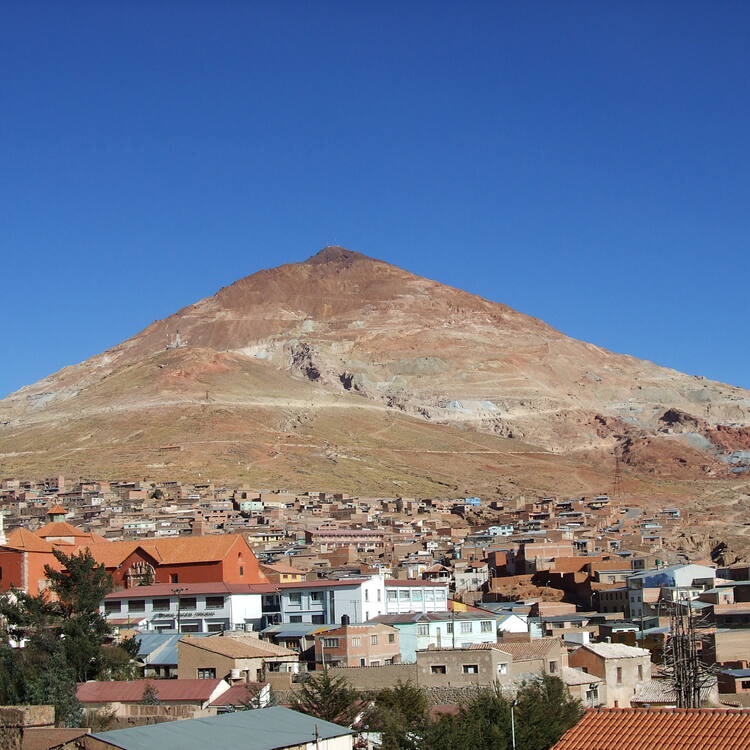
Potosi is a major historic city located in the south central highlands of Bolivia, resting at an extreme high altitude of about 13,000 feet above sea level.
Stephanie GeorgieffHOST
During the colonial era, Potosi was one of the wealthiest and most important cities in the Spanish Empire because it sits directly beneath the Cerro Rico, or Rich Hill, which produced staggering amounts of silver.
Stephanie GeorgieffHOST
Yupanchi lived there around 1582 to 1583 to study under master woodcarvers and image makers, specifically in the workshop of Maestro Diego Ortiz.
Stephanie GeorgieffHOST
Yupanchi studied fine religious sculpture and used his newly honed skills to carve the refined definitive image of Our Lady of Copacabana out of mage wood.
Stephanie GeorgieffHOST
With his newly developed skill, he revolved to create an improved image of the Candelaria that had been rejected before.
Stephanie GeorgieffHOST
He looked through the churches of Potosi for an image of the Virgin which could serve as a model, finally finding the best one in the convent of Santo Domingo, to the Virgin del Rosario.

speaker_0NARRATOR
A city grew at its foot almost overnight.
speaker_0NARRATOR
By around 1650, Potosí had roughly 160,000 people, larger than most major European cities of the day.
speaker_0NARRATOR
Potosi's silver was minted into coins that circulated around the world, including the famous Spanish pieces of eight.
speaker_0NARRATOR
Those coins were so widely trusted that they were legal tender in the United States until 1857, and they gave the American dollar its name.

speaker_0NARRATOR
And after the conquest, the Spanish established a mining economy across New Spain that was one of the largest and most profitable extractive operations in human history.
speaker_0NARRATOR
The silver mines of Zacatecas, Guanajuato, and Potosí produced staggering quantities of precious metal that flowed back to Spain and funded the Spanish Empire's ambitions in Europe and around the world.
speaker_0NARRATOR
Mining was not a side enterprise of the colonial project.
speaker_0NARRATOR
It was the colonial project, or at least its economic engine, and it depended almost entirely on the forced labor of indigenous peoples.

speaker_12NARRATOR
But this great inland country is noted the world around for its rich mines.
speaker_12NARRATOR
Mount Potosí is often spoken of as a mountain of silver.
speaker_12NARRATOR
It is said that not only millions but billions of dollars' worth of silver have been taken from this one mountain.
speaker_12NARRATOR
There are said to be six thousand abandoned mines on its slopes, to say nothing of the hundreds that are being worked today.
speaker_12NARRATOR
The city of Potosí used to be the largest city in the western hemisphere and was ten times its present size when the early settlements of the United States were but small villages.
speaker_12NARRATOR
While the silver in this mountain is not nearly exhausted by any means, yet it was discovered that deeper down is a mountain of tin.
speaker_12NARRATOR
Bolivia has been furnishing more than one-fourth of the world's supply of tin for many years.
speaker_12NARRATOR
On the hills back of the city of Potosí can still be seen the thirty-two lakes or reservoirs that used to furnish water for the city and mines.

Paul HarrisHOST
Okay.
Paul HarrisHOST
I want to obviously talk to you about your sort of two projects, the Silver Sun project in Potosi and Corangas in Oruro.
Jalen YuanGUEST
Yeah.
Paul HarrisHOST
Um, but before we get into that, we are here at an investor conference, so let me ask you about, uh, investor interest in Bolivia.
8 MINS LATER
Jalen YuanGUEST
All they need is a environmental license for both of these projects.
Jalen YuanGUEST
And internally, we're equally distributing our financial resource and the human resource to push these two projects' permitting, uh, progress simultaneously.
Jalen YuanGUEST
We have two Uh, local teams in place, one based in Potosi to handle the, uh, so- uh, Silver Sand project's, uh, permitting, uh, matters.
Jalen YuanGUEST
The other one based in Oruro province, uh, which is where Corangus project is, uh, to handle Corangus matters.

Alexander BickGUEST
Um, Brazil, which, uh, by the mid-1640s, the Dutch controlled not just half, but really the most productive half of the country, that ultimately, uh, falls back to Portugal in 1654.
Alexander BickGUEST
The efforts to attack Potosí through, uh, Chile, uh, and a couple other, uh, routes, all of those, uh, end in spectacular failure.
Alexander BickGUEST
So you could look at this, um, uh, and say, really, this company, you know, emerged, uh, was, uh, badly managed, uh, and then ends in this kind of failure.
Alexander BickGUEST
Ultimately, the company goes bankrupt and has to be, be reorganized.

speaker_0HOST
The authorities also deployed hundreds of joint police and military personnel in La Paz and El Alto, following renewed calls for protests and roadblocks.
speaker_0HOST
Protesters also temporarily blocked the Potosí-Sucre Highway.
speaker_0HOST
The planned transport strike on September 28, organised by the Bolivian Trade Union Confederation of Drivers, was only partially observed in Santa Cruz, Chuquisaca, Oruro and Potosí.
speaker_0HOST
Blockades were also reported at the entrance to the State Oil and Gas Company's office in Santa Cruz.

Si SheppardGUEST
Once that was accomplished though, the whole process became very integrated into the Spanish imperial orbit, the first empire in which the sun never sets.
Si SheppardGUEST
Once the Spanish had discovered and exploited a mountain of silver at Potosí, what's now, um, Bolivia, uh, they put the last piece in puzzle for, of the puzzle in place for, for true globalization, right? Initially, the gold and silver was all going east, as you say, into the coffers of, of, of King Philip V, and, uh, sorry, King Charles V, then his son, uh, King Philip II, for their wars of evangelical, uh, defense and expansion against the Ottomans, um, to keep the Netherlands under their control, to ideally, through the Armada, bring the one true Apostolic faith of Catholicism back to England.
Si SheppardGUEST
Um, most of those ventures, of course, were failures.
Si SheppardGUEST
And as you say, um, the net impact for Spain was, was ultimately quite negative because by infusing Europe with this enormous expansion in liquidity through the silver that was pouring off the treasure ships every year arriving, uh, i, i- in Spain, um, all they were doing was importing inflation, right, pushing prices up to levels.

Lauren WorkingGUEST
Even thinking back to Henry VIII marrying Catherine of Aragon, she's the daughter of Ferdinand and Isabella of Spain who are, who financed Columbus's voyages, and Henry wants in on some of that wealth.
Lauren WorkingGUEST
And it's really during his reign, and especially in the later part of his reign in the 1540s, that the Spanish find the silver veins of Potosí, which causes Potosí to quickly escalate into a boom town with a population that rivals that of London at the time.
Lauren WorkingGUEST
Mary I marries the soon to be Philip II of Spain, heir to his father Charles V's Atlantic Empire, and she receives South American silver as part of the wedding gifts and celebrations.
Lauren WorkingGUEST
So procession carts in October 1554 brought such a large amount of silver that historians estimate that it caused a 7% increase in England's real wealth at the time.