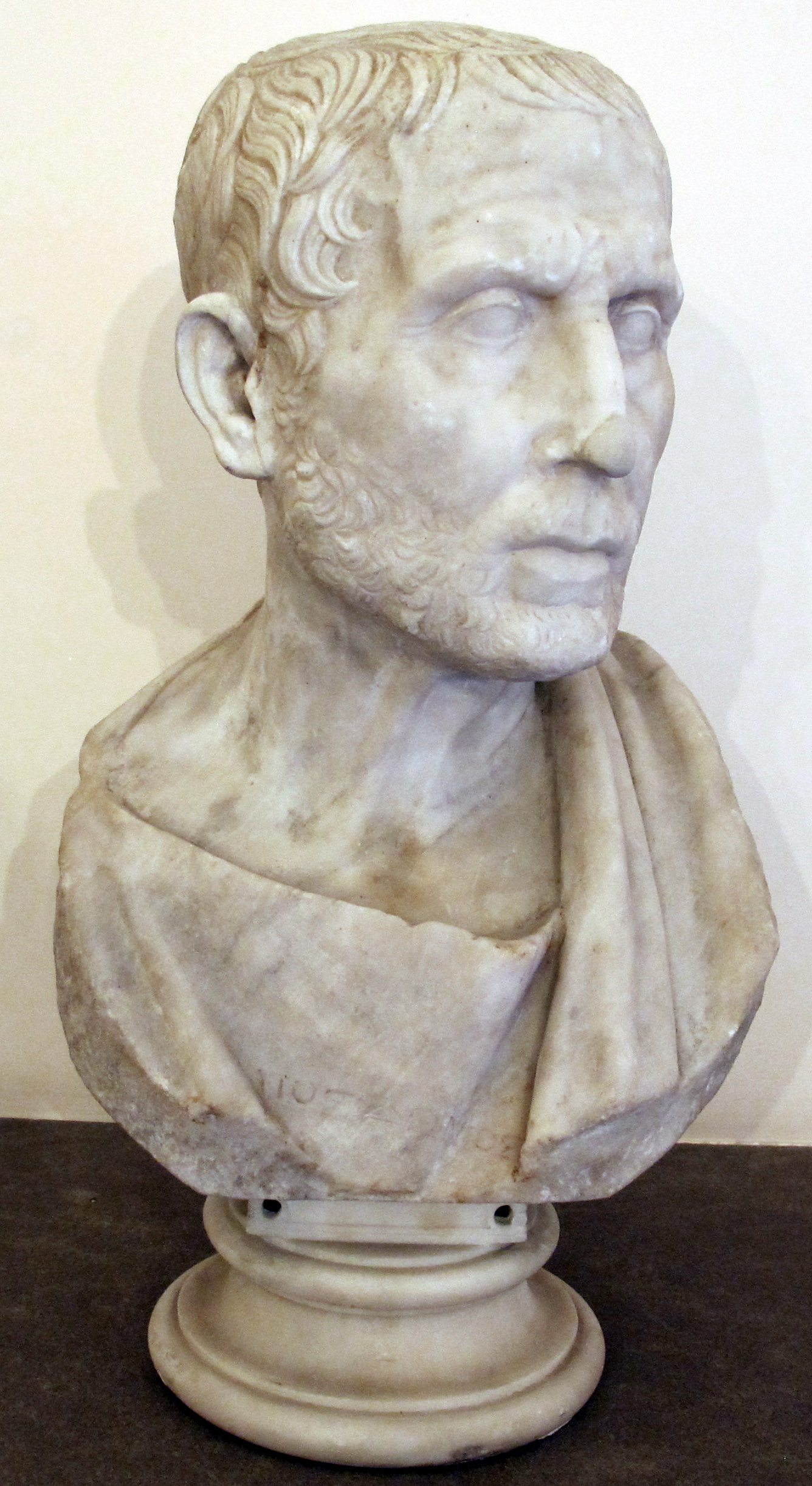
Posidonius
Greek politician and astronomerWikipedia
80
MENTIONS
32
EPISODES
20
PODCASTS
Search complete. 80 mentions across 32 episodes found for "Posidonius".
Nov 2, 2026

Bill BoerstNARRATOR
Ethic was the good fruit, physic the tall plants, and logic the strong wall.
Bill BoerstNARRATOR
The wall existed only to guard the trees, and the trees only to produce the fruit or again philosophy was likened to an egg of which ethic was the yolk containing the chick physic the white which formed its nourishment while logic was the hard outside shell Posidonius, a later member of the school, objected to the metaphor from the vineyard, on the ground that the fruit and the trees and the wall were all separable, whereas the parts of philosophy were inseparable.
Bill BoerstNARRATOR
He preferred, therefore, to liken it to a living organism, logic being the bones and sinews, physic the flesh and blood, but ethic the soul.
Bill BoerstNARRATOR
End of chapter 2 CHAPTER III.

Leon MireNARRATOR
The wall existed only to guard the trees, and the trees only to produce the fruit, or again philosophy was likened to an egg of which ethic was the yolk containing the chick, physic the white which formed its nourishment, while logic was the hard outside shell.
Leon MireNARRATOR
Posidonius, a later member of the school, objected to the metaphor from the vineyard on the ground that the fruit and the trees and the wall were all separable, whereas the parts of philosophy were inseparable.
Leon MireNARRATOR
He preferred, therefore, to liken it to a living organism, logic being the bones and sinews, physic the flesh and blood, but ethic the soul.
Leon MireNARRATOR
Section 2.
1 HR 36 MINS LATER
Leon MireNARRATOR
1.30. Nisarchus, a disciple of Panasius, was teaching at Athens when the orator Crassus visited that city.
Leon MireNARRATOR
1.11. Hecaton of Rhodes, a great Stoic writer, a disciple of Panasius and a friend of Tuborot.
Leon MireNARRATOR
Posidonius, about 128-44, born at Epamia in Syria, became a citizen of Rhodes, represented the Rhodians at Rome.
Leon MireNARRATOR
86.
Bill BoerstNARRATOR
Ethic was the good fruit, physic the tall plants, and logic the strong wall.
Bill BoerstNARRATOR
The wall existed only to guard the trees, and the trees only to produce the fruit or again philosophy was likened to an egg of which ethic was the yolk containing the chick physic the white which formed its nourishment while logic was the hard outside shell Posidonius, a later member of the school, objected to the metaphor from the vineyard, on the ground that the fruit and the trees and the wall were all separable, whereas the parts of philosophy were inseparable.
Bill BoerstNARRATOR
He preferred, therefore, to liken it to a living organism, logic being the bones and sinews, physic the flesh and blood, but ethic the soul.
Bill BoerstNARRATOR
End of chapter 2 CHAPTER III.

speaker_4NARRATOR
Beer thinks that the dream visions chapters 83 through 90 belong to the time of John Hyrcanus, 135 to 105 B.C., and he includes under the pre-Maccabean portions only 91, 12 through 17, 92, 93, 1 through 14, and holds that the rest of the book was written before 64 B.C., Dahlman maintains that it cannot be proved that the important sections 37 through 71, the similitudes, is the product of the pre-Christian period, though he fully recognizes its Jewish character.
speaker_4NARRATOR
Burkitt regards the writer as almost contemporary with the philosopher Posidonius, when 35 to 51 BC.
speaker_4NARRATOR
There is thus some diversity of opinion as to the date of the book among leading authorities.
speaker_4NARRATOR
That it is, as a whole, pre-Christian, may be regarded as definitely established.
Bill BoerstNARRATOR
The wall existed only to guard the trees, and the trees only to produce the fruit, or again philosophy was likened to an egg of which ethic was the yolk containing the chick, physic the white which formed its nourishment, while logic was the hard outside shell.
Bill BoerstNARRATOR
Posidonius, a later member of the school, objected to the metaphor from the vineyard on the ground that the fruit and the trees and the wall were all separable, whereas the parts of philosophy were inseparable.
Bill BoerstNARRATOR
He preferred therefore to liken it to a living organism, logic being the bones and sinews, physic the flesh and blood, but ethic the soul.
Bill BoerstNARRATOR
End of Section 1 Section 2.
1 HR 41 MINS LATER
Bill BoerstNARRATOR
1.30. Nisarchus, a disciple of Panasius, was teaching at Athens when the orator Crassus visited that city.
Bill BoerstNARRATOR
1.11. Hecaton of Rhodes, a great Stoic writer, a disciple of Panasius and a friend of Tuborot.
Bill BoerstNARRATOR
Posidonius, about 128-44.
Bill BoerstNARRATOR
Born at Epamia in Syria.

speaker_4NARRATOR
Beer thinks that the dream visions chapters 83 through 90 belong to the time of John Hyrcanus, 135 to 105 B.C., and he includes under the pre-Maccabean portions only 91, 12 through 17, 92, 93, 1 through 14, and holds that the rest of the book was written before 64 B.C., Dahlman maintains that it cannot be proved that the important sections 37 through 71, the similitudes, is the product of the pre-Christian period, though he fully recognizes its Jewish character.
speaker_4NARRATOR
Burkett regards the writer as almost contemporary with the philosopher Posidonius, when 35 to 51 BC.
speaker_4NARRATOR
There is thus some diversity of opinion as to the date of the book among leading authorities.
speaker_4NARRATOR
That it is, as a whole, pre-Christian, may be regarded as definitely established.

Ryan HolidayHOST
There would be no clever dialectics for him.
Ryan HolidayHOST
He was cut from a different cloth than even a genius like Posidonius.
Ryan HolidayHOST
Nearly every Stoic before and after was in part famous for what they said and wrote.
Ryan HolidayHOST
Alone among them, Cato would achieve towering fame, not for his words, but for what he did and for who he was.
CJ PloegNARRATOR
Dallmann maintains that it cannot be proved that the important sections thirty-seven through seventy-one, The Similitudes, is the product of the pre-Christian period, though he fully recognizes its Jewish character.
CJ PloegNARRATOR
Burkitt regards the writer as almost contemporary with the philosopher Posidonius, one thirty-five to fifty-one BC.
CJ PloegNARRATOR
There is thus some diversity of opinion as to the date of the book among leading authorities.
CJ PloegNARRATOR
That it is, as a whole, pre-Christian may be regarded as definitely established.

David WalesNARRATOR
Bury.
David WalesNARRATOR
We were discussing the change that took place in Greek thought between, say, Plato and the Neoplatonists, or even between Aristotle and Posidonius, and which is seen at its highest power in the Gnostics.
David WalesNARRATOR
I had been calling it a rise of asceticism or mysticism or religious passion or the like when my friend corrected me.
David WalesNARRATOR
It is not a rise, it is a fall or failure of something, a sort of failure of nerve.
3 HRS LATER
David WalesNARRATOR
Let us forget that this system of astronomy has been overthrown and that we now know that man is not the center of the universe.
David WalesNARRATOR
Let us forget that the majestic order which reigns or seems to reign among the stars is matched by a brutal conflict and a chaos of jarring purposes in the realms of those sciences which deal with life.
David WalesNARRATOR
If we can recover the imaginative outlook of the generations which stretched from, say, Mitan in the fifth century before Christ to Copernicus in the sixteenth after, we shall be able to understand the spiritual exaltation with which men like Zeno or Posidonius regarded the world.
David WalesNARRATOR
We are part of an order, a cosmos, which we see to be infinitely above our comprehension, but which we know to be an expression of love for man.
Bill BoerstNARRATOR
Ethic was the good fruit, physic the tall plants, and logic the strong wall.
Bill BoerstNARRATOR
The wall existed only to guard the trees, and the trees only to produce the fruit or again philosophy was likened to an egg of which ethic was the yolk containing the chick physic the white which formed its nourishment while logic was the hard outside shell Posidonius, a later member of the school, objected to the metaphor from the vineyard, on the ground that the fruit and the trees and the wall were all separable, whereas the parts of philosophy were inseparable.
Bill BoerstNARRATOR
He preferred, therefore, to liken it to a living organism, logic being the bones and sinews, physic the flesh and blood, but ethic the soul.
Bill BoerstNARRATOR
End of chapter 2 CHAPTER III.
22 more episodes mention Posidonius.
Create an account to see the whole feed, search across every transcript, and follow the entities you care about.