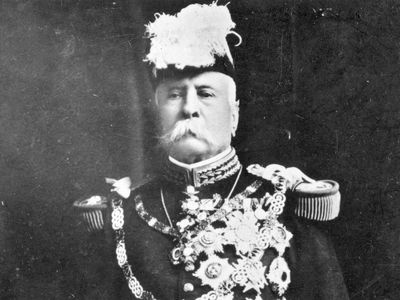
Porfirio Díaz
Former President of MexicoWikipedia
36
MENTIONS
15
EPISODES
14
PODCASTS
Search complete. 36 mentions across 15 episodes found for "Porfirio Díaz".
Nov 1, 2026

speaker_0NARRATOR
He was probably born in the first decades of the 19th century, and he led his people through the long years of raiding and warfare that marked the borderlands in that era, when Apache bands, Mexican settlers and soldiers, and later Americans struggled for control of the country along the Rio Grande.
speaker_0NARRATOR
In the late 1870s and early 1880s, the Mexican government, under President Porfirio Díaz, moved decisively against the Apache bands in its northern states.
speaker_0NARRATOR
According to the accounts that have come down, Alsate and his followers were invited to the village of San Carlos, in Chihuahua, under the promise of peace and an amnesty.
speaker_0NARRATOR
There, after a feast, they were surrounded by troops and taken prisoner.

AndreHOST
One most notable incident were the 10 tragic days in the early 1900s.
AndreHOST
Porfirio Diaz was the 33rd president of Mexico, taking charge in 1884, and he's considered by many historians to be an oppressive dictator.
AndreHOST
In 1910, it was time to elect someone new, but Diaz was not fully ready to face the possibility of losing and moving out of office.
AndreHOST
His opponent, Francisco Madero, was jailed.

James William MooreHOST
But honestly, some of the disagreements were not far off.
James William MooreHOST
First, why the walls? The Mexican Revolution began in 1910, and shattered the long dictatorship of Porfirio Diaz.
James William MooreHOST
What followed was years of political upheaval, violence, and competing visions for Mexico's future.
James William MooreHOST
By the early 1920s, the new government faced a major problem.

Andrew M. HenryHOST
She first appeared in 1910 from the pen of José Guadalupe Posada, who's considered the father of Mexican printmaking.
Andrew M. HenryHOST
Posada was alive under the reign of the Mexican dictator Porfirio Díaz.
Andrew M. HenryHOST
who ruled the country for 31 years.
Andrew M. HenryHOST
Despite modernizing Mexico, Diaz was notorious for operating a repressive regime that oppressed the farmers and working classes.
Andrew M. HenryHOST
The satirical cartoon of La Catrina was created to mock the ruling classes.
Andrew M. HenryHOST
La Catrina, also known as La Calavera Garbanzera, was originally a black and white zinc etching of a female skeleton wearing a large floppy hat.
Andrew M. HenryHOST
It's said she was drafted in the likeness of the dictator's wife.
Andrew M. HenryHOST
Posada's popular illustrations were deeply embedded into the cultural context of the Mexican Revolution, the first great popular revolt on the world stage of the 20th century, which led to a new appreciation of the indigenous past.

KateHOST
This is likely a reference to the first ever self-loading rifle made in Mexico.
KateHOST
also known as the M1908, which would be adopted in the Mexican army under the Porfirio Diaz regime and would be modified by SIG for chambering in the 7x57mm Mauser cartridge.
KateHOST
As Frank suggests, these weapons would eventually be solely used by the German army during World War I, including by the Imperial German Flying Corps, after they were re-chambered for the 7.52x57mm S Patron cartridge.
KateHOST
Those conversions proved too susceptible to mud for active use within the trenches, so they were put in aircrafts and renamed to the FISK-15 Aviator Self-Loading Carbine.
15 MINS LATER
KateHOST
This was a region that underwent significant dispute between the United States and Mexico over whose territory it was, starting in 1864 when the Rio Grande made a southward shift after flooding.
KateHOST
And then it remains a place of significant political dispute until 1964, when negotiations were started by JFK that resulted in the Chamizal Treaty between the two nations.
KateHOST
Interestingly, though, in 1909, a planned summit between William Howard Taft and Porfirio Diaz was planned to settle the dispute.
KateHOST
But tensions over whose flags could be placed where and Where you were like if you were crossing from what we would call the United States to Mexico or vice versa, where you would say one was the other, like literally disputes over how to do the ceremonial aspects of this treaty process between the two led to such significant tension between.

Santiago SegoviaHOST
Para entender la raíz de este vínculo, Hay que buscar en mitos antiguos, hay que mirar al hombre que inició la Revolución Mexicana en 1910, Francisco I. Madero.
Santiago SegoviaHOST
La historia oficial nos presenta a Madero como el apóstol de la democracia, un idealista educado en Francia y Estados Unidos, que luchó contra la dictadura de Porfirio Díaz, lo que los libros de texto suelen ocultar en una nota al pie de es que Madero era un ferviente practicante del espiritismo kardecista y un místico que actuaba como medium escribiente.
Santiago SegoviaHOST
A su regreso de Europa, Madero no solo leía sobre espiritismo espiritual, Se encerraba en su hacienda de San Pedro de las Colonias Coahuila.
Santiago SegoviaHOST
Entraba en estados de trance profundo y dejaba que su mano fuera guiada por entidades desencarnadas sobre hojas de papel en blanco.
Santiago SegoviaHOST
Toda esa acumulación de dolor físico, sumada a la angustia de mentes que veían y escuchaban entidades aterradoras las veinticuatro horas del día, convirtió a los manicomios en puntos de infestación masiva, lugares donde la frontera entre la locura médica y la presencia demoníaca se disolvió por completo.
Santiago SegoviaHOST
Inaugurado el 1 de septiembre de 1910 por el presidente Porfirio Díaz como una de las obras cumbres de la conmemoración del centenario de la independencia, el Manicomio General de la Castañeda se erigía majestuoso en los terrenos de la hacienda de Mixcoac, en la Ciudad de México Construido inspirándose en el modelo francés del hospital de Charenton, La Castañeda era una ciudadela médica de más de veinticinco pabellones de arquitectura neoclásica.
Santiago SegoviaHOST
Concebido inicialmente para albergar a mil quinientos pacientes con la tecnología médica más avanzada de la época, el manicomio pronto se convirtió en un infierno sobrepoblado.
Santiago SegoviaHOST
Para la década de 1930, La Castañeda albergaba más de cuatro mil quinientas personas hacinadas en condiciones infrahumanas.

James StoutHOST
To the south, across the wall, is the town of Kostolitsky, its name for the Russian-Mexican soldier who earned the right to have a valley of someone else's land named after him by participating in the oppression of the Yaki and their revolutionary comrades, as well as putting down the miners' strike at the US-owned mine in Kananeya.
James StoutHOST
Kostolitsky, who came to the continent in the Russian Navy, which he then deserted, became one of Porfirio Diaz's most potent enforcers.
James StoutHOST
punishing the working people who fought alongside Diaz at the Battle of Puebla for cresting the general's right to rule as a dictator, and the indigenous people of the region for defending their lands, water, and communities.
James StoutHOST
Pancho Villa used to rustle cattle from these ranches.

AlistairNARRATOR
Other foreign capitalists provided funds for railways.
AlistairNARRATOR
To encourage such investment, President Diaz offered attractive terms, tax remission for 15 or 20 years, kilometric subsidies, one remembers the Baghdad Railway, ranging from $6,000 to $12,000 a kilometer, and grants of public lands.
AlistairNARRATOR
Early in the 20th century the American capital invested in Mexican railways was estimated to be somewhere between one-third and half a billion dollars.
AlistairNARRATOR
Another important foreign interest was in Mexican land, for cattle and sheep ranches or lumber.
AlistairNARRATOR
If British investments amounting to two-thirds of a billion dollars and other foreign properties valued at a slightly lower figure are added, the total foreign investment in Mexico is well over two and a half billions.
AlistairNARRATOR
Such investments were no menace to Mexico's independence as long as order reigned south of the Rio Grande.
AlistairNARRATOR
And order reigned on the whole during the long dictatorship of President Porfirio Diaz, a shrewd mestizo who ruled Mexico from 1877 to 1880 and from 1884 to 1911.
AlistairNARRATOR
With one firm hand, Diaz suppressed insurrections in Mexico, while with the other he welcomed foreign capital.

Stephen PittsGUEST
And you do that for 20 years and they start to believe you.
Stephen PittsGUEST
So the indigenous, right, their land had been taken away by Porfirio Díaz in the 19th century.
Stephen PittsGUEST
So it's something similar that happened to Native Americans in the U.S., right? So in one generation, the indigenous go from working their own land to being indentured servants on somebody else's land, not growing corn, growing cane sugar to produce rum.
Stephen PittsGUEST
Then right at the company store, getting indebted.
5 more episodes mention Porfirio Díaz.
Create an account to see the whole feed, search across every transcript, and follow the entities you care about.