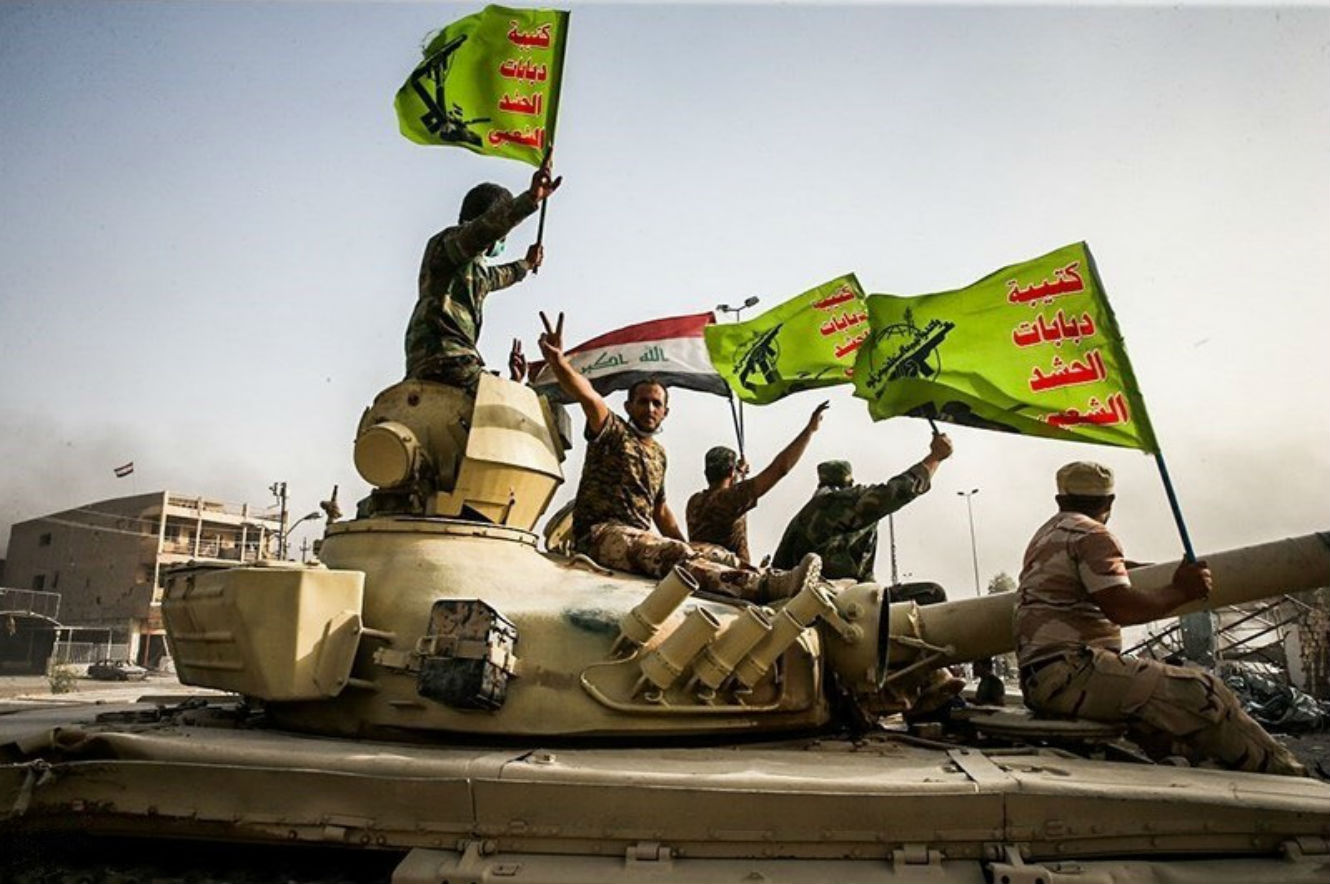
Popular Mobilization Forces
Armed forcesWikipedia
98
MENTIONS
49
EPISODES
39
PODCASTS
Search complete. 98 mentions across 49 episodes found for "Popular Mobilization Forces".
Oct 12, 2026

Bikrum GillGUEST
The United States can do whatever it wants.
Bikrum GillGUEST
It's gonna go and invade Iraq and occupy Iraq, but it will give rise to today another flank of the axis, the Popular Mobilization Forces.
Bikrum GillGUEST
Again, they don't just arise, and I mention this because if there is some sense that there's a directive force coming out of Tehran, no.
Bikrum GillGUEST
You have, um, regional forces, right, that are paying the cost of this end of history equation of power, right? This belief of the United States and, and the Zionists that they can enact with impunity the violence they need to be able to enact their colonial imperial projects in the region.

Trita ParsiGUEST
Um, [laughs] but my, my suspicion would be that if...
Trita ParsiGUEST
I mean, depending on how fast they wanna escalate, it would determine whether they would do anything themselves, or if they would want to have a degree of plausible deniability, and have an escalation take place, uh, in the Persian Gulf, most likely, but perhaps conducted by either Hashd or one of the other militias, or something-
Mario NawfalHOST
The Iraqi militias
Trita ParsiGUEST
...

Victoria TaylorGUEST
But I think there, there remains to be seen whether the, the Turkish military presence, the NATO presence, uh, will also become s- uh, subject of future political consideration.
Scott R. AndersonHOST
So Omar, I wanna come to you because one of the visuals that has circulated, uh, I think in American social media circles, to some extent American media, have been some sort of striking images about, uh, of examples being like the, some members of the Popular Mobilization Forces driving trucks over the American flag.
Scott R. AndersonHOST
Uh, statements by, uh, I think the Secretary General of Kata'ib Hezbollah saying essentially that this was, uh, uh, around the resistance has won, something to that effect.
Scott R. AndersonHOST
Obviously, that is a perspective in a part among a segment of Iraqis that have long been openly hostile to the U.S. military presence.

James StoutHOST
Yeah.
James StoutHOST
Uh, a Popular Mobilization Forces, like militia that was mobilized to fight the Islamic State.
Robert EvansHOST
Right.
Robert EvansHOST
I- in, in the fighting against ISIS in Mosul, you had, like, two primary, like, non-state militias.
Robert EvansHOST
There was the Peshmerga, which is like the Kurdish militias from the north, and then you had the, the Popular Mobilization Forces, which were the Iranian-backed guys.
Robert EvansHOST
And the dudes you wanted to avoid when you were there, to be honest.
James StoutHOST
[laughs] Yeah, so they-

speaker_12CORRESPONDENT
The exemption comes as the US formally ended its occupation of Iraq on September 30th.
speaker_12CORRESPONDENT
Iran still maintains a heavy presence in Iraq through the Popular Mobilization Forces, or PMF, Shiite militias that are technically part of the Iraqi military but are Islamic terror groups loyal to Iran.
speaker_12CORRESPONDENT
Iranian leaders claim the flights will not move weapons, sanctioned people, or elicit money.
speaker_12CORRESPONDENT
Nevertheless, Iran is almost certainly going to use the sanctions exemption as a loophole to continue arming the PMF and engage in other terrorist activities.

Mihailo ZekicCORRESPONDENT
And America still has, or at least on paper, has good influence among the Iraqi Kurds, which we've spoken of before, they almost got used as part of the Iran war.
Mihailo ZekicCORRESPONDENT
But whatever presence America has left, it's not going to be anything meaningful to push back against the Shiite militias, or better known as the Popular Mobilization Forces.
Mihailo ZekicCORRESPONDENT
These are various different jihadist terrorist groups that officially have been grafted into the Iraqi army, but for years have had skirmishes with the United States.
Mihailo ZekicCORRESPONDENT
while taking orders from iran and the big sticking point i think this is very revealing this comes at the same time last month was supposed to be the deadline for the iraqi government to disarm these militias to dissolve these militias essentially at the bequest of the united states then the iraqi prime minister last month said that the new deadline is 2027.

James StoutPANELIST
Yeah.
James StoutPANELIST
Uh, a Popular Mobilization forces, like militia that was mobilized to fight the Islamic State.
Robert EvansPANELIST
Right.
Robert EvansPANELIST
I- in, in the fighting against ISIS in Mosul, you had, like, two primary, like, non-state militias.
Robert EvansPANELIST
There was the Peshmerga, which is, like, the Kurdish militias from the north, and then you had the, the Popular Mobilization forces, which were the Iranian-backed guys, and the dudes you wanted to avoid when you were there, to be honest.
James StoutPANELIST
[laughs] Yes.
Robert EvansPANELIST
They were s- they were not the, the least trustworthy of the, uh, of the Iraqi state forces.

Alistair TaylorHOST
At the end of last month, the U.S. military completed its final withdrawal from the country.
Alistair TaylorHOST
The other, the disarming of the so-called Popular Mobilization Forces militias, most of which enjoy the backing of neighboring Iran, already had to be delayed.
Alistair TaylorHOST
Against the backdrop of the ongoing Iran war, what does the U.S. withdrawal mean for the future of Washington's relationship with Baghdad, for Iraq's security, and for the Prime Minister's push to bring all arms under state control?
Matthew CzekajHOST
To discuss these issues and more, we've invited back on the program MEI Distinguished Diplomatic Fellow Robert S. Ford.

Marc LynchHOST
Uh, this week we're gonna start off by talking to Inna Rudov about her new book from Manchester University Press called Iraq's Shia Warriors: From Battlefield to Parliament.
Marc LynchHOST
Uh, this is a really fascinating book that digs into the diversity of the origins, the motivations, the institutional place of the various armed, uh, uh, Shia factions in Iraq, including the, the Hashd, but also the Sadrists, and a whole range of actors that are involved in various forms of civic, military, and political activity inside Iraq.
Marc LynchHOST
It's deeply researched and quite theoretically nuanced, and I'm especially delighted to lead off the season with, uh, uh, Inna's book because she's a recipient of one of our, uh, small research grants.
Marc LynchHOST
We, uh, pr- we he- held a book workshop for her at a later stage, and then she also contributed to a special issue that, uh, that we produced, uh, on Islamists in war scapes.
19 MINS LATER
Inna RudovGUEST
It does not make any claims to be reinterpreting Bourdieu, but rather like to be borrowing certain very practical, uh, terms from, from the Bourdieuan toolkit.
Inna RudovGUEST
Because for me, the other, uh, the other very important thing for me was not to write a chronological book.
Inna RudovGUEST
I didn't want to write a chronology of what happened like with 2014, how the Hashd was formed, how they developed.
Inna RudovGUEST
It does not follow the phenomenon chronologically, but, uh, rather it looks at how this actor has competed and performed and, in a way, staged itself within three distinct but still interconnected fields of struggle-

Stanly JohnyGUEST
So the Americans had to stay and they continued to fight.
Stanly JohnyGUEST
And once the Islamic State was pushed out of the American, excuse me, Iraqi cities, the Americans turned their focus towards the PMFs, the Popular Mobilization Forces, the Shia militias.
Stanly JohnyGUEST
And there were occasional bombings and counterattacks between these two groups.
Stanly JohnyGUEST
But then what happened? Now the Now, in the midst of another American war in the region, the American troops are out of Iraq and the PMFs are staying.
Stanly JohnyGUEST
So these three are the major political organizations which make up the Shia Coordination Committee and the Shia Coordination Committee is one of the major backers of the current government of Prime Minister Zaidi and all three parties are like Sadaki Network, and the State of the Law, and the Badr Organization, all three parties are closely aligned with the Iranians.
Stanly JohnyGUEST
So we are talking about the parties that back the government in Iraq.
Stanly JohnyGUEST
So you have the popular mobilization forces, you also have the political parties, and you also have the cultural connect, which goes back in centuries.
Stanly JohnyGUEST
So you look at it from any point of view, Iran maintains you know, extreme leverage and influence inside Iraq.
39 more episodes mention Popular Mobilization Forces.
Create an account to see the whole feed, search across every transcript, and follow the entities you care about.