Pope Sixtus IV
Former head of the Catholic ChurchWikipedia
11
MENTIONS
9
EPISODES
9
PODCASTS
Search complete. 11 mentions across 9 episodes found for "Pope Sixtus IV".
Oct 27, 2026

Ada PalmerGUEST
And that resentment helped an ambitious pope recruit them.
Ada PalmerGUEST
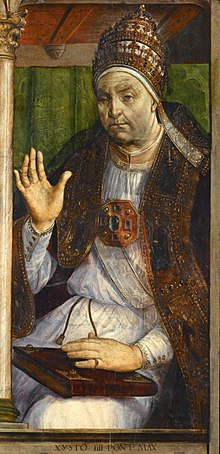
Now, what does this ambitious pope want? This is Pope Sixtus IV.
Ada PalmerGUEST
And we have to zoom out now, but I'm giving you kid Machiavelli verse.
Ada PalmerGUEST
And we've talked about on
Adam DavidsonHOST
other episodes that the popes of this time, they had armies, they were conquerors, they were more thought of as kings than as religious.
Ada PalmerGUEST
Yeah, this is much more of a...
Ada PalmerGUEST
And I love how Sixtus IV is an exception in both directions, both unusually pious and then also unusually warlike.
Ada PalmerGUEST
Because he began life as a Franciscan monk, from an unimportant family from an unimportant city on the outskirts of Genoa.

John MoffattHOST
states themselves were lucrative.
John MoffattHOST
For the Renaissance popes, they provided revenues to commission ever more spectacular works of humanist art, Sixtus IV had built his
speaker_1UNKNOWN
new oratory, the Sistine Chapel, and established a choir to go with
John MoffattHOST
it.

William CiofaniHOST
That's what that was, okay? I didn't mean to interrupt you too much, I'm sorry.
PerryGUEST
In 1477, Pope Sixtus IV said they could apply to purgatory.
William CiofaniHOST
All right, I want to stop you right there, and I want to bring up what happened during the time of Pope Leo.
William CiofaniHOST
He needed money to complete St. Peter's Cathedral in Rome.

Joshua CharlesHOST
Thus, Urban IV testified that every day the rosary obtained fresh boon for Christianity.
Joshua CharlesHOST
Sixtus IV declared that this method of prayer "redounded to the honor of God and the Blessed Virgin, and was well suited to obviate impending dangers." Leo X, that "it was instituted to oppose pernicious heresiarchs and heresies," while Julius III called it the "glory of the church." So also St.
Joshua CharlesHOST
Pius V, that "with the spread of this devotion, the meditations of the faithful have begun to be more inflamed, their prayers more fervent, and they have suddenly become different men." I've experienced this myself.
Joshua CharlesHOST
"The darkness of heresy has been dissipated, and the light of Catholic faith has broken forth again." Lastly, Gregory XIII, in his turn, pronounced that the rosary had been instituted by St.

Terence M. StantonHOST
Thus, Urban IV testified that every day the Rosary obtained fresh boon for Christianity.
Terence M. StantonHOST
Sixtus IV declared that this method of prayer redounded to the honor of God and the Blessed Virgin and was well suited to obviate impending dangers.
Terence M. StantonHOST
Leo X that it was instituted to oppose pernicious heresiarchs and heresies, while Julius III called it the glory of the Church.
Terence M. StantonHOST
So also St. Pius V, that with the spread of this devotion, the meditations of the faithful have begun to be more inflamed, their prayers more fervent, and they have suddenly become different men.

Craig SteppHOST
I know Steve's going to correct me on that then.
Craig SteppHOST
having received its corporate rights from Pope Sixtus IV earlier that year.
Craig SteppHOST
Or was it
Chuck TomasiHOST
Pope Forthus VI? Yeah, Sixtus.

Pete QuiñonesHOST
Nowhere was the maxim more true than in Rome of the Renaissance popes.
Pete QuiñonesHOST
The editio prin- princeps of the complete code of Talmudic law, Maimonides' Mishneh Torah, replete not only with the most offensive precepts against all Gentiles, but also with explicit attacks on Christianity and on Jesus, this is in parentheses, after whose name the author adds piously, "May the name of the wicked perish," close parentheses, was published exp- expurgated in Rome in the year 1480 under Sixtus IV, politically a very active pope who had a constant and urgent need for money.
Pete QuiñonesHOST
Parenthesis again, a few years earlier, the only older edition of The Golden Ass by Apuleius, from which the violent attack on Christianity had not been removed, was also published in Rome.
Pete QuiñonesHOST
Alexander VI Borgia was also very liberal in this respect.