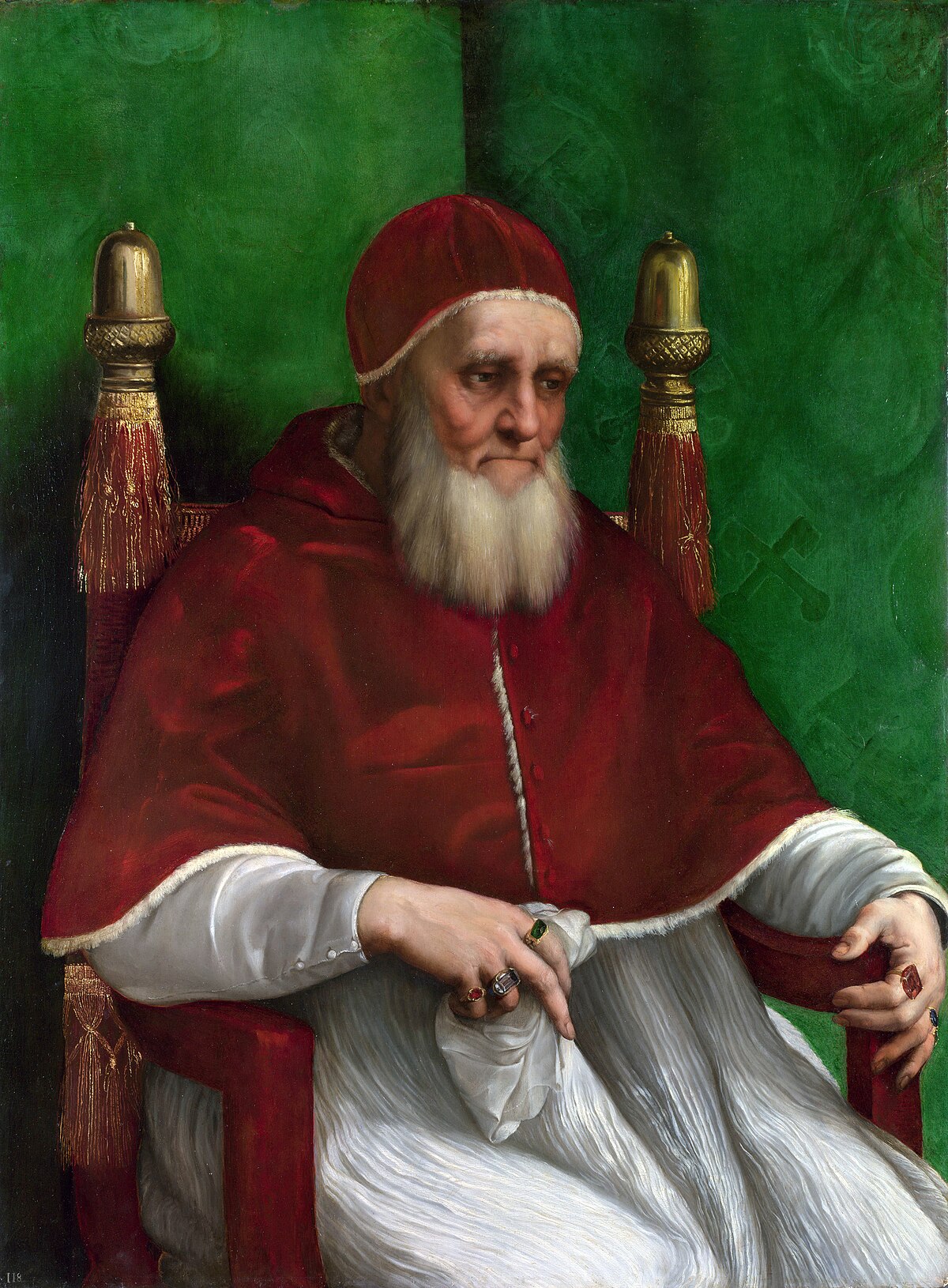
Pope Julius II
Former head of the Catholic ChurchWikipedia
154
MENTIONS
63
EPISODES
54
PODCASTS
Search complete. 154 mentions across 63 episodes found for "Pope Julius II".
Sep 24, 2026

John GreenmanNARRATOR
The solemnization whereof ended, he found the means to get the possession of all his predecessor's goods into his hands, whereof I have seen divers times some part thereof furnish his house.
John GreenmanNARRATOR
It was not long after that Dr. Bainbridge, Archbishop of York, died at Rome, being there the king's ambassador under Pope Julius, unto which benefice the king presented his new bishop of Lincoln, so that he had three bishoprics in one year given him.
John GreenmanNARRATOR
Then prepared he again of new as fast for his translation from the see of Lincoln unto the see of York.
John GreenmanNARRATOR
After which solemnization done, and he being in possession of the archbishopric of York and primas Angliae, thought himself sufficient to compare with Canterbury, and thereupon erected his cross in the court, and in every other place, as well in the presence of the Archbishop of Canterbury and in the precinct of his jurisdiction as elsewhere.

John GreenmanNARRATOR
The solemnization whereof ended, he found the means to get the possession of all his predecessor's goods into his hands, whereof I have seen divers times some part thereof furnish his house.
John GreenmanNARRATOR
It was not long after that Dr. Bainbridge, Archbishop of York, died at Rome, being there the king's ambassador under Pope Julius, unto which benefice the king presented his new Bishop of Lincoln, so that he had three bishoprics in one year given him.
John GreenmanNARRATOR
Then prepared he again of new as fast for his translation from the See of Lincoln unto the See of York.
John GreenmanNARRATOR
After which solemnization done, and he being in possession of the Archbishopric of York and Primas Angliae, thought himself sufficient to compare with Canterbury, and thereupon erected his cross in the court, and in every other place, as well in the presence of the Archbishop of Canterbury, and in the precinct of his jurisdiction as elsewhere.

Louise J. BellNARRATOR
Likewise, there are numerous holy shrouds.
Louise J. BellNARRATOR
That at Besançon, which was brought from Palestine by crusaders about the beginning of the 12th century, won fame by delivering the city from a destructive plague in 1544, while that at Turin had a festival instituted for it by Pope Julius II in 1506.
Louise J. BellNARRATOR
Other authentic shrouds may be found at the Church of St. Cornelius at Compiègne, in Rome, Milan, Lisbon, and Aix-la-Chapelle.
Louise J. BellNARRATOR
Another much-multiplied relic is the Virgin's Ring, supposed to have been the marriage ring used at the nuptials of Joseph and Mary.

speaker_4NARRATOR
And it is seen that his foundations were good, for the Romagna awaited him for more than a month.
speaker_4NARRATOR
in rome although but half alive he remained secure and whilst the baglioni the vitelli and the orsini might come to rome they could not effect anything against him if he could not have made pope him whom he wished at least the one whom he did not wish would not have been elected but if he had been in sound health at the death of alexander everything would have been different to him on the day that julius the second was elected he told me that he had thought of everything that might occur at the death of his father and had provided a remedy for all except that he had never anticipated that when the death did happen he himself would be on the point to die when all the actions of the duke are recalled i do not know how to blame him but rather it appears to be as i have said that i ought to offer him for imitation to all those who by the fortune or the arms of others are raised to government because he having a lofty spirit and far-reaching aims could not have regulated his conduct otherwise and only the shortness of the life of alexander and his own sickness frustrated his designs therefore he who considers it necessary to secure himself in his new principality to win friends to overcome either by force or fraud to make himself beloved and feared by the people to be followed and revered by the soldiers to exterminate those who have power or reason to hurt him to change the old order of things for new to be severe and gracious magnanimous and liberal to destroy a disloyal soldiery and to create new to maintain friendship with kings and princes in such a way that they must help him with zeal and offend with caution cannot find a more lively example than the actions of this man Only can he be blamed for the election of Julius II, in whom he made a bad choice, because, as is said, not being able to elect a pope to his own mind, he could have hindered any other from being elected pope, and he ought never to have consented to the election of any cardinal whom he had injured or who had caused to fear him if they became pontiffs.
speaker_4NARRATOR
For men injure either from fear or hatred.
speaker_4NARRATOR
Those whom he had injured, amongst others, were San Pietro Advincula, Colonna, San Giorgio, and Ascanio.
1 HR 3 MINS LATER
speaker_4NARRATOR
therefore any one wishing to maintain among men the name of liberal is obliged to avoid no attribute of magnificence so that a prince thus inclined will consume in such acts all his property and will be compelled in the end if he wish to maintain the name of liberal to unduly weigh down his people and tax them and do everything he can to get money this will soon make him odious to his subjects and becoming poor he will be little valued by any one thus with his liberality having offended many and rewarded few he is affected by the very first trouble and imperilled by whatever may be the first danger recognizing this himself and wishing to draw back from it he runs at once into the reproach of being miserly therefore a prince not being able to exercise this virtue of liberality in such a way that it is recognized except to his cost if he is wise he ought not to fear the reputation of being mean for in time he will come to be more considered than if liberal seeing that with his economy his revenues are enough that he can defend himself against all attacks and is able to engage in enterprises without burdening his people thus it comes to pass that he exercises liberality towards all from whom he does not take who are numberless and meanness towards those to whom he does not give who are few We have not seen great things done in our time except by those who have been considered mean.
speaker_4NARRATOR
The rest have failed.
speaker_4NARRATOR
Pope Julius II was assisted in reaching the papacy by the reputation for liberality, yet he did not strive afterwards to keep it up, when he made war on the King of France.
speaker_4NARRATOR
And he made many wars without imposing any extraordinary tax on his subjects, for he supplied his additional expenses out of his own thriftiness.

Sarah Urist-GreenHOST
So with the Medici brand behind him, Michelangelo was basically one of Italy's biggest influencers.
Sarah Urist-GreenHOST
He even caught the eye of Pope Julius II, who commissioned him to paint the now-famous Sistine Chapel ceiling.
Sarah Urist-GreenHOST
Now, the Medici's were also sponsors of the painter and architect Giorgio Vasari, who wrote a book called Lives of the Most Excellent Italian Painters, Sculptors, and Architects.
Sarah Urist-GreenHOST
It celebrated Michelangelo and other artists like him, and it gave the Medici's credit for supporting a historic, quote, rebirth.

Ruth GoldingNARRATOR
The barefoot boy did persevere until he had overcome every difficulty and become the greatest master of art the world has known.
Ruth GoldingNARRATOR
Although Michelangelo made himself immortal in three different occupations and his fame might well rest upon his Dome of St. Peter as an architect, upon his Moses as a sculptor, or upon his Last Judgment as a painter, yet we find by his correspondence now in the British Museum that when he was at work on his colossal bronze statue of Pope Julius II, he was so poor that he could not have his younger brother come to visit him at Bologna because he had but one bed in which he and three of his assistants slept together.
Ruth GoldingNARRATOR
Yet, quote, "The star of an unconquered will arose in his breast, serene and resolute and still and calm and self-possessed." End quote.
Ruth GoldingNARRATOR
Concentrated energy.

John GreenmanNARRATOR
The solemnization whereof ended, he found the means to get the possession of all his predecessor's goods into his hands, whereof I have seen divers times some part thereof furnish his house.
John GreenmanNARRATOR
It was not long after that Dr. Bainbridge, Archbishop of York, died at Rome, being there the king's ambassador under Pope Julius, unto which benefice the king presented his new bishop of Lincoln, so that he had three bishoprics in one year given him.
John GreenmanNARRATOR
Then prepared he again of new as fast for his translation from the see of Lincoln unto the see of York.
John GreenmanNARRATOR
After which solemnization done, and he being in possession of the archbishopric of York and Primas Angliae, thought himself sufficient to compare with Canterbury, and thereupon erected his cross in the court, and in every other place, as well in the presence of the Archbishop of Canterbury and in the precinct of his jurisdiction as elsewhere.

John BradshawHOST
One event in particular profoundly affected him.
John BradshawHOST
Pope Julius II had recently made a decree that a special indulgence was available to those who would walk on their knees up what had become known as Pilate's Staircase.
John BradshawHOST
The staircase was believed to have been the very staircase Jesus walked on during his trial before Pontius Pilate, and the church claimed it had been miraculously transported from Jerusalem to Rome.
John BradshawHOST
Luther was determined to acquire this indulgence, and so one day he devoutly climbed these stairs on his knees.

Lawrence GinangeliHOST
His real name, Il Sodoma, is Giovanni Antonio Bazzi, and he was born in 1477 in northern Italy in the region of Piemonte, Piedmont.
Lawrence GinangeliHOST
He was already integrated into the Sienese professional circle by 1503 and was working on the Vatican decoration of for Pope Julius II by 1508, which then led to his work for Agostino Chigi in the Farnesina.
Lawrence GinangeliHOST
Now, it's important to understand that Il Sodoma was his nickname, and it just means the Sodomite.
Lawrence GinangeliHOST
Sodoma lived well into the middle of the 16th century, and was a contemporary of the biographer Giorgio Vasari, who we talk about all the time, who gives us the story behind why Sodoma was given the This name is very important.

Dustin MooreGUEST
Not today, but it was at one point.
Dustin MooreGUEST
Pope Julius... has commissioned Michelangelo to paint the ceiling of the Sistine Chapel.
Dustin MooreGUEST
Imagine that before a single brushstroke is made, the Pope gives Michelangelo one assignment.
Dustin MooreGUEST
And in that one assignment, he says, Michelangelo, I want you to create one image, one, just one image that captures the very essence of Christianity.
53 more episodes mention Pope Julius II.
Create an account to see the whole feed, search across every transcript, and follow the entities you care about.