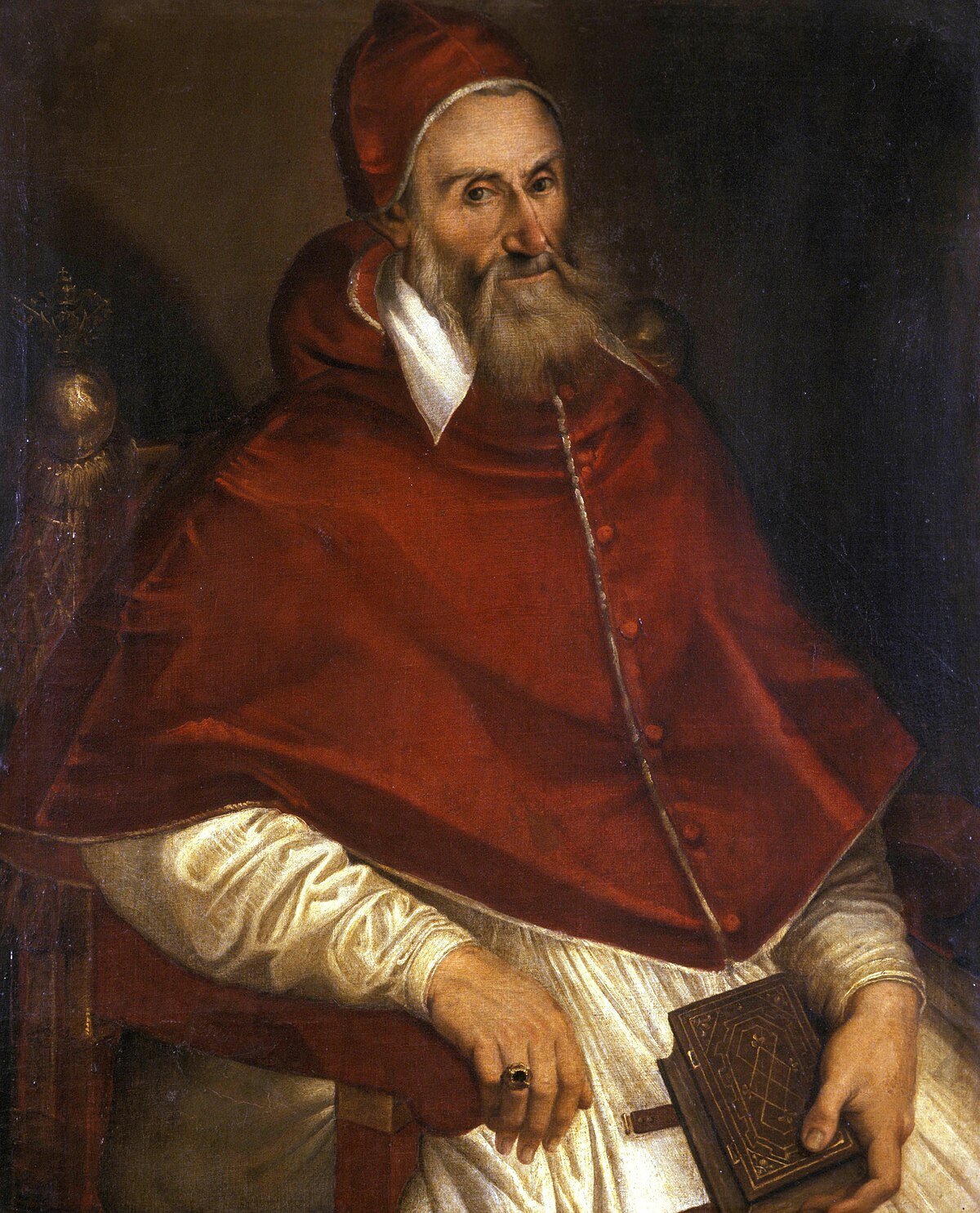
Pope Gregory XIII
Former head of the Catholic ChurchWikipedia
30
MENTIONS
16
EPISODES
16
PODCASTS
Search complete. 30 mentions across 16 episodes found for "Pope Gregory XIII".
Sep 12, 2026

MomHOST
By the 1500s, the error had grown to 10 days.
MomHOST
Pope Gregory XIII ordered a correction in 1582.
MomHOST
In countries adopting the reform, October 4th was followed immediately by October 15th.
DanielHOST
Hmm.
DanielHOST
Julius Caesar reformed the Roman calendar in 46 BC, apparently with help from the astronomer Sosigenes, creating a 365-day calendar with a leap day every four years.
DanielHOST
But the Julian calendar was still about 11 minutes too long each year, and by the 1500s that had added up to 10 days.
DanielHOST
I also remember that Pope Gregory XIII corrected it in 1582, dropping 10 dates from October in countries adopting the reform and refining the leap year rule.
DanielHOST
And Britain did not switch until 1752.

speaker_0NARRATOR
He also was gifted and lovable, but all too soon he slipped from our clinging arms and passed away from earth, leaving us very lonely, but with the happy consciousness that a dear saint awaited us in heaven, and that we who remained behind must be all the more affectionate each to each." my third boy sylla was also musical two of his motets are with my own one by one i saw these gifted youths pass from me till only my youngest born inyo remained in fifteen eighty the light of my life went out when my dear wife died i was inconsolable it did not seem possible to live without my faithful partner For so many years we had lived and labored together that it was as if part of my heart and soul went from me with my wife.
speaker_0NARRATOR
Prince Giacomo Buoncompagni, a son born to Pope Gregory XIII before he entered holy orders, made me at this time master of his concerts.
speaker_0NARRATOR
I took the added duty for—did I not have my boys to work for? three of them were still with me and i welcomed the added labor which kept me from thinking too often of the dear ones gone before in my old age i was honored and beloved for from the time of my battle for church music my fame and fortune grew i received many titles of praise and was known and admired throughout europe i was an indefatigable worker nearly a hundred masses besides motets madrigals offertories hymns litanies and magnificats flowed from my busy pen some of these i myself published dedicating them to my different patrons So, working and attending to my many duties, I lived on till my final summons came.
speaker_0NARRATOR
Then I called my sole surviving son to my bedside and spoke to him as follows.

FinnHOST
Why is it broken again? Who's going to save them this time?
MiraHOST
Pope Gregory XIII stepped up.
MiraHOST
The Catholic Church was worried because Easter was celebrated on the wrong day.
MiraHOST
It was drifting closer and closer to summer.
MiraHOST
For question two, Caesar's Year of Confusion was exactly 445 days long.
MiraHOST
Number three, the answer is the moon.
MiraHOST
Question four, it was Pope Gregory XIII who ordered the time heist.
MiraHOST
And the final answer is Benjamin Franklin.

Ed HumpalNARRATOR
Howbeit infinite cases there are wherein all these impediments and lets are so manifestly excluded that there is no show or colour whereby any such exception may be taken, but that the testimony of man will stand as a ground of infallible assurance.
Ed HumpalNARRATOR
That there is a city of Rome, that Pius Quintus and Gregory XIII and others have been popes of Rome, I suppose we are certainly enough persuaded.
Ed HumpalNARRATOR
The ground of our persuasion, who never saw the place nor persons before named, can be nothing but man's testimony.
Ed HumpalNARRATOR
Will any man here notwithstanding allege those mentioned human infirmities as reasons why these things should be mistrusted or doubted of? Yea, that which is more, utterly to infringe the force and strength of man's testimony were to shake the very fortress of God's truth.

Eli AmdurHOST
So parliament decreed that Wednesday, December 2nd will be followed by Thursday, September 14th.
Eli AmdurHOST
The Gregorian calendar had been adopted by Pope Gregory the 13th.
Eli AmdurHOST
It would make sense that Gregorian calendar was adopted by Gregory.
Eli AmdurHOST
And that took place in most European countries.

speaker_3NARRATOR
For so many years we had lived and labored together that it was as if part of my heart and soul went from me with my wife.
speaker_3NARRATOR
Prince Giacoma Buoncompagni, a son born to Pope Gregory XIII before he entered holy orders, made me at this time master of his concerts.
speaker_3NARRATOR
I took the added duty, for did I not have my boys to work for? Three of them were still with me, and I welcomed the added labor which kept me from thinking too often of the dear ones gone before.
speaker_3NARRATOR
in my old age i was honored and beloved for from the time of my battle for church music my fame and fortune grew i received many titles of praise and was known and admired throughout europe i was an indefatigable worker nearly a hundred masses besides motets madrigals offertories hymns litanies and magnificats flowed from my busy pen some of these i myself published dedicating them to my different patrons so working and attending to my many duties i lived on till my final summons came then i called my sole surviving son to my bedside and spoke to him as follows

Mark PalmerHOST
This meant that the first day of spring was not even close to March 21.
Mark PalmerHOST
In 1582, Pope Gregory XIII issued a papal bull for the adoption of a new calendar, which is known as the Gregorian calendar.
Mark PalmerHOST
It's the same as the Julian calendar, except there are no leap years for years ending in 00, unless the year is exactly divisible by 400.
Mark PalmerHOST
Here's an example.

PaulHOST
What you think of as a Franciscan character, but there have been many Franciscans who answered that description anyway.
PaulHOST
So apparently at one point in his career as an inquisitor, he was sent along with a cardinal who had become Gregory XIII to Spain to investigate the Archbishop of Toledo, who may have been a heretic.
PaulHOST
You know, one of those, you know, grim 16th century sort of pastimes.
PaulHOST
And apparently they didn't really get along.
PaulHOST
And so Gregory XIII is elected pope, and that means that the man who would become 65th really became sort of sidelined, kind of retired, maybe did some writing, you know, organized an estate somewhere in Italy, the things that you did as a cardinal who was out of favor with the pope.
PaulHOST
And then Gregory XIII, of course, dies, and people look around and say, you know, the way he was doing things was really not that effective.
PaulHOST
Um, let's go get his enemy over here and elect him.
PaulHOST
He seems like a capable fellow anyway.

Garth BurtonNARRATOR
St. Norbert died in 1134 and was buried at Magdeburg, which bishopric he had held for 14 years.
Garth BurtonNARRATOR
In the year 1582, St. Norbert was canonized by Pope Gregory XIII.
Garth BurtonNARRATOR
In 1627, his remains were translated to the Primonstratention Abbey of Strahau, near Prague.
Garth BurtonNARRATOR
At the end of the 15th century, it was computed that no less than 2,000 abbeys and nunneries in Europe acknowledged the head of the order at Primontray.
6 more episodes mention Pope Gregory XIII.
Create an account to see the whole feed, search across every transcript, and follow the entities you care about.