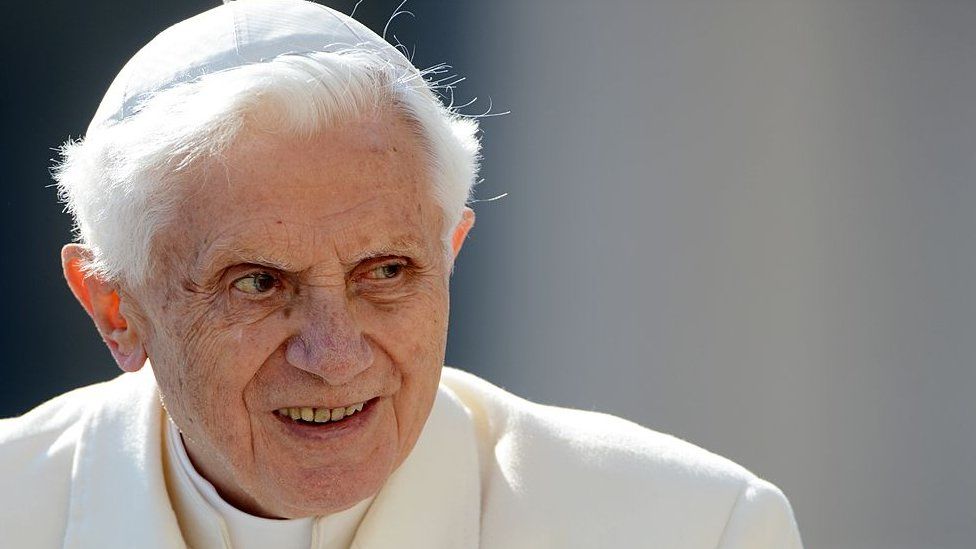
Pope Benedict XVI
Former head of the Catholic ChurchWikipedia
618
MENTIONS
330
EPISODES
193
PODCASTS
Search complete. 618 mentions across 330 episodes found for "Pope Benedict XVI".
Sep 15, 2026

Ben HarnwellHOST
Now, if the, um, if the so-called Catholic hierarchy had demolished a Catholic church or a basilica that was 1,700 years old, they'd gone and, and the Taliban, like, put the dynamite under it and blew it to smithereens, the world would absolutely be outraged and disgusted.
Ben HarnwellHOST
And y- when they did it to the Mass, the words of the Mass, um, that it changed from one moment to the next in the words that Benedict himself said, Ratzinger, excuse me, himself said, turning the, the Novus Ordo, bringing in, introducing the Novus Ordo liturgy, which he called a banal on-the-spot product, the first time he was ever right about something.
Ben HarnwellHOST
Um, of course, there's, there was no actual ac- there was no actual carry through when he became pope after that, but he, he was right in the i- i- in, in the, uh, aesthetic analysis part of, of it.
Ben HarnwellHOST
Nothing.

Marcus PeterHOST
And I just want to provide some context here.
Marcus PeterHOST
For those of us approaching theology for the first time, I mean, you know, Ratzinger has his own lexicon.
Marcus PeterHOST
Aquinas has his own lexicon.
Marcus PeterHOST
Augustine has his own lexicon.
Randall SmithGUEST
So that was my lesson to Catholics, right? I know sometimes the church documents are written in a kind of odd style.
Randall SmithGUEST
I mean, official ones and stuff.
Randall SmithGUEST
But again, there's oftentimes, again, when you're reading Ratzinger, when you're reading Pope John Paul II, when you're reading Thomas Aquinas or Augustine, it can be a hard language to get into, but there's a lot there.
Marcus PeterHOST
Why the reticence, Randall? And maybe I'm asking a question that has an obvious answer, but why the unwillingness to do the work of kind of hacking the weeds of the language so that we can get into the meal?

Jimmy AkinGUEST
Um, and that thing that happened in 1988, that was a long time ago.
Jimmy AkinGUEST
So what practical steps could we take to mend things?" And during the, uh, pontificate of Benedict XVI, we saw substantial progress.
Jimmy AkinGUEST
One of the things that Benedict did, um, because he had a real heart for inter-Christian unity, um, was he, um, [lip smacks] uh, he liberalized the celebration of the traditional Latin Mass, which I thought was great.
Jimmy AkinGUEST
Um, then a couple years later, he lifts the excommunications on the SSPX bishops.

J. Marianne SiegmundGUEST
Since martyrdom is both a grace and a virtue, the martyr participates in the very unity being goodness, beauty, and truth of God Himself.
J. Marianne SiegmundGUEST
Pope Benedict XVI highlights the fact that the capacity to suffer for the sake of truth is the measure of humanity.
J. Marianne SiegmundGUEST
The more one is able to suffer for the sake of the truth, the more human one becomes.
J. Marianne SiegmundGUEST
I do not mean to say that one is not human until one suffers on account of the truth, but rather that one becomes who he was meant to be in the first place.

speaker_1NARRATOR
To learn more and to attend these events, visit us at thomisticinstitute.org.
Irenaeus DunlevyGUEST
We've already had two conferences on this, uh, during this retreat of Forming the Catholic Imagination, and in the first one, uh, Father Allen was so kind to kind of walk us through some of the thought of Benedict XVI on the, the role of, of art in the Christian way of life, and we learned about the, the wound of beauty, and there's a particularly, I think, important, um, element in that talk among the many, uh, in which the wound of beauty is something that, you know, it, we, we encounter beauty in artwork or within the liturgy, within music, where, uh, it strikes us, it transforms us, and precisely because it sort of acts as a, like a catapulting veil, if that makes any sense.
Irenaeus DunlevyGUEST
Um, but the idea is that it doesn't simply want you to look at it as object, but to lead you through into something kind of deeper or higher, uh, with regard to reality, especially with regard to God.
Irenaeus DunlevyGUEST
Uh, our second talk, um, from Father Chris, uh, going through a lot of, uh, Aquinas's epistemology, um, showed us that the, the place imagination has within this, this sort of apparatus, which is the, uh, the human body and soul composite, uh, by which we come to intellectual knowledge through what's called epistemological abstraction, uh, where we move from what is visible to what's invisible.

Chris AlarGUEST
Divine mercy is also a message, the message of the gospel.
Chris AlarGUEST
And Pope Benedict said it well.
Chris AlarGUEST
He said divine mercy is not just a secondary Christian devotion, but an integral part of Christian life and prayer.
Chris AlarGUEST
He called it the nucleus of the gospel.

Terrence M. StantonHOST
He is the Fatima expert par excellence.
Terrence M. StantonHOST
This appendix is entitled Joseph Cardinal Ratzinger Speaks About the Third Secret.
Terrence M. StantonHOST
And of course, he became the Pope in 2005, if memory serves, when John Paul II passed away.
Terrence M. StantonHOST
So those of you who've been following each and every broadcast know that Fr.
Terrence M. StantonHOST
He knew it would center on the Pope.
Terrence M. StantonHOST
So we begin.
Terrence M. StantonHOST
In November 1984, an account appeared in an Italian review of an interview granted in August by Joseph Cardinal Ratzinger, Prefect of the Congregation for the Doctrine of the Faith, to journalist Vittorio Massori.
Terrence M. StantonHOST
In this long article entitled, Here is Why the Faith is in Crisis, an important section was devoted to Fatima and its third secret.

John RiccardoHOST
And if you're intimidated by the Gospels, there are four great books to accompany your reading of the Gospels.
John RiccardoHOST
There used to be three, then Pope Benedict wrote Jesus of Nazareth, and now there are four.
John RiccardoHOST
There are four great, not quite biographies of Jesus, but they're Lives of Christ, To Know Christ Jesus by Frank Sheed, The Life of Christ by Fulton Sheen, The Lord by Romano Guardini, and then Jesus of Nazareth by Pope Benedict, which is only volume one.
John RiccardoHOST
Hopefully volume two is coming out soon.
John RiccardoHOST
Next quick observation on the scriptures.

ApolloHOST
Mm-hmm.
ApolloHOST
That was, I wanna say that was Pope Benedict?
Kali The KidGUEST
Yeah.
Kali The KidGUEST
Maybe.

Alan SmithGUEST
They know that Sheen is this trusted voice that, um, hey, um, it's pre-approved.
Alan SmithGUEST
I always say, when the Vatican in 2012, Pope Benedict XVI, uh, declared Sheen venerable, he was saying his writings are approved.
Alan SmithGUEST
His-
Patricia Hedy-MurrayHOST
Mm-hmm.
320 more episodes mention Pope Benedict XVI.
Create an account to see the whole feed, search across every transcript, and follow the entities you care about.