Pomodoro Technique
161
MENTIONS
77
EPISODES
75
PODCASTS
Search complete. 161 mentions across 77 episodes found for "Pomodoro Technique".
Sep 12, 2026

Stephen PuriGUEST
Sometimes that minute, three minutes of just breathing, envisioning it, is very powerful.
Stephen PuriGUEST
You mentioned Pomodoros.
Stephen PuriGUEST
where there are breaks cut into your work time.
Stephen PuriGUEST
On the breaks that we offer, because we have a timer that you can do a traditional Pomodoro 25 and 5, or you can set it, customize it.

Kate ForsterHOST
So please lean into a specific goal, not 17, just one.
Kate ForsterHOST
Disciplined work sessions, some Pomodoro perhaps, a Pomodoro for you, madam.
Kate ForsterHOST
Sit down and do the work.
Kate ForsterHOST
Put your ass on the chair.

Costin RaiuHOST
And that's how he-
Juan Andres Guerrero-SaadeHOST
Pomodoro
Costin RaiuHOST
... actually worked, like, forever.
Juan Andres Guerrero-SaadeHOST
This is... [laughs] Yeah.
Juan Andres Guerrero-SaadeHOST
It's, Leonardo da Vinci was a big Pomodoro fan.
Juan Andres Guerrero-SaadeHOST
Uh, [laughs]
Costin RaiuHOST
Pizza?

speaker_6HOST
We created external scaffolds to force our brains into a state of concentration.
speaker_5HOST
And the poster child for this is, of course, the Pomodoro technique, right?
speaker_6HOST
Oh, absolutely.
speaker_5HOST
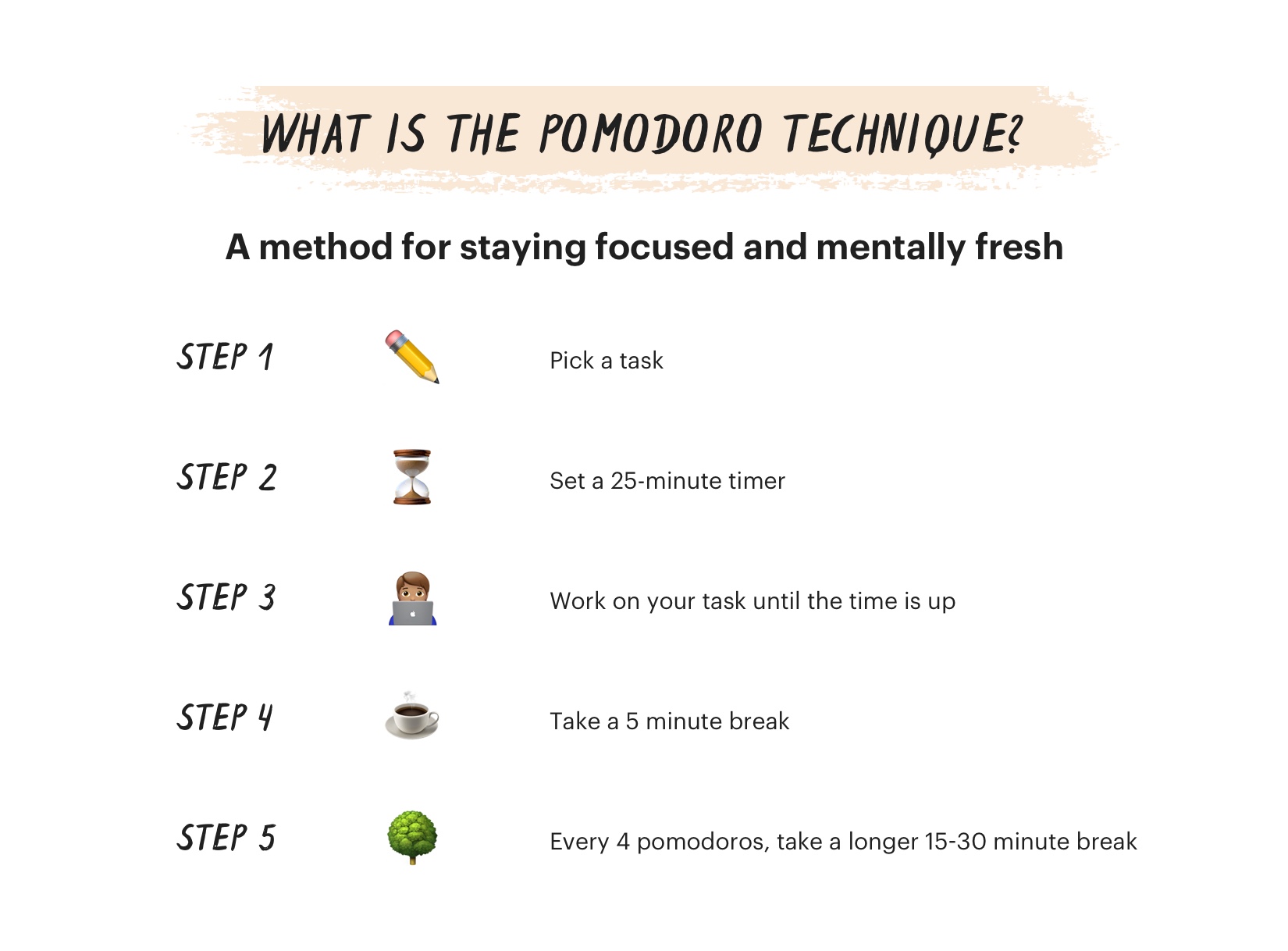
The system of working in strict 25-minute intervals separated by five-minute breaks.
9 MINS LATER
speaker_5HOST
How so?
speaker_6HOST
Well, think about forced focus.
speaker_6HOST
Staring at a ticking Pomodoro timer, relying on sheer willpower to ignore distractions, that is cognitively expensive.
speaker_5HOST
Even because you're fighting yourself.

Jackson ReedHOST
4.
Jackson ReedHOST
The Pomodoro Technique This is a game-changer.
Jackson ReedHOST
It involves working in 25-minute bursts with short breaks in between.
Jackson ReedHOST
Think of it like interval training for your brain, intense focus followed by a quick recharge to prevent burnout.

MJHOST
I'm bringing over two bags of dry pasta, two 500 gram bags, 17 point something ounces.
MJHOST
And I'm bringing two jars of, Of my homemade Pomodoro.
MJHOST
Ooh, dude.
MJHOST
So I'm bringing two jars.
MJHOST
These are pints.
MJHOST
These are old Talenti containers.
MJHOST
of my homemade Pomodoro.
MJHOST
So a pint is how many ounces? Two cups, so is that like 16 ounces? Yes, a pint is 16 ounces.

Laura ByrneHOST
If you were gonna define it, what would be an example of adaptive scaffolding?
Kieran KennedyGUEST
So I think adaptive scaffolding, for example, might look like knowing that we work a whole lot better with a task or with study, for example, if we're breaking it into chunks and having regular breaks, and, like, that's a really basic one 'cause we've all kind of heard about that tip and the Pomodoro Technique and things.
Kieran KennedyGUEST
But I think that's an example of a really simple adaptive one that kind of just helps us get through the task.
Kieran KennedyGUEST
Maybe more maladaptive scaffolding or masking might look like only being able to function if we are so hypervigilant around structures and everything going in a specific order-

Rob DialHOST
How can you use parts of your brains, batch them all together to get things done? So that's number two is to batch.
Rob DialHOST
And then number three is when you're sitting down to work, use something that's called the Pomodoro Technique.
Rob DialHOST
The Pomodoro Technique is very, very simple.
Rob DialHOST
You sit down.
Rob DialHOST
You have a timer.
Rob DialHOST
If you've ever been on a Zoom call with me, I usually show it.
Rob DialHOST
I have a timer that lives on my desk, and the timer will time for 25 minutes.
Rob DialHOST
The Pomodoro Technique is 25 minutes on, five minutes off, 25 minutes on working on one thing and one thing only, five minutes off.

Matt FyfieldGUEST
They might be switching between the two, but they're not doing them at the same time.
Matt FyfieldGUEST
So, okay, running a Pomodoro in your classroom and then giving the students a talk break and then coming back in.
Matt FyfieldGUEST
Once you know that these things are not true... you are a far more effective teacher.
Matt FyfieldGUEST
Sure,
Danny JaberHOST
sure.
Danny JaberHOST
And that notion of Pomodoro being that kind of five minutes on, five minutes off, or whatever time frame you want to work with there.
Matt FyfieldGUEST
And again, here's a lethal mutation.
Matt FyfieldGUEST
The Pomodoro, the original Pomodoro idea, I think was 20 or 25 minutes or something like that.

Chelsea HendersonHOST
So you need to take that break.
Chelsea HendersonHOST
Maybe you're using the Pomodoro method again, right? You're taking 25 minutes off, going to do something that requires less brain capacity, and then you're getting back to it.
Chelsea HendersonHOST
Like I just too often I feel the pull to keep doing and keep catching up and keep getting ahead.
Chelsea HendersonHOST
But I more and more give myself permission to just stop, take that break, do something that feeds my soul or really gives me a rest.
67 more episodes mention Pomodoro Technique.
Create an account to see the whole feed, search across every transcript, and follow the entities you care about.