Polysomnography
Diagnostic testWikipedia
7
MENTIONS
5
EPISODES
4
PODCASTS
Search complete. 7 mentions across 5 episodes found for "Polysomnography".
Oct 2, 2026

speaker_2NARRATOR
Laboratories are used to diagnose a wide range of disorders, including insomnia, apnea, narcolepsy, and restless leg syndrome.
speaker_2NARRATOR
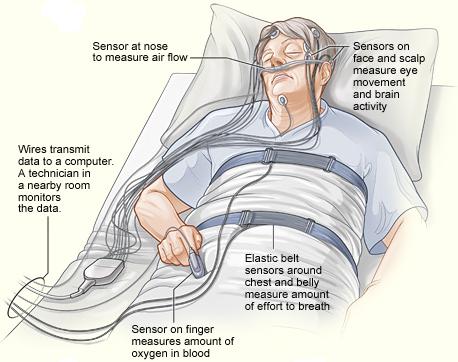
Polysomnography, the standard diagnostic tool used in these laboratories, simultaneously records brain waves, eye movements, muscle activity, heart rate, breathing patterns, and blood oxygen levels throughout the night.
speaker_2NARRATOR
A typical session generates thousands of pages of data, which a trained technologist must score and interpret.
speaker_2NARRATOR
Narcolepsy, a neurological disorder that causes sudden and uncontrollable episodes, is associated with an unusual pattern of REM.

Cathy GoldsteinHOST
It is incredibly sedating, incredibly.
Cathy GoldsteinHOST
I mean, have you ever looked at PSG data when somebody's on Seroquel? They're having apneas, no arousals.
Cathy GoldsteinHOST
They're sleeping through everything.
Cathy GoldsteinHOST
They're like 30% N3.
speaker_2HOST
Laboratories are used to diagnose a wide range of disorders, including insomnia, apnea, narcolepsy, and restless leg syndrome.
speaker_2HOST
Polysomnography, the standard diagnostic tool used in these laboratories, simultaneously records brain waves, eye movements, muscle activity, heart rate, breathing patterns, and blood oxygen levels throughout the night.
speaker_2HOST
A typical session generates thousands of pages of data, which a trained technologist must score and interpret.
speaker_2HOST
Narcolepsy, a neurological disorder that causes sudden and uncontrollable episodes, is associated with an unusual pattern of REM.

Gordon SmithHOST
Is it a common thing in your practice, or do you rely on clinical phenomenology in a, you know, polysomnogram with multiple sleep latency testing to confirm a diagnosis of narcolepsy?
Margaret Kay-StaceyGUEST
Most commonly, you're gonna still do the PSG and the MSLT, obviously, because it's less invasive than doing the lumbar puncture.
Margaret Kay-StaceyGUEST
There are scenarios, right, where you may consider doing the LP.
Margaret Kay-StaceyGUEST
I think if someone has cataplexy, and you're pretty confident in that, and they have a positive PSG, MSLT testing done, you know, you really don't need the lumbar puncture, right? But if you're in that gray area that for whatever reason you have a really high suspicion they have narcolepsy, but for whatever reason the PSG, MSLT either couldn't be done or it was inconclusive, then I might think about doing the lumbar puncture.
Margaret Kay-StaceyGUEST
The other scenario is that there are some patients who have to be on REM-suppressing medications, like antidepressants, for example.
Margaret Kay-StaceyGUEST
In those patients, it can confound the results.
Margaret Kay-StaceyGUEST
And so if you're not able to stop those for the MSLT testing, then that would be a scenario where I might use the lumbar puncture.
Margaret Kay-StaceyGUEST
Insurance is another reason that, again, if you have some of that inconclusive findings on the PSG, MSLT, that doing the lumbar puncture then can help to confirm the diagnosis, but only useful for type one narcolepsy, not type two.