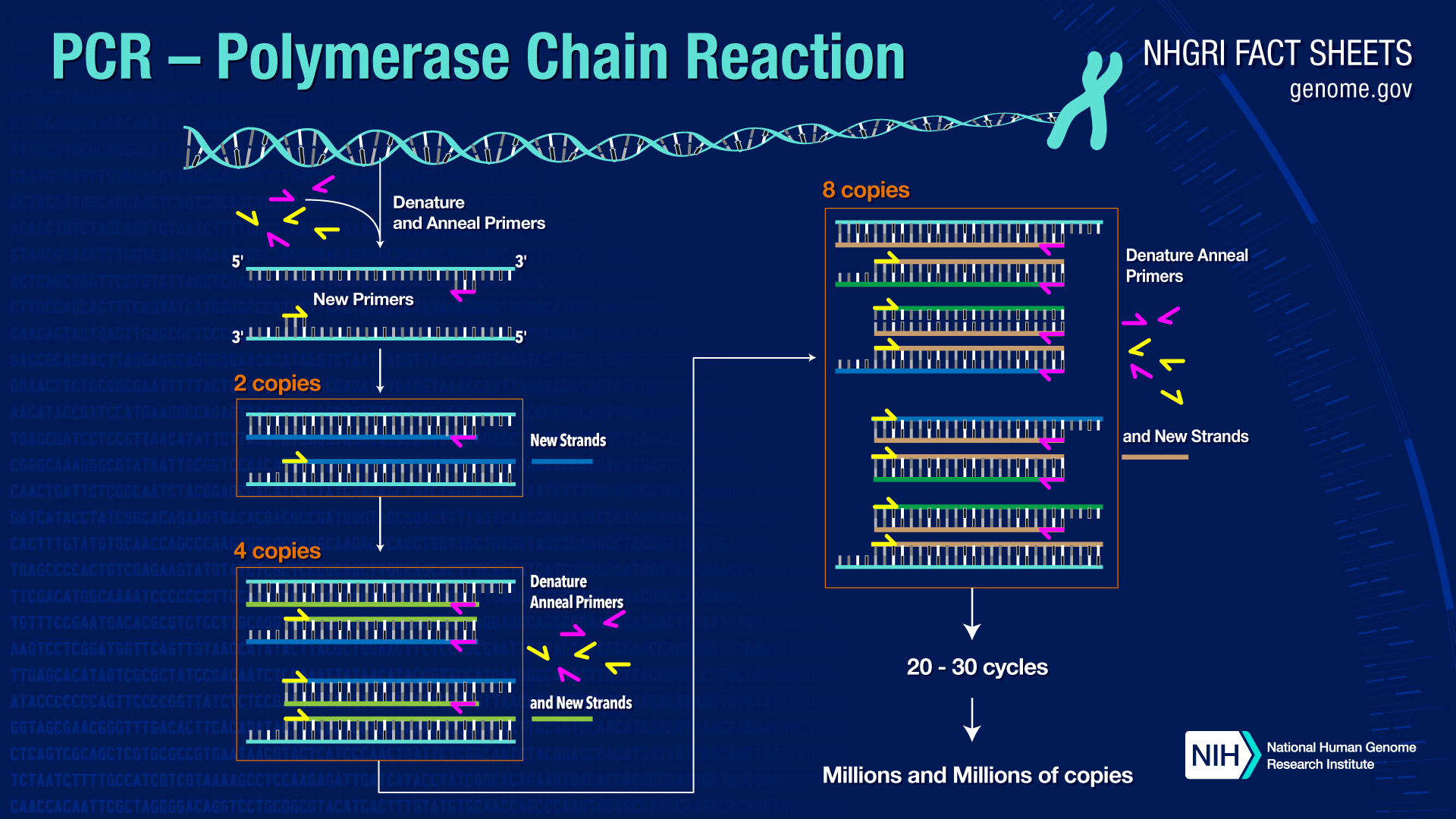
Polymerase chain reaction
Diagnostic testWikipedia
850
MENTIONS
315
EPISODES
263
PODCASTS
Search complete. 850 mentions across 315 episodes found for "Polymerase chain reaction".
Oct 27, 2026

Liz MeriwetherGUEST
Oh my gosh.
Liz HannahGUEST
We were PCR testing every single day until two weeks after Thanksgiving.
Liz HannahGUEST
And then we were PCR testing three days a week.
Liz HannahGUEST
And then we got hit by Omicron two days before we wrapped.
Liz HannahGUEST
And I turned to Dan Minahan, the director, and I was like, Dan, I have to leave.

Belinda SmithHOST
Nobody knew that Barooli Elsa was lurking here.
Belinda SmithHOST
But it's good timing in some ways, because just a few years earlier, something called a PCR test had been invented.
Belinda SmithHOST
You will remember this as the method used to rapidly diagnose COVID cases in the pandemic.
Belinda SmithHOST
But in the 90s, this was revolutionary technology.
Paul JohnsonGUEST
It was really only invented in about 1984, 85.
Paul JohnsonGUEST
We were kind of the first people to think that maybe we could use PCR for diagnosis because otherwise you need a biopsy and it's very slow to culture.
Paul JohnsonGUEST
So it was a much more rapid way of making a diagnosis.
Paul JohnsonGUEST
But also we could look in the environment with PCR because People had been looking in the environment for mycobacterium ulcerans in Africa for years, never found it by culture.

Ashley HowardGUEST
Earlier maternal infection, particularly around conception and during the first trimester, is associated with the greatest risk of severe fetal injury and long-term sequelae.
Ashley HowardGUEST
So moving to the diagnosis of congenital CMV, congenital CMV has to be confirmed within the first 21 days of life, ideally with urine PCR.
Ashley HowardGUEST
And saliva PCR is not used for confirmation because it can lead to false positives due to breastfeeding.
Ashley HowardGUEST
Why 21 days? After birth, infants can acquire CMV, most commonly through breast milk.
Ashley HowardGUEST
There is an incubation period before postnatally or after birth acquired virus replicates and begins to shed.
Ashley HowardGUEST
So a positive PCR obtained within the first three weeks reflects infection acquired in utero.
Ashley HowardGUEST
Once we test beyond that window, a positive result may represent either congenital or postnatally acquired infection and we can no longer reliably distinguish between the two.
Ashley HowardGUEST
So how common is CMV? CMV is far more common than most people realize.

Jill CarnahanGUEST
So let's talk about what to do.
Jill CarnahanGUEST
So the very basics, if you're looking for a home or if you're in a home and you're like, is it safe? Is my office safe? I always recommend patients start with an ERMI, E-R-M-I, which is also known as QPCR.
Jill CarnahanGUEST
That means qualitative PCR.
Jill CarnahanGUEST
It's a dust sample.
Eric BermanHOST
What do you do?
Jill CarnahanGUEST
Okay.
Jill CarnahanGUEST
So Ermey start QPCR.
Jill CarnahanGUEST
You can get that online.

Andrea MoreGUEST
It's hurting you.
Sean ClementsHOST
I'm going PCR up there.
Sean ClementsHOST
That's some of Hayes' comedies.
Sean ClementsHOST
He's like, it was really uncomfortable when they had all the COVID testing going on and he had to pretend to also be uncomfortable with it.

Robert StackNARRATOR
Police suspected the red spots on Sabo Claw's right sleeve came from the victim's dog, Chief.
Robert StackNARRATOR
Dr. Halverson cut out a piece of the sleeve with the red stains on it and analyzed it with a PCR-based DNA test.
Joy HalversonSOUNDBITE_SPEAKER
A little piece of that fabric is taken and put into a tube, and various buffers and so on are added to it.
Joy HalversonSOUNDBITE_SPEAKER
Blood cells will come off the fabric into the liquid, and then the various treatments are done to extract the DNA from that.

Michel ToledanoGUEST
And she was started initially on an empiric treatment with intravenous eftraxone, vancomycin, and acyclovir.
Michel ToledanoGUEST
Her CSF JC virus PCR eventually came back negative.
Michel ToledanoGUEST
She had serum and CSF autoimmune encephalitis panels, which were negative.
Michel ToledanoGUEST
But her CSF meningitis encephalitis panel was although it showed a negative enterovirus that come back positive for HHV-6.
Michel ToledanoGUEST
And this seemed like a very unlikely result.
Zohaib SiddiqiHOST
So then why the positive CSF?
Michel ToledanoGUEST
We normally test for HHV-6 using nucleic acid amplification tests, and you can do that with a standalone PCR, or the HHV-6 is included in the multiplex meningitis encephalitis panel.
Michel ToledanoGUEST
In this patient, the CSF panel detected HHV-6 DNA, but we always have to be really careful when we're interpreting this, especially in a patient in whom epidemiologically we would not suspect for them to have this disease.

Alan WattSOUNDBITE_SPEAKER
It's a coronavirus.
Alan WattSOUNDBITE_SPEAKER
And the PCR tests detect these things as well.
Alan WattSOUNDBITE_SPEAKER
They detect fragments of coronaviruses.
Alan WattSOUNDBITE_SPEAKER
Fragments, not viruses, but fragments of what could have been coronaviruses.

speaker_0NARRATOR
239.
speaker_0NARRATOR
Pooled Adaptive PCR Testing This article proposes adaptive pool testing which involves testing a combined sample from multiple people as a methodology to increase testing capacity for SARS-CoV-2 using PCR.
speaker_0NARRATOR
Pool tests involve that if a pool is detected positive, each sample from the pool will be tested separately.
speaker_0NARRATOR
Also, this article proposes an optimization algorithm for the pool size determine the optimum number of samples that can be combined into a single test in order to obtain the best results with minimum number of tests.

Jarrod CooperGUEST
It's a totally different stool test.
Jarrod CooperGUEST
All that's going to do is be looking for it's a PCR and that's just – looking for parasites basically so as opposed to running an advanced stool test like a dna-based stool test really maps what's going on in the gut you get key gut functional markers as well so say calprotectin for inflammation it's pancreatic elastase to make sure you're breaking down your food and digesting it properly uh there's beta-glucuronidase which is a detox marker which can get um when it's high can get impaired so you're not detoxing through your gut properly You're starting to recycle those toxins and hormones and things, which can lead to in females, estrogen dominance and other issues.
Jarrod CooperGUEST
It's that high beta glucuronidase, um, Yeah, and then there's a range of other markers that looks at the function of the gut and how well that's performing.
Jarrod CooperGUEST
You've got your zonulin, which is your leaky gut mark.
305 more episodes mention Polymerase chain reaction.
Create an account to see the whole feed, search across every transcript, and follow the entities you care about.