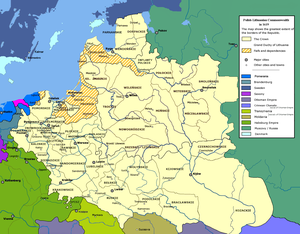
Polish–Lithuanian Commonwealth
StateWikipedia
67
MENTIONS
38
EPISODES
33
PODCASTS
Search complete. 67 mentions across 38 episodes found for "Polish–Lithuanian Commonwealth".
Nov 2, 2026

Philip PilkingtonGUEST
know.
Philip PilkingtonGUEST
It's not happening, and they're not going to have the Polish-Lithuanian Commonwealth, but they might get Lvov if they're lucky.
Philip PilkingtonGUEST
If they're really nice to the bad man and the Kremlin, though.
Philip PilkingtonGUEST
And they know that, by the way.

speaker_0NARRATOR
The victors established the Holy League in March 1684.
speaker_0NARRATOR
Its members, the Habsburg monarchy, the Polish-Lithuanian Commonwealth, and the Republic of Venice, agreed to drive the Ottomans from Europe entirely.
speaker_0NARRATOR
That same year they led an assault against Buda, a city that had been under Ottoman rule for 145 years.
speaker_0NARRATOR
The siege ended in failure, and after nearly four months, the Holy League had to withdraw, suffering heavy losses.

Matthew Raphael JohnsonGUEST
There was something called the trilateralist solution to Ukrainian independence.
Matthew Raphael JohnsonGUEST
The Polish Empire was formerly called the Polish-Lithuanian Commonwealth.
Matthew Raphael JohnsonGUEST
Well, what people like Vyhovsky wanted was Polish-Lithuanian-Russian union with a great degree of independence and religious freedom as far as the Russian side was concerned.
Matthew Raphael JohnsonGUEST
And this eventually became the Treaty of Pereslav.

Paul BavillHOST
So if we compare that to the democracy that's present in the United Kingdom that they've just broken away from, you know, I would say possibly, you know, between 1770 and 1820, there's not a huge amount of what we would consider democracy in the UK either.
Paul BavillHOST
In fact, democracy across the world is, even the Polish-Lithuanian Commonwealth haven't gone that far yet.
Paul BavillHOST
You know, is there much, you know, have they just kind of decided on democracy, but actually wouldn't, it would never have occurred to them to put in something that we might recognize today?
Jackson Van UdenGUEST
See, here's the point, Paul.

Ryan McMakenNARRATOR
Poland is a heaven for the nobility, purgatory for the burghers, and hell for the peasants.
Ryan McMakenNARRATOR
An idiom during the Polish-Lithuanian Commonwealth While the idiom itself has come under a lot of scrutiny as of late, as the original was made at a time when tensions between Poles and Jews were high and are still high, thanks to Warsaw's attempt to censor research into Polish collaboration and responsibility during the Holocaust, It expressed a common grievance against the Polish-Lithuanian politics and economy at the time, which was marked with punitive serfdom, constant noble infighting, and extreme opposition towards merchant-run towns and urbanization.
Ryan McMakenNARRATOR
It is a stark contrast to the Polish and, to some extent, modern Western narrative of the Commonwealth, as a time of great development and tolerance, which contrasted itself against the many principalities and kingdoms in Europe that were expelling Jews.
Ryan McMakenNARRATOR
That mythologized legacy is also used to portray modern Poland as a bastion of sensibility amidst the ongoing immigration crises and leftist radicalization in the West, without the baggage of association with whatever is more right-wing than standard pro-deportation rhetoric.
Ryan McMakenNARRATOR
the Polish landowning military nobility, as the towns were undercutting export revenues by providing a source of unhindered competition.
Ryan McMakenNARRATOR
Decrees, privileges and statues prohibited landownership, forbade town dwellers from earning a profit of over 7% per annum, stripped them of representative rights in the Sejum imposed movement restrictions on the peasantry and allowing only one member of each peasant family to move to the towns to destroy any chance of urbanization.
Ryan McMakenNARRATOR
The Slachta was able to impose such punitive restrictions came from the political and territorial configuration of the Polish-Lithuanian Commonwealth.
Ryan McMakenNARRATOR
as the consolidation of the Commonwealth began when Poland was a kingdom under dynasties through incorporation of other Eastern noble families and principalities before the creation of the noble Republican Commonwealth.

RobertoHOST
But it's his son who becomes king.
RobertoHOST
And then he gets taken over by the Polish-Lithuanian Commonwealth.
AuroraHOST
I also like to think of this, Greg, as the how many churches did he build index.
AuroraHOST
Because that's often one of the only indicators early on for what cultural things did they leave behind.

Chris HaslerHOST
However, the Ottomans had certainly not abandoned their territorial ambitions.
Chris HaslerHOST
John III Sobieski To the north of the Ottoman Empire in the 17th century was the Polish-Lithuanian Commonwealth, a superstate which dominated Eastern Europe for centuries.
Chris HaslerHOST
John Sobieski was born in 1629 into the Polish-Lithuanian nobility at Olesko Castle, which is now in the modern country of Ukraine.
Chris HaslerHOST
As a member of a noble family, John was afforded the best education at the Jagiellonian University in the city of Krakow, where he studied languages, mathematics and military science.
Chris HaslerHOST
Further education saw him travel through France, Germany and the Netherlands when he studied military systems.
Chris HaslerHOST
A Cossack-led revolt called the Khmelnytsky Uprising against the Polish-Lithuanian Commonwealth occurred in 1648 which enabled Sobieski to gain valuable military experience.
Chris HaslerHOST
The uprising was led by Bohdan Khmelnytsky who sought Russian protection and the Russians agreed and went to war with the Commonwealth from 1654.
Chris HaslerHOST
In 1655, Sweden invaded the Polish-Lithuanian Commonwealth in something that has been named the Deluge, a series of conflicts which lasted until 1660.

Eugene FinkelGUEST
Thanks for having me, John.
Eugene FinkelGUEST
Who Bogdan Chmielnicki is? Essentially, his story begins in early 17th century when the area that we now know as Ukraine is a part of Polish-Lithuanian Commonwealth.
Eugene FinkelGUEST
He is a local nobleman an Orthodox Christian, which makes him very different from the majority of the Polish nobility who are Catholic, who grows up in Ukraine, serves in the Polish army and then starts a rebellion of people like him or people who we now know as Ukrainians against Poland.
Eugene FinkelGUEST
He wants to go his own way.

Matthias StrohnHOST
Um, you can go to Cleves, so going close to the modern day, uh, Dutch border.
Matthias StrohnHOST
So all over the place, but it's really the Brandenburg area and, um, and the Prussia bit, which are not connected at the time because in between, what later on becomes known as West Prussia, that is controlled by the Polish-Lithuanian Commonwealth.
Matthias StrohnHOST
You can see the whole map is really confusing.
Matthias StrohnHOST
I can't talk you through all the details here.

Darryl CooperGUEST
I mean, depending on where you were in Europe and what time you're talking about, I mean, they could execute their own members for religious laws, you know.
Darryl CooperGUEST
And like in the Polish-Lithuanian Commonwealth, the... local authorities would sometimes enforce those rules for them.
Darryl CooperGUEST
They would go arrest Jews who the rabbis, you know, request to be arrested and they would bring them in for punishment, corporal or otherwise.
Darryl CooperGUEST
And so when you have that and all of a sudden, you know, you have a series of revolutions and this nationalist idea that everybody is an equal citizen, the rule of law and stuff, but you still have this group of people.
28 more episodes mention Polish–Lithuanian Commonwealth.
Create an account to see the whole feed, search across every transcript, and follow the entities you care about.