Pliocene
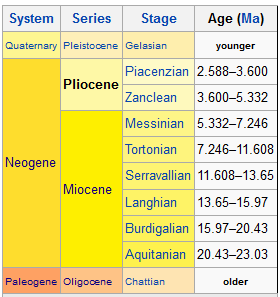
Geologic time scaleWikipedia
32
MENTIONS
19
EPISODES
17
PODCASTS
Search complete. 32 mentions across 19 episodes found for "Pliocene".
Nov 26, 2026

Dave BorlaceHOST
And those greenhouse gas emissions that we're constantly being told we need to start rapidly reducing? Well, they just keep going up as well.
Dave BorlaceHOST
In April 2025, atmospheric CO2 concentrations hit 430 parts per million, a level not seen on this planet since the Pliocene era about 3 million years ago, when we humans weren't around to witness it.
Dave BorlaceHOST
Anyway, back to our friends at JPMorgan Chase.
Dave BorlaceHOST
They help us understand one of the impacts of a changing climate with this little graphic showing how the probability of heat waves shifts with rising temperatures.

Julie MeachenGUEST
Right.
Julie MeachenGUEST
It's in a time called the Pliocene.
Julie MeachenGUEST
And so cats get to South America then.
speaker_0HOST
And that must have been the happy time because they show up and some of the biggest predators in South America are these giant predatory ground birds.

speaker_5SOUNDBITE_SPEAKER
On to our great guests.
speaker_5SOUNDBITE_SPEAKER
That level of one degree warmer than today is the absolute maximum that we should allow human-made effects to change the planet because otherwise we will be approaching the temperatures that existed in the middle Pliocene three million years ago when it was a very different planet.
speaker_5SOUNDBITE_SPEAKER
Radio Ecoshock
Alex SmithHOST
Why is the weather so violently strange? Is global warming accelerating? Could we crash into a new climate state? In the thick of these questions we find Dr.

speaker_5NARRATOR
For two millions, some hold even three millions, of years, man lived and moved and had his being in a world very different from that upon which we look out.
speaker_5NARRATOR
there appear indeed to have been various types of man some as different from us as we are from the anthropoid apes what upstarts of yesterday are the pharaohs in comparison with the men who survived the tragedy of the glacial period The ancient history of man, only now beginning to be studied, dates from the Pliocene or Miocene period.
speaker_5NARRATOR
The modern history as we know it embraces that brief space of time that has elapsed since the earliest Egyptian and Babylonian records were made.
speaker_5NARRATOR
This has to be borne in mind in connection with the present mental status of man, particularly in his outlook upon nature.

DKHOST
It's very specifically the Bluff Downs Fossil Site, which is located on the station.
DKHOST
This is a Pliocene archaeological site that has revealed some incredible fossil findings that I want to share with all of you lovely people.
DKHOST
So let's sit back and enjoy this week's installment of the Two Ticks Fossil Talk on pluff.com. And then I probably will come back to this specific location in the future.
DKHOST
But this week, we're going to very specifically focus on a fossil.
DKHOST
I'm sure the station itself is quite interesting in its own way, but it is private property and it's more what's on the station that we care about, very specifically the Bluff Downs Fossil Site, which... which is located on the station.
DKHOST
This is a Pliocene archaeological site that has revealed some incredible fossil findings that I want to share with all of you lovely people.
DKHOST
So, let's sit back and enjoy this week's installment of the Two Ticks Fossil Talk on Bluff Downs.
DKHOST
And then I probably will come back to this specific location in the future.
DKHOST
So Megalania is a scientific name.
DKHOST
Varanus priscus is an extinct, thankfully, species of giant monitor lizard.
DKHOST
It's a member of the megafauna ensemble that happened to inhabit Australia during the Plasticine era.
DKHOST
Sorry.

PeterNARRATOR
Quais seriam essas características? Antes de falarmos sobre o Meg 2.0, vamos ver o megalodon em seu auge.
PeterNARRATOR
Vamos voltar vinte e três milhões de anos atrás, nas épocas Miocena e Pliocena.
PeterNARRATOR
O megalodon dominava os oceanos, medindo aproximadamente dezoito metros.
PeterNARRATOR
Isso é três vezes o tamanho do maior tubarão branco que já conhecemos.

Simon MitchellGUEST
There are eruptions that continue going.
Simon MitchellGUEST
So the last, some of the last zircons in some of these deposits are Pliocene.
Simon MitchellGUEST
So it does seem that there have been large eruptions that have actually added material, even going up into the Pliocene.
Bridget ScanlonHOST
Right, right.
Bridget ScanlonHOST
And that asphalt source, might that explain why we have high levels of critical minerals and rare earths in these box sites? Do you think that might be linked to the source from the ash?

Juan NaulaNARRATOR
And to be fair, who can blame them when there are serpents like the 30-foot-long and 550-pound green anaconda out there? However, things could be a whole lot worse for those that get the snake shakes.
Juan NaulaNARRATOR
You see, back around 60 million years ago during the Pliocene period, the world was home to the biggest species of snake ever discovered, the Titanoboa.
Juan NaulaNARRATOR
From the name, I bet you're thinking of a snake that can rear itself up above the tree line or that could take up the width of an entire road.
Juan NaulaNARRATOR
and you're not far off.
8 MINS LATER
Juan NaulaNARRATOR
Megalodon We're actually staying underwater for now because this next colossal critter is so sizable, it'd have made even the Leetsik these nervous.
Juan NaulaNARRATOR
While the Meg was a fictitious action film about a gigantic shark, the Megalodon itself was a real shark.
Juan NaulaNARRATOR
In fact, it was the largest shark to have ever existed and one of the largest fish in the world which terrorized the oceans during the Miocene and Pliocene period approximately 20 to 3.6 million years ago.
Juan NaulaNARRATOR
Now, exactly how big it could grow is up to debate, with all estimates based on tooth size, the largest verified specimen of which is a colossal 7.48 inches long.

Ken HudnallHOST
which was heard on a tape the night of the discovery.
Ken HudnallHOST
Ruthie was a three-and-a-half-foot-tall biped, initially considered merely another Australopithecus africanus, a previously known hominid from the late Pliocene epoch.
Ken HudnallHOST
Sometime later, following other finds, she was recognized as a separate species.
Ken HudnallHOST
In the months following her discovery, Johansson's team found prehistoric hominid teeth and bones from at least 13 individuals.
9 more episodes mention Pliocene.
Create an account to see the whole feed, search across every transcript, and follow the entities you care about.