Plesiosaur
ReptileWikipedia
20
MENTIONS
9
EPISODES
9
PODCASTS
Search complete. 20 mentions across 9 episodes found for "Plesiosaur".
Nov 1, 2026

TimHOST
So, yeah, maybe it's a big brontosaurus thing or whatever Nessie is.
TimHOST
Plesiosaurus.
TomHOST
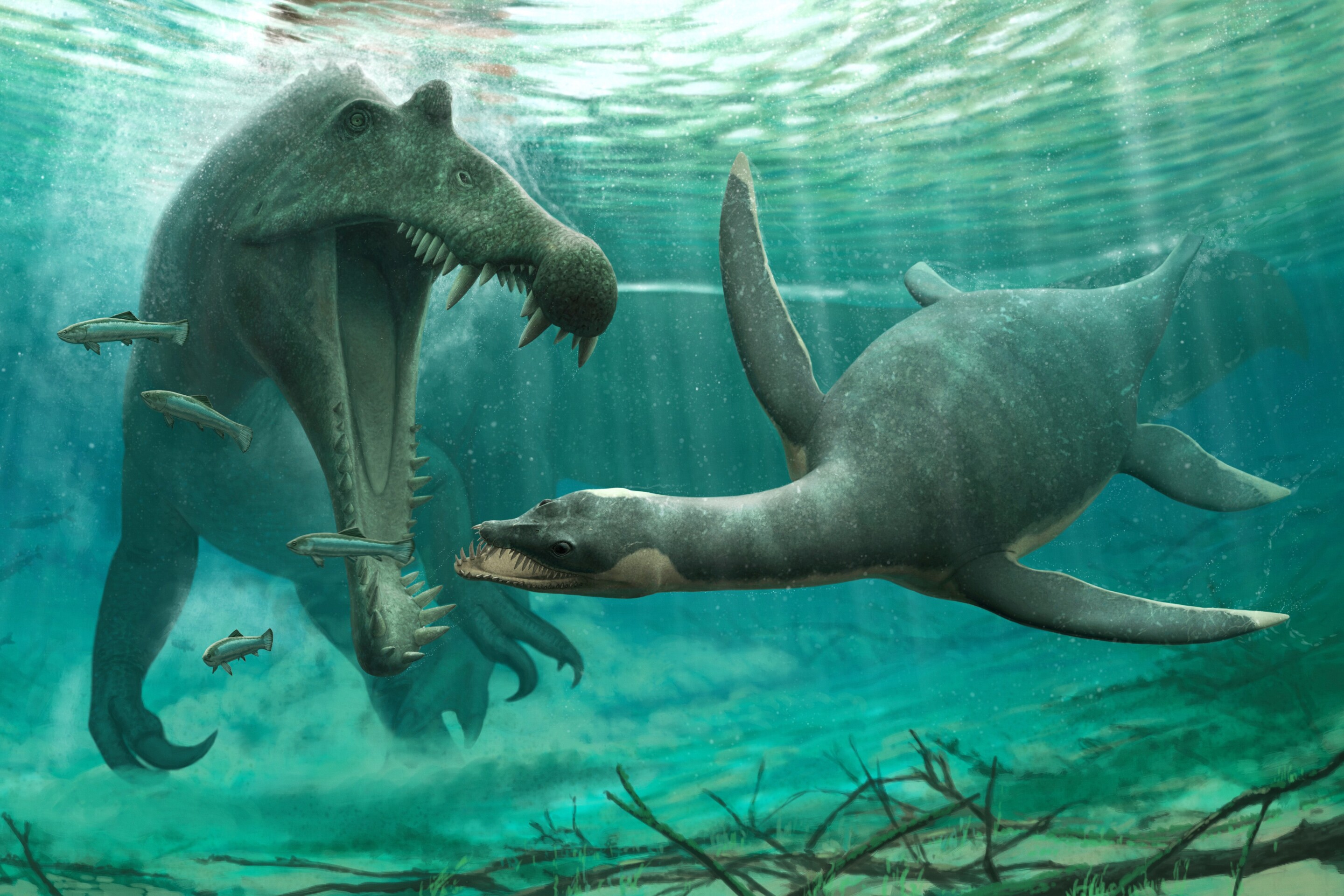
Plesiosaur is what people think, which is like a long neck.
TomHOST
It's a brontosaurus with flippers instead of legs.

Hayley SproullHOST
But sort of like a seal body.
FletchHOST
Okay.
Hayley SproullHOST
Plesiosaurs.
Hayley SproullHOST
The reason I'm talking about plesiosaurs is that there were some oil crulls drilling, disgusting, off the coast of Norway looking for oil.
Hayley SproullHOST
And they pulled something up and they were like, what is this? Couldn't figure it out.

Dirk KnaustGUEST
And at the end we, uh, just concluded must be a kind of marine reptile very close to plesiosauria and most likely a family or members of a family of the plesiosaurs.
Bob McDonaldHOST
plesiosaurs.So what did the contents of the vomit tell you about the lifestyle of the plesiosaur?
Dirk KnaustGUEST
We know quite a lot about plesiosaur from the anatomic construction, from the skeletons and so on, but not too much about the diet, what they eat.
Dirk KnaustGUEST
And this plesiosaur vomit, we have much more insight into the diet and the food web of, of those animals and, uh, what they digested.

David WalesNARRATOR
Thus in the coal formations we find the trunks of palms standing upright amid conifers, tree ferns, vaniatites, and fishes having rhomboidal osseous scales.
David WalesNARRATOR
In the Jura limestone, colossal skeletons of crocodiles, plesiosauri, planulites, and stems of the cicadee.
David WalesNARRATOR
In the chalk formations, small polythalamia and bryozoa, whose species still exist in our seas.
David WalesNARRATOR
In Tripoli, or polishing slate, in the semi-opal and the farina-like opal, or mountain meal, agglomerations of siliceous infusoria which have been brought to light by the powerful microscope of Ehrenberg.

Bill BoerstNARRATOR
Thus in the coal formations we find the trunks of palms standing upright amid conifers, tree ferns, goniotites, and fishes having rhomboidal osseous scales.
Bill BoerstNARRATOR
In the Jura limestone, colossal skeletons of crocodiles, plesiosauri, planulites, and stems of the ciccidae.
Bill BoerstNARRATOR
In the chalk formations, small polythalamia and bryozoa, whose species still exist in our seas.
Bill BoerstNARRATOR
In Tripoli, or polishing slate, in the semi-opal and the farina-like opal, or mountain meal, agglomerations of siliceous infusoria which have been brought to light by the powerful microscope of Ehrenberg.

Jay CloneHOST
Who knows?
Mr. EHOST
Plesiosaur.
Jay CloneHOST
Oh, my goodness.
Mr. EHOST
Well, no, but so from his, he, that, there's a spinal cord-
Mr. EHOST
Initially, the scientists at the Science Museum of Tokyo unanimously declared the creature was a...
Jay CloneHOST
Who knows?
Mr. EHOST
Plesiosaur.
Jay CloneHOST
Okay, so they just declared it?

David WalesNARRATOR
Thus, in the coal formations, we find the trunks of palms standing upright amid conifers, tree ferns, goniatites, and fishes having rhomboidal osseous scales.
David WalesNARRATOR
In the Jura limestone, colossal skeletons of crocodiles, plesiosauri, planulites, and stems of the siccidae.
David WalesNARRATOR
In the chalk formations, small polythalamia and bryozoa, whose species still exist in our seas.
David WalesNARRATOR
In Tripoli, or polishing slate, in the semi-opal and the farina-like opal, or mountain meal, agglomerations of siliceous infusoria which have been brought to light by the powerful microscope of Ehrenberg.

Steve BrusatteGUEST
They are.
Steve BrusatteGUEST
So when that asteroid knocked off T-Rex and Triceratops and the Pterodactyls on land, it also knocked off the big reptiles in the ocean, the Mosasaurs, the Plesiosaurs.
Steve BrusatteGUEST
And this is for similar reasons as to what happened on land.
Steve BrusatteGUEST
The Earth went dark and cold.
Steve BrusatteGUEST
So that crashed as well.
Steve BrusatteGUEST
So you had profound extinctions in the ocean as on land.
Steve BrusatteGUEST
And when these Mosasaurs and Plesiosaurs went extinct, and by the way, we have fossils of Plesiosaurs, particular from New Zealand.
Steve BrusatteGUEST
I mean, we know they were living in the south right to the very end of the Cretaceous, right before the asteroid hit.

David WalesNARRATOR
Thus in the coal formations we find the trunks of palms standing upright amid conifers, tree ferns, goniatites, and fishes having rhomboidal osseous scales.
David WalesNARRATOR
In the Jura limestone, colossal skeletons of crocodiles, plesiosauri, planulites, and stems of the cycadi.
David WalesNARRATOR
In the chalk formations, small polythalamia and bryozoa, whose species still exist in our seas.
David WalesNARRATOR
In Tripoli, or polishing slate, in the semi-opal and the farina-like opal, or mountain meal, agglomerations of siliceous infusoria which have been brought to light by the powerful microscope of Ehrenberg.