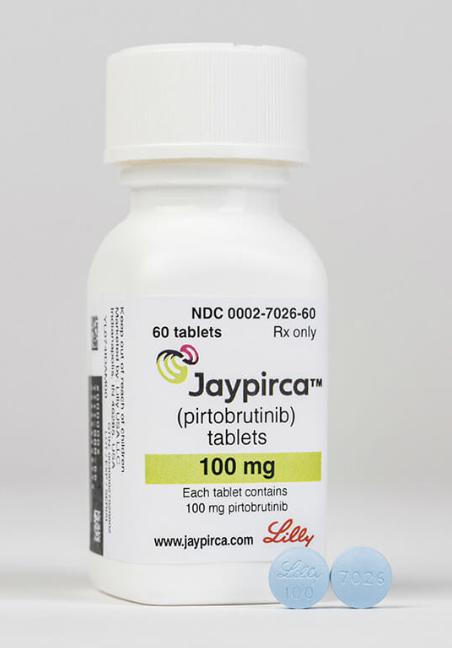
Pirtobrutinib
MedicationWikipedia
48
MENTIONS
4
EPISODES
3
PODCASTS
Search complete. 48 mentions across 4 episodes found for "Pirtobrutinib".
Oct 16, 2026

Paolo GhiaGUEST
Indeed, the, uh, the update of the guidelines are typically driven by practical issues, and the issue this time was the recent approval of two different combination of regimens.
Paolo GhiaGUEST
One is the combination of acalabrutinib plus venetoclax plus, minus obinutuzumab, and the other one is the, uh, in frontline treatment, and the other one is the approval of pirtobrutinib, a non-covalent BTK inhibitor, in the relapse refractory setting, in particular in post BTKi-treated patients.
Paolo GhiaGUEST
Other reason is that really we wanted to change the entire setting of the, of the guidance, and in fact, we involved for the first time patients, patients' advocates, that are in- indeed listed among the authors and participated in the drafting and writing of the guidance, so really to give a patient-centric perspec- perspective of the new guideline.
Isabel Olivera-MartínezHOST
So CLL is biologically very heterogeneous.
Barbara EichhorstGUEST
Yeah.
Barbara EichhorstGUEST
So, um, in the relapse setting, we have these different scenarios depending on the prior treatment, pre-exposures of the patients.
Barbara EichhorstGUEST
And patients being pre-exposed to covalent BTK inhibitors, there we differentiate if patients are progressing while being on the covalent BTK inhibitor, so becoming really refractory to these, um, agents, like the three different covalent BTK inhibitors which are approved, which means if you want to stay, uh, want to give an additional treatment, either you switch to venetoclax plus rituximab, or you switch to pirtobrutinib, first non-covalent BTK inhibitor approved in that indication.
Barbara EichhorstGUEST
In case patients stop the continuous c- covalent BTK inhibitor due to toxicities and may have some in-treatment free interval, for example, in this scenario, patients, uh, have a relapse again.

Neil LoveHOST
I met with Dr. Catherine Kuhns from UCI Health in Orange County, California, for two five-minute journal clubs featuring recent select related key presentations and publications, all of which you'll find as a link in the program notes.
Neil LoveHOST
In part one of this program, we focused on treatment approaches for treatment-naive CLL, and in part two, we started off our conversation on the management of previously treated CLL by discussing the Bruin CLL-322 trial of fixed-duration pirtobrutinib combined with venetoclax rituximab.
Neil LoveHOST
So let's talk about a study that was actually just presented at the EHA meeting.
Neil LoveHOST
To me, this seems like one of the most interesting, uh, CLL papers in the last year or so, uh, the Bruin CLL-322 study.
Catherine C CoombsGUEST
But, uh, these were post-chemo patients, so only about 2% of the treated patients with VenR in that trial had prior BTK inhibitor, meaning like 98% had something else, most typically chemoimmunotherapy and one median prior line of therapy.
Catherine C CoombsGUEST
And that makes VenR look like a great treatment, but we never really knew how well it was gonna perform in a post-covalent BTK setting aside from, you know, real-world data that support that it works, but we hadn't seen that prospectively.
Catherine C CoombsGUEST
So with that background, this trial compared standard of care VenR, it's two years of venetoclax, um, six cycles of rituximab, to, uh, the triplet regimen of pirtobrutinib, uh, with VenR.
Catherine C CoombsGUEST
Uh, the pirto is done as a lead-in with the rituximab, and then the venetoclax is added after, uh, I think three cycles, and it's also, uh, for two years of the doublet, um, oral doublet.
Catherine C CoombsGUEST
Uh, this is the preferred NCCN regimen for using Ven in that relapse setting, largely based on extrapolation from a frontline trial, the CLL thirteen trial that showed VenO is superior to VenRetux, albeit in the front- frontline setting.
Catherine C CoombsGUEST
So what do we know about other options? Well, there's actually a great wealth of data looking at Pirtobrutinib in that post-covalent BTKI setting, and so there's good rationale for this.
Catherine C CoombsGUEST
We know Pirtobrutinib is a non-covalent BTK inhibitor, and it doesn't directly interact with the C481 residue, so it can inhibit this important target, BTK, both in the setting of wild-type protein but also the most commonly acquired resistance mechanism, which is a C481S mutation.
Catherine C CoombsGUEST
And so it was first studied in the phase one-two Bruin trial that showed, uh, I would say excellent PFS in a very heavily pretreated population, about four prior lines of therapy.
Catherine C CoombsGUEST
And, uh, the drug tends to work a little longer if someone's naive to venetoclax, where the PFS is twenty-three months.
Catherine C CoombsGUEST
And infections can be reported, and it's always hard to know, is it the drug or is it the underlying patient population who are very immunosuppressed? This trial specifically with CLL patients with three median prior lines of therapy and exclusively, uh, treated with covalent BTK inhibitor at a minimum, but most patients had, you know, other things as well.
Catherine C CoombsGUEST
Uh, so yeah, I'm very excited, uh, to share these results [laughs] that, uh, Dr. David's very, uh, uh, beautifully presented at, uh, in Stockholm at EHA last, uh, June or in June, uh, Bruin CLL three two two trial.
Catherine C CoombsGUEST
So what this did is it compared standard of care VenR to the triplet regimen that includes Pirtobrutinib with VenR.

Jacob SoumeraiGUEST
Now, what if we, uh, uh, we've l- seen some data from the AVO triplet thus far.
Jacob SoumeraiGUEST
What if we, uh, instead, uh, study the non-covalent BTK inhibitor b- uh, uh, pirtobrutinib in combination with venetoclax obinutuzumab in the frontline setting? This is a study that's been led, uh, here at the MD Anderson, and 80 patients were enrolled in this study.
Jacob SoumeraiGUEST
This is an appealing strategy given the potential to incorporate pirtobrutinib into an earlier line of therapy as a time-limited option to potentially overcome some concerns about sequencing this prior to a covalent inhibitor.
Jacob SoumeraiGUEST
In this study, uh, at the end of, uh, cycle, uh, 13 or one year of treatment, the UMRD4 and UMRD6 rates in the blood were 100% and 86% respectively.
Jacob SoumeraiGUEST
And in the bone marrow were 96% and 74% respectively.
Jacob SoumeraiGUEST
They did see relatively high rates of grades III, IV, uh, cytopenias, including neutropenia in 67% of patients.
Jacob SoumeraiGUEST
Uh, although this translated only to relatively few incidents of neutropenic fever, just 5% of patients.
Jacob SoumeraiGUEST
And they did observe, uh, a, a fair bit of dose reductions of the venetoclax and pirtobrutinib, but overall, patients were able to, to remain on therapy and tolerated treatment quite well.