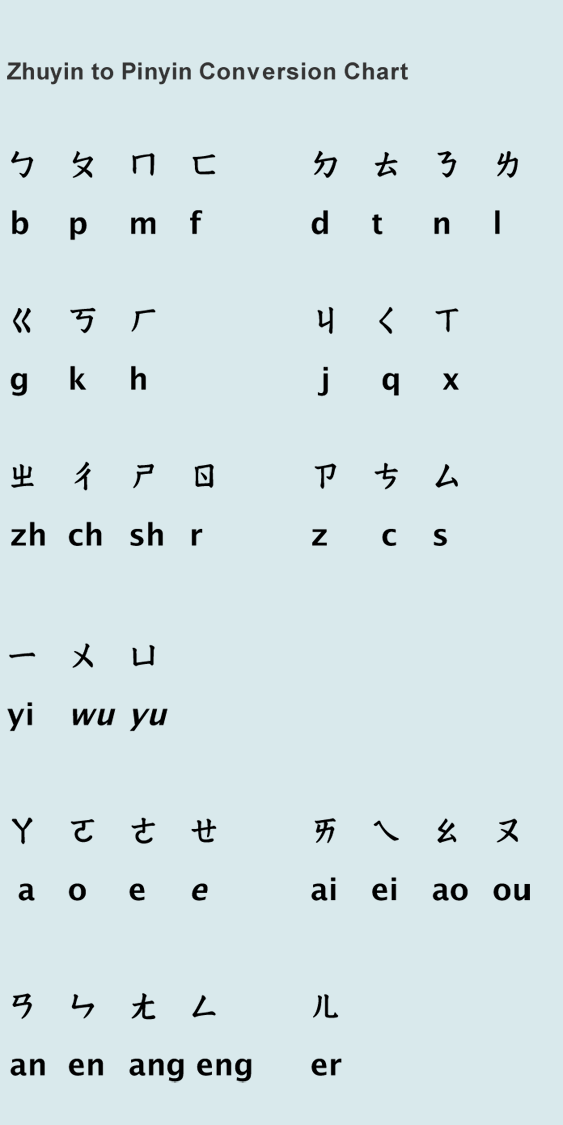
Pinyin
Writing systemWikipedia
12
MENTIONS
6
EPISODES
6
PODCASTS
Search complete. 12 mentions across 6 episodes found for "Pinyin".
Sep 14, 2026

speaker_0NARRATOR
Do you know how to write the Chinese radical meaning go? 芷.
speaker_0NARRATOR
The Pinyin for this Chinese radical is zhǐ.
speaker_0NARRATOR
Let's look at the stroke order.
speaker_0NARRATOR
Zhǐ.

Tiger LiuGUEST
So what you get in the kind of cyberspace in China is a kind of a play on words, and it's a little bit satirical.
Tiger LiuGUEST
So when they say ren jue, so ren literally is how you would pronounce the word run in Chinese, like if you were to pronounce it according to the Pinyin system, right? So they do it that way because of the kind of, uh, cyberspace censoring on either, like, the kind of Chinese version of Twitter, like Weibo, or on different places where you can't really say things too explicitly.
Tiger LiuGUEST
So the word became popular as a way to bypass, on the one hand, that kind of cyberspace censoring, and on the other hand, to make a kind of satirical comment on, on the kind of tightening immigration policy.
Tiger LiuGUEST
But gradually became this kind of a thing that kind of took on a life of its own.

Olle LingeHOST
The a sound is, practically speaking, the same in these.
Olle LingeHOST
If you want to read more about these things in general, I suggest you check out my article, A Guide to Pinyin Traps and Pitfalls, which covers a lot of these things that usually tend to trip up students.
Olle LingeHOST
Okay, so let's move on to question number two, which is about spelling convention in pinyin again, and this time about tones.
Olle LingeHOST
So when we write bo and i, so that's no or not or one, such as in Bu Ke Qi or Yi Yang.
Olle LingeHOST
That's kind of the point because it's meant to describe pronunciation.
Olle LingeHOST
Whereas pinyin is not really that.
Olle LingeHOST
Pinyin is more like a convenient way of writing down pronunciation or spoken words in Chinese using a phonetic alphabet.
Olle LingeHOST
Now, to the casual viewer or listener, that might seem like the difference between those two might not be that important, but in reality, it is.

Lee MooreHOST
Actually, part of the way that I found out that I was dyslexic was when I was studying Chinese.
Lee MooreHOST
So I had studied Chinese first in the PRC, and while I was there, I struggled with some aspects of pinyin.
Lee MooreHOST
Pinyin, for those of you who don't know, is the romanization system used in the PRC.
Lee MooreHOST
There are some words in pinyin where it's very easy to reverse the letter order.
Lee MooreHOST
So shuo and shou.
Lee MooreHOST
These are s-h-u-o and s-h-o-u.
Lee MooreHOST
So when I was studying Chinese, I could never actually read the difference between the two.
Lee MooreHOST
So I would see something that in pinyin said shuo dao.

Brendan ColumbusHOST
What do you think computer keyboards look like?
Dylan SprouseHOST
Well, so Pinyin is like-
Brendan ColumbusHOST
I couldn't even imagine.
Brendan ColumbusHOST
[laughs]
Gianmarco SoresiGUEST
Yeah.
Dylan SprouseHOST
Pinyin is, like, the, they're trying to simplify it to be more of an alphabet.
Dylan SprouseHOST
However, that being said, there's the characters, and then there's the way that those characters were interpreted in different provinces-
Brendan ColumbusHOST
Mm