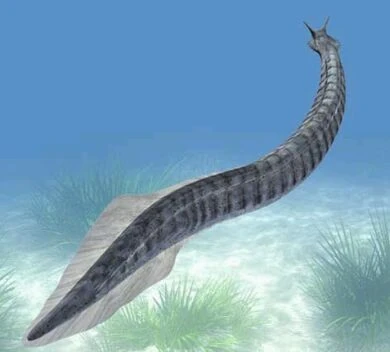
Pikaia
AnimalWikipedia
9
MENTIONS
3
EPISODES
3
PODCASTS
Search complete. 9 mentions across 3 episodes found for "Pikaia".
Oct 15, 2026

Dave FarinaHOST
Extant forms are small, only three to seven centimeters in length, slender, laterally compressed, translucent, and found in sandy sediments of coastal waters around the world.
Dave FarinaHOST
Modern lancelets closely resemble 530 million year old Pikaia, likely one of the first chordates, fossils of which are known from the Burgess Shale.
Dave FarinaHOST
As such, they are often studied because they hold clues within their genomes about the evolution of early vertebrates.
Dave FarinaHOST
Let's go over their anatomy and physiology, ecology, and phylogeny.

speaker_4NARRATOR
On the other hand, countless experiments took place simultaneously in the Cambrian seas.
speaker_4NARRATOR
Pikaia was a small creature similar to an amphioxus, which possessed primitive signs of a structure similar to the spinal cord.
speaker_4NARRATOR
This simple anatomical characteristic would lead to the evolution of all vertebrates, including human beings.
speaker_4NARRATOR
Pikaia is one of the most important creatures of Burgess Shale, not because it was large or fearsome, but because it represented the beginning of a completely new branch of animal evolution.
speaker_4NARRATOR
Otoya was a predator worm that used a retractable pharynx to capture prey.
speaker_4NARRATOR
This creature could extend its mouth outwards like a tube to catch small animals and insert them into its body.

Ken LacovaraGUEST
And we're not here.
Ken LacovaraGUEST
If you can Google something called, uh, Pikaia So P-I-K-A-I-A, I think.
Julian DoreyHOST
Got it.
Ken LacovaraGUEST
I'm really testing your skills here, Joe, aren't I?
Ken LacovaraGUEST
Yeah.
Julian DoreyHOST
Yeah.
Ken LacovaraGUEST
So Pikaia is from the Cambrian period, so it's about a half a billion years ago.
Julian DoreyHOST
Okay.