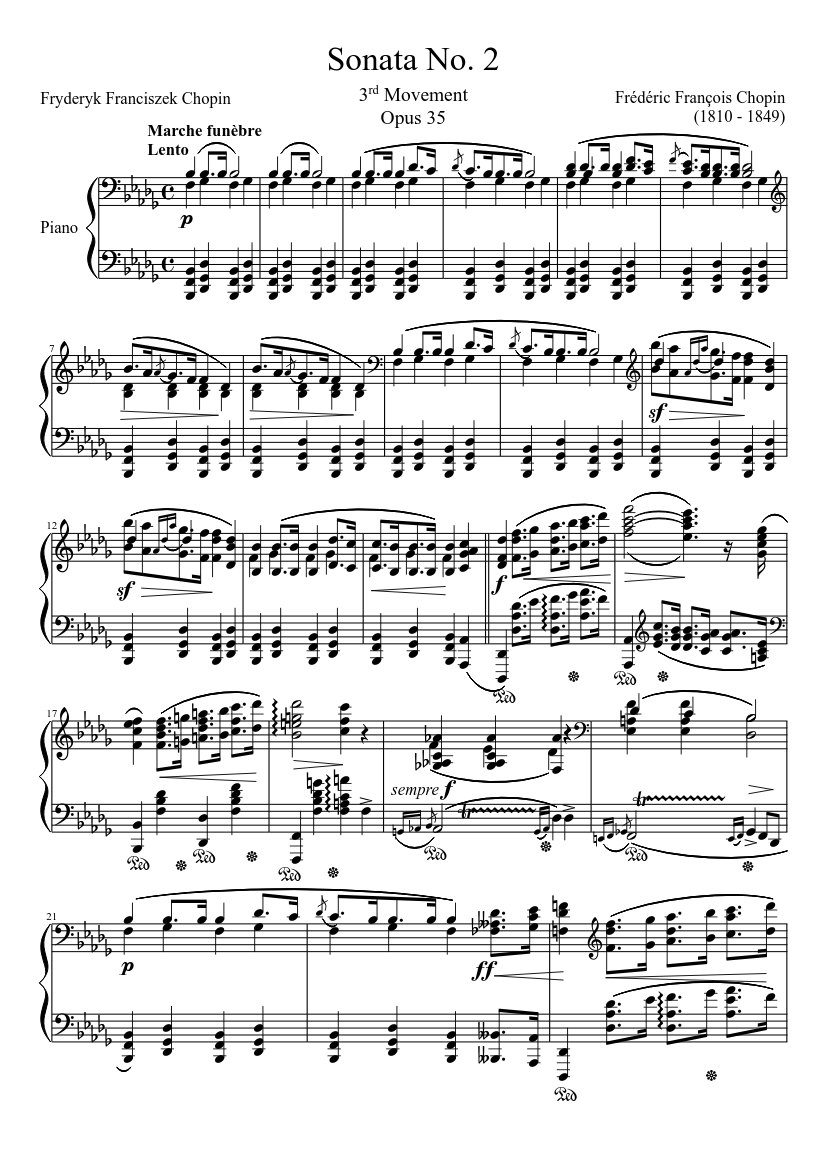
Piano Sonata No. 2
Piano sonata by Frédéric ChopinWikipedia
20
MENTIONS
5
EPISODES
5
PODCASTS
Search complete. 20 mentions across 5 episodes found for "Piano Sonata No. 2".
Sep 27, 2026

LambdaNARRATOR
For more information or to volunteer, please visit LibriVox.org. Life of Koppen by Franz Liszt, translated by Martha Walker Cook.
LambdaNARRATOR
Chapter one: Koppen, style and improvements, the Adagio of the Second Concerto, Funeral March, psychological character of the compositions of Koppen, and so on and so on.
LambdaNARRATOR
Deeply regretted as he may be by the whole body of artists, lamented by all who have ever known him, we must still be permitted to doubt if the time has even yet arrived which he, whose loss is so peculiarly deplored by ourselves, can be appreciated in accordance with his just value or occupy that high rank which in all probability will be assigned him in the future.
LambdaNARRATOR
If it has been often proved that no one is a prophet in his own country, is it not equally true that prophets, the men of the future, who feel its life in advance and prefigure it in their works, are never recognized as prophets in their own times? It must be presumptuous to assert that it can ever be otherwise.
20 MINS LATER
LambdaNARRATOR
A bitter and irreparable regret seizes the wildly throbbing human heart even in the midst of the incomparable splendor of external nature.
LambdaNARRATOR
This contrast is sustained by a fusion of tones, a softening of the gloomy hues, which prevent the intrusion of aught rude or brusque that might awaken a dissonance in the touching impression produced, which, while saddening joy, soothes and softens the bitterness of sorrow.
LambdaNARRATOR
It would be impossible to pass in silence the funeral march inserted in the First Sonata, which was arranged for the orchestra and performed for the first time at his own obsequies.
LambdaNARRATOR
What other accents could have been found capable of expressing with the same heart-breaking effort the emotions, the tears, which should accompany to the last long sleep one who had taught in a manner so sublime how great losses should be mourned? We once heard it remarked by a native of his own country, "These pages could only have been written by a Pole." All that the funeral train of an entire nation weeping in its own ruin and death can be imagined to feed of desolating woe, of majestic sorrow, wails in the musical ringing of this passing bell, moans in the tolling of this solemn knell as it accompanies the mighty escort on its way to the still city of the dead.

Musicology DuckGUEST
So we go, it's
EdHOST
Shogun's Funeral March.
GeorgeHOST
Is it literally based off of Chopin's Funeral March?
Musicology DuckGUEST
Mm-hmm.
Musicology DuckGUEST
The da-da, like the clergy thing.

Phil BensonNARRATOR
Each partner has a dual personality; each partner is indeed two different persons, and one of these fights against the other, with the common result of a fatal inaction.
Phil BensonNARRATOR
The wickeder of the opposing persons in Edward Henry, getting the upper hand of the more virtuous, sniggered, "Dirty teeth indeed! Blood-poisoning indeed! Why not rabies while she's about it? I guarantee she's dreaming of coffins and mourning coaches already." Scanning nonchalantly the titles of the music-rolls, he suddenly saw "Funeral March, Chopin." "She shall have it," he said, affixing the roll to the mechanism; and added, "whatever it is." For he was not acquainted with the Funeral March from Chopin's pianoforte sonata.
Phil BensonNARRATOR
His musical education had in truth begun only a year earlier with the advertisement of the Pianisto mechanical player.
Phil BensonNARRATOR
He was a judge of advertisements, and the Pianisto literature pleased him in a high degree.
Phil BensonNARRATOR
Beethoven was no more to him than Arthur Sullivan; indeed, was rather less.
Phil BensonNARRATOR
The works of his choice were the Tannhauser Overture, a potpourri of Verdi's Aida, Chopin's Study in Thirds (which ravished him), and a selection from The Merry Widow (which also ravished him); so that on the whole it may be said that he had a very good natural taste.
Phil BensonNARRATOR
He at once liked Chopin's Funeral March.
Phil BensonNARRATOR
He entered profoundly into the spirit of it.

Peter CudlipHOST
And if you are new to the music of Frédéric Chopin, I hope that some of what I've played has illustrated that point.
Peter CudlipHOST
I want to finish with the third section of his Piano Sonata No. 2 from 1838.
Peter CudlipHOST
Chopin gave it the name Funeral March.
Peter CudlipHOST
When I was a kid, this piece was wildly overused in advertising and even to satirical effect in cartoons, so I maybe didn't take it too seriously.
Peter CudlipHOST
But listening again, it really is pretty extraordinary.
Peter CudlipHOST
But what it can mean is best left up to each individual listener.
Peter CudlipHOST
Certainly Chopin did not, to our knowledge, have any specific funeral in mind.
Peter CudlipHOST
He called it a funeral march, In the same way he used the term waltz or polonaise, it was about a musical form, a slow musical procession which, more by implication than specific intent, captures a certain universal grief.

Peter CudlipHOST
And if you are new to the music of Frédéric Chopin, I hope that some of what I've played has illustrated that point.
Peter CudlipHOST
I want to finish with the third section of his Piano Sonata No. 2 from 1838.
Peter CudlipHOST
Chopin gave it the name Funeral March.
Peter CudlipHOST
When I was a kid, this piece was wildly overused in advertising and even to satirical effect in cartoons, so I maybe didn't take it too seriously.
Peter CudlipHOST
But listening again, it really is pretty extraordinary.
Peter CudlipHOST
But what it can mean is best left up to each individual listener.
Peter CudlipHOST
Certainly Chopin did not, to our knowledge, have any specific funeral in mind.
Peter CudlipHOST
He called it a funeral march, In the same way he used the term waltz or polonaise, it was about a musical form, a slow musical procession which, more by implication than specific intent, captures a certain universal grief.