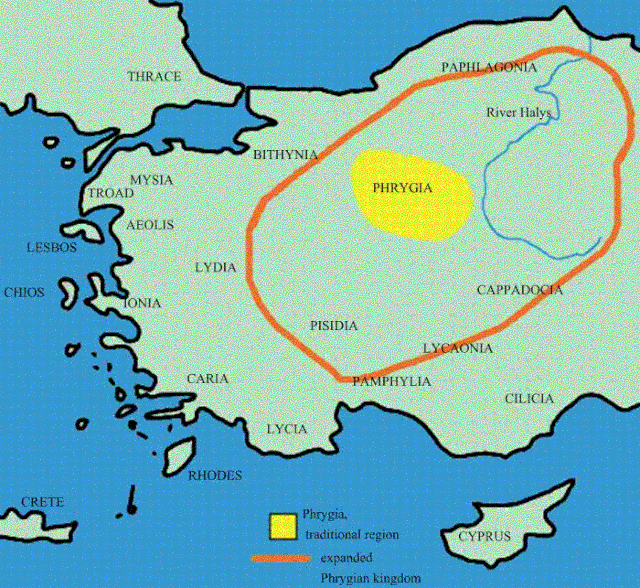
Phrygia
203
MENTIONS
122
EPISODES
102
PODCASTS
Search complete. 203 mentions across 122 episodes found for "Phrygia".
Oct 29, 2026

SamHOST
And listen to the list.
SamHOST
Parthians and Medes and Elamites and residents of Mesopotamia, Judea and Cappadocia and Pontus and Asia and Phrygia and Pamphylia.
SamHOST
Are you exhausted yet? Egypt and parts of Libya belonging to Cyrene, visitors from Rome, both Jews and proselytes, Cretans and Arabians.
SamHOST
The author of Acts, which is Luke, what he wants you to understand is...

Pamela NagamiNARRATOR
Footnote.
Pamela NagamiNARRATOR
Isauria is the mountainous district on the north of Mount Taurus between Cilicia and Phrygia.
Pamela NagamiNARRATOR
End footnote.
Pamela NagamiNARRATOR
To the imperial throne.
1 HR 11 MINS LATER
Pamela NagamiNARRATOR
after a hard fight the vandal host was broken and the victorious romans entered carthage amid the cheers of the provincial population who welcomed the imperial army as their deliverers from the hated vandal yoke One
Pamela NagamiNARRATOR
more fight outside the walls of Carthage finally broke the power of the Vandals, and Belisarius came home in 534, bringing great spoils and the Vandal king as a captive to grace his triumph.
Pamela NagamiNARRATOR
Gelimir was generously treated by Justinian and allowed to live in Phrygia in comfort to the end of his life.
Pamela NagamiNARRATOR
North Africa became once more an imperial province.

Jack HibbsHOST
Parthians and Medes, Elamites, those dwelling in Mesopotamia, Judea and Cappadocia.
Jack HibbsHOST
Pontus in Asia, Phrygia, Pamphylia, Egypt and the parts of Libya adjoining Cyrene.
Jack HibbsHOST
Visitors from Rome.
Jack HibbsHOST
both Jews and proselytites, Cretans and Arabs.

LukeHOST
When they heard this sound, a crowd came together in bewilderment because each one heard their own language being spoken.
LukeHOST
Utterly amazed, they asked, aren't all these who are speaking Galileans? Then how is it that each of us hears them in our native language? Parthians, Medes, and Elamites, residents of Mesopotamia, Judea, and Cappadocia, Pontus in Asia, Phrygia, and Pamphylia, Egypt, and the parts of Libya near Cyrene.
LukeHOST
Visitors from Rome, both Jews and converts to Judaism, Cretans and Arabs, we hear them declaring the wonders of God in our own tongues.
LukeHOST
Amazed and perplexed, they asked one another, what does this mean? Some, however, made fun of them and said, they have had too much wine.

speaker_1HOST
And this is where our second protagonist comes in.
speaker_1HOST
Epictetus was born in Hierapolis, in Phrygia, in what is now Turkey, and came to Rome as a slave.
speaker_1HOST
His master was Epaphroditus, a powerful freedman at Nero's court.
speaker_1HOST
While Helvidius was standing up to emperors in the Senate, that young slave, lame and without a single right to his name, was attending the lectures of the great Stoic teacher in Rome, Musonius Rufus.

TriciaGNARRATOR
It is the moment when, as Herodotus puts it, the Hellenic race was marked off from the barbarian as more intelligent and more emancipated from silly nonsense.
TriciaGNARRATOR
In the 8th century B.C., for instance, so far as our remains indicate, there cannot have been much to show that the inhabitants of Attica and Boeotia and the Peloponnese were markedly superior to those of, say, Lycia or Phrygia,
TriciaGNARRATOR
or even Epirus.
TriciaGNARRATOR
By the middle of the 5th century the difference is enormous.

Maria Luisa PiraquiveHOST
What's going on? And it says that among the languages that they were speaking there, that the Holy Spirit gave each one a language to speak.
Maria Luisa PiraquiveHOST
It says that there were Parthians and Medes and Elamites, those dwelling in Mesopotamia, Judea and Cappadocia, Pontus and Asia, Phrygia, Pamphylia, Egypt, and the parts of Libya.
Maria Luisa PiraquiveHOST
visitors from Rome, both Jews and proselytes.
Maria Luisa PiraquiveHOST
There was everything, the proselytes, the students of the word of God, according to that time, Cretans and Arabs, all of it.

Jenny SaltHOST
And at this sound the multitude came together, and they were bewildered, because each one was hearing them speak in his own language.
Jenny SaltHOST
And they were amazed and astonished, saying, Are not all these who are speaking Galileans? And how is it that we hear each of us in his own native language? Parthians and Medes and Elamites, and residents of Mesopotamia, Judea and Cappadocia, Pontus and Asia, Phrygia and Pamphylia, Egypt and the parts of Libya belonging to Cyrene, and visitors from Rome, both Jews and proselytes, Cretans and Arabians, we hear them telling in our own tongues the mighty works of God.
Jenny SaltHOST
And all were amazed and perplexed, saying to one another, What does this mean? But others mocking said, They are filled with new wine.
Jenny SaltHOST
But Peter, standing with the eleven, lifted up his voice and addressed them, Men of Judea and all who dwell in Jerusalem, let this be known to you and give ear to my words.

speaker_1NARRATOR
When he had landed at Caesarea, he went up to Jerusalem and greeted the church and then went down to Antioch.
speaker_1NARRATOR
After spending time in Antioch, Paul set out from there and traveled from place to place throughout the region of Galatia, Phrygia, strengthening all the disciples.
speaker_1NARRATOR
Meanwhile, a Jew named Apollos, a native of Alexandria, came to Ephesus.
speaker_1NARRATOR
He was a learned man with a thorough knowledge of the Scripture.

Dirk KoetjeHOST
And at this sound the multitude came together, and they were bewildered because each one was hearing them speak in his own language.
Dirk KoetjeHOST
And they were amazed and astonished, saying, Are not all these who are speaking Galileans? How is it that we hear each of us in his own native language, Parthians and Medes and Elamites and residents of Mesopotamia, Judea and Cappadocia, Pontus and Asia, Phrygia and Pamphylia, Egypt and the parts of Libya belonging to Cyrene and visitors from Rome, both Jews and proselytes, Cretans and Arabians.
Dirk KoetjeHOST
We hear them telling in our own tongues the mighty works of God and all were amazed and perplexed saying to one another, what does this mean? But others mocking said they're filled with new wine.
Dirk KoetjeHOST
But Peter, standing with the eleven, lifted up his voice and addressed them, Men of Judea and all who dwell in Jerusalem, let this be known to you and give ear to my words, for these people are not drunk, as you suppose, since it's only the third hour of the day.
112 more episodes mention Phrygia.
Create an account to see the whole feed, search across every transcript, and follow the entities you care about.