PHQ-9
Diagnostic assessmentWikipedia
49
MENTIONS
35
EPISODES
35
PODCASTS
Search complete. 49 mentions across 35 episodes found for "PHQ-9".
Sep 12, 2026

Neil ParikhSOUNDBITE_SPEAKER
We measure a bunch of different outcomes.
Neil ParikhSOUNDBITE_SPEAKER
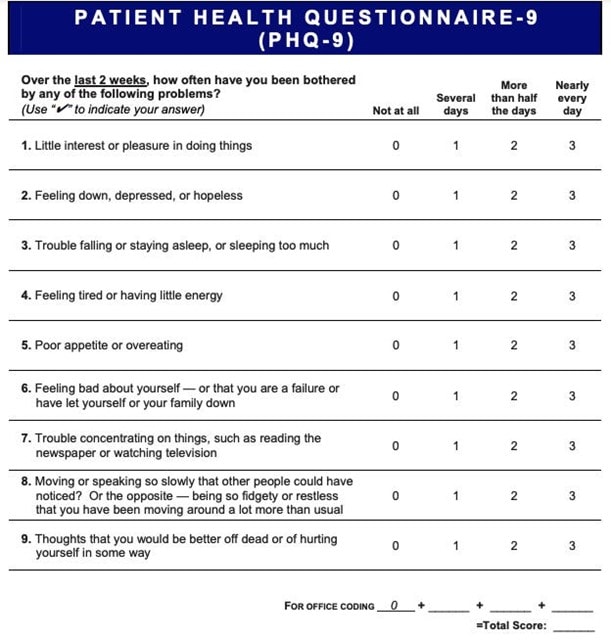
PHQ-9 is movement on a depression scale.
Neil ParikhSOUNDBITE_SPEAKER
GAD-7 is movement on an anxiety scale.
Neil ParikhSOUNDBITE_SPEAKER
And what we saw is the people that were using Ash saw similar movements on those two scales as, as what you would get in traditional therapy.

Courtney BrownHOST
She said she was easily distracted, had excessive worry and guilt, and she was unable to feel pleasure and unable to fall asleep.
Courtney BrownHOST
Now, during this appointment, Lindsay completed three standard assessments: the GAD screening for anxiety, the PHQ-9 questionnaire for depression, and a suicide risk assessment, and her answers showed significant anxiety.
Courtney BrownHOST
On the GAD, Lindsay reported feeling nervous, anxious, or on edge nearly every day.
Courtney BrownHOST
She also reported that she was extremely worried all the time and had trouble controlling it.
Courtney BrownHOST
Dr. Tufts would later testify that on the PHQ-9 assessment, there were also signs of depression.
Courtney BrownHOST
But on the suicide risk assessment, Lindsay answered no to every question about suicidal thoughts, plans, or thoughts of harming others.
Courtney BrownHOST
Now, during this first meeting with Dr. Tufts, she prescribed Lindsay 25 milligrams of Zoloft, an antidepressant that raises serotonin levels in the brain to balance your mood.

Joshua FletcherHOST
I went to have, uh, NHS CBT three times, didn't do a- they didn't understand my anxiety disorder.
Joshua FletcherHOST
A lot of it was just filling out GAD-7s and PHQ-9 forms, and it didn't feel like ther- it didn't feel like I was understood, but I wanted to do a very specific episode today is actually no, like, good CBT for anxiety disorders, um, you know, c- c- can be really, really helpful, and that's what Drew and I often pull a lot from, but it's a massive umbrella.
Drew LinsalataHOST
Oh, it's huge.
Joshua FletcherHOST
You know? It's like, yeah, it's like saying, "Oh, I tried food.

Rachel WileyGUEST
Some of the ones I like a little more are the modified caregiver strain index or the perceived change scale.
Rachel WileyGUEST
I also try to incorporate some like depression screens, possibly anxiety screens or things like the PHQ-9.
Rachel WileyGUEST
or geriatric depression screen depending on the age of the care partner.
Rachel WileyGUEST
There's also things like the capacity card sort, which helps us, again, understand if the care partner is underestimating, overestimating, or accurately estimating the functional capacity of the person living with dementia.

Brian KurtzGUEST
And knowing that those have slightly different best practices in terms of how to follow up on those, it's still really useful for us to be able to ask those questions of youth, to be able to find folks who are willing to tell us as trusted medical providers that they've experienced this so that we can really make sure that we are doing things in that episode of care that will be helpful for them to protect them from suicide, and also be connecting them to resources that will allow them to get treatment if they do have a mental health condition that would benefit from treatment.
Paul BunchHOST
So for those people who have not used the ASQ framework of questions, a lot of practices will use the PHQ system, the PHQ-2, the PHQ-9, PHQ-A, that also have some suicide risk questions.
Paul BunchHOST
How do those two tools differ?
Brian KurtzGUEST
That's a great question.
Brian KurtzGUEST
So the PHQ is very specific for asking about the DSM-5 criteria for a major depressive episode.
Brian KurtzGUEST
There's nine questions for that.
Brian KurtzGUEST
So where the PHQ-9 comes from.
Brian KurtzGUEST
The ninth question is one that relates to thoughts about death, dying, suicide.

speaker_0HOST
I was wondering if you could tell us how risk is managed within the Silver Cloud programmes?
SimonGUEST
When users begin with SoundCloud, when they log in, they are invited to fill in some questionnaires, one of which is the PHQ-9, which is a well-validated measure of low mood.
SimonGUEST
And in the final question, the PHQ-9 asks about suicidal ideation.
SimonGUEST
If people score at a certain point on that, literally a little red flag appears, which is very, very useful because it means there's possibly gonna be some risk there.
SimonGUEST
People are then invited to complete further risk questionnaires.

Kira RadinskyGUEST
We need to have different conditions.
Kira RadinskyGUEST
So what the system then does, it's, uh, calling the patient, if not the patient, their family, and asking, "Well, first of all, am I seeing this correctly? Are you stopped taking this?" There is also a way of, um, diagnosing depression, so there is different questionnaires, so it's called PHQ-9.
Kira RadinskyGUEST
So we're asking, like, "How are you feeling? Are you feeling down?" Based on that, we're gonna analyze that a patient is depressed, and, uh, we see that, uh, this is something that needs to be taken care of.
Kira RadinskyGUEST
So we can either have the discussion on the phone, connect, uh, a nurse on the phone, understand the barriers.

Anna OhGUEST
And trying to, like I mentioned, trying to be best assistant for them.
Anna OhGUEST
so that they can spend more time, more quality time with our patients to take care of more, for purely focusing on care, not repeated tasks, such as checking vital, or there are structured assessments such as PHQ-9, mental health assessment, or there are a lot of...
Anna OhGUEST
Another example, if senior patients fall, after fall, for three days, nurses need to check the patients every 15 minutes.
Anna OhGUEST
That's a lot of work.

speaker_1HOST
Therefore, modern measurement-based care has to capture both domains.
speaker_1HOST
We use the PHQ-9 or the QIDs to track the depressive symptoms, but we must also use functional scales.
Manaan KarrayHOST
Like the LAPS.
speaker_1HOST
Yeah, the LAPS, the Lamb Employment Absence and Productivity Scale, or the SDS, the Sheehan Disability Scale, to track whether we are actually restoring their ability to live their life.

BrianGUEST
So doctors, nurse practitioners, primary care providers, they are told the drugs will solve these problems.
BrianGUEST
If you screen a patient with this Pfizer-created personal health questionnaire, PHQ-2 or PHQ-9, and it scores this score, that means they are blah, right? And blah could be moderate depressive disorder or severe depressive disorder.
BrianGUEST
And if it's that, then you have to, you know, these drugs are the family of drugs that can help.
BrianGUEST
It can mirtazapine, bupropion, you know, SSRIs, whatever.
25 more episodes mention PHQ-9.
Create an account to see the whole feed, search across every transcript, and follow the entities you care about.