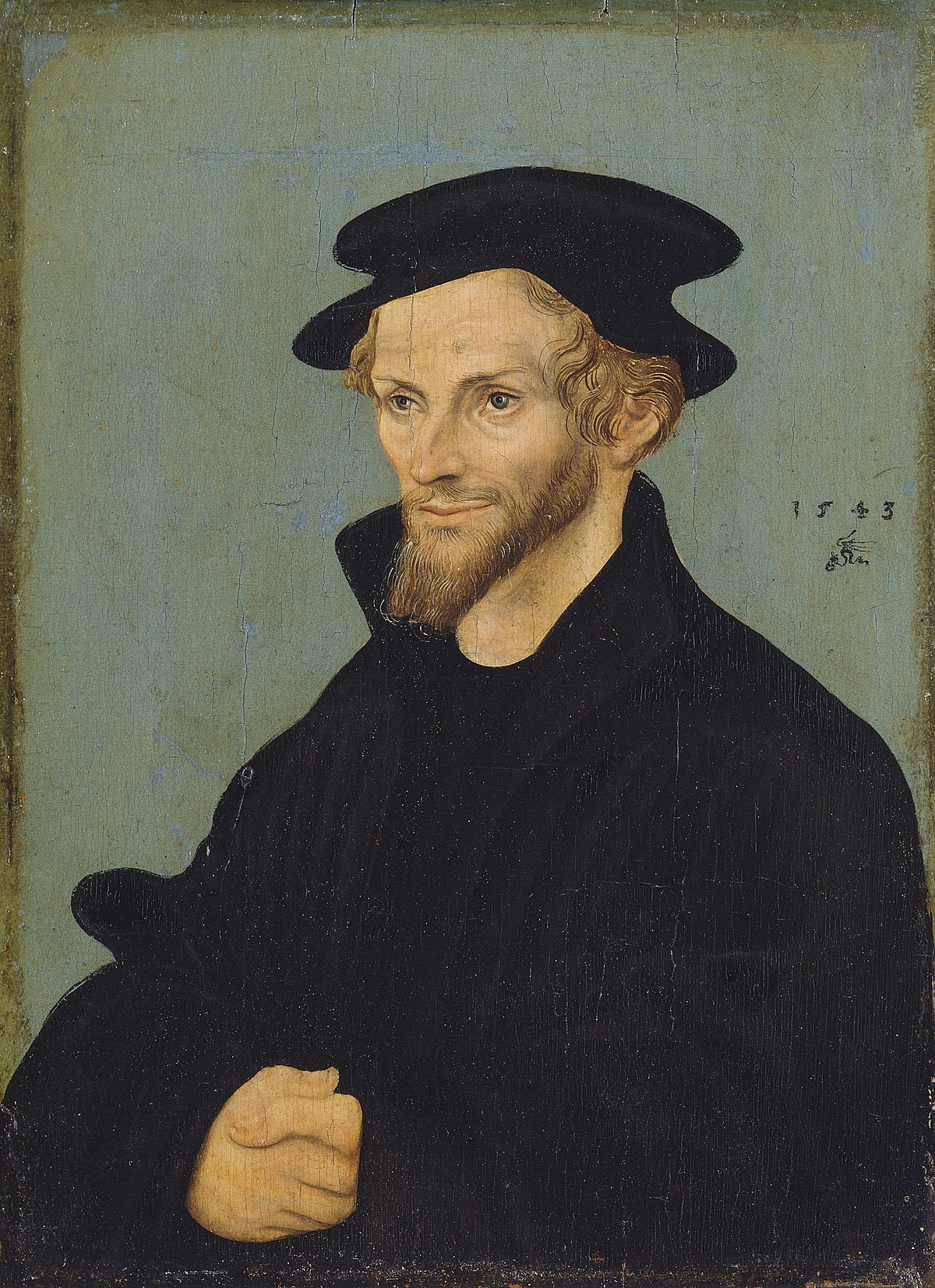
Philipp Melanchthon
German theologianWikipedia
368
MENTIONS
83
EPISODES
57
PODCASTS
Search complete. 368 mentions across 83 episodes found for "Philipp Melanchthon".
Oct 29, 2026

Dirk Hoffmann-BeckingHOST
He was a combative, learned and impatient man.
Dirk Hoffmann-BeckingHOST
And there was the newest member of the faculty, Philipp Melanchthon, a 21-year-old wunderkind, who arrived in August 1518 to take the new chair in Greek.
Dirk Hoffmann-BeckingHOST
And he bowled everyone over with his inaugural lecture, which we're probably going to discuss in more detail sometime later.
Dirk Hoffmann-BeckingHOST
He would very quickly become Luther's closest and longest-suffering collaborator.

R. Scott ClarkHOST
He's reading Scripture with new eyes, new perspectives, and so he sees imputation.
R. Scott ClarkHOST
Some people have speculated and argued that it was really Melanchthon who came up with that.
R. Scott ClarkHOST
I don't think that's true.
R. Scott ClarkHOST
I don't think the evidence supports that.
R. Scott ClarkHOST
It's an academic journal article and covers a lot of territory and probably too much.
R. Scott ClarkHOST
At any rate, if you want to know more about that in the debate, you can check that out and see the argument from Luther himself that yes, indeed, he really did teach that.
R. Scott ClarkHOST
Part of the argument that says that he got it from Melanchthon depends on some timing of the publication of Erasmus, a Greek and Latin New Testament, and whether Luther would have had it.
R. Scott ClarkHOST
And there's good reason to doubt that he would have had it just then.

Keith FoskeyHOST
We've talked about William Tyndale.
Keith FoskeyHOST
We've talked about Philip Melanchthon.
Keith FoskeyHOST
We've talked about Jonathan Edwards.
Keith FoskeyHOST
We've talked to several different theologians and different teachers.

Troy FrasierGUEST
Krusiger? Krusager? Krusager? Anyway, I call her Lizzie, right? No, Elizabeth here, of course, starts out in a convent, ends up as a nun, runs away, all that stuff, right? She actually runs away before Catherine von Boreda.
Troy FrasierGUEST
She runs away in 1522. um but while she was in the nunnery while she was placed there she learned to read she learned to write she could do latin she could kind of make music um she runs off to wittenberg she runs into luther's group she gets married uh to one of luther's best students they have a couple children together and uh in fact one of her sons casper jr here caspar i don't know anyway He'll replace Melanchthon as like when Melanchthon dies.
Troy FrasierGUEST
If you don't know, Melanchthon is like Martin Luther's right hand man.
Troy FrasierGUEST
He helps create education.
Troy FrasierGUEST
He's a really important guy.

Joseph SchleeHOST
It's kind of a long quote, but this is just a Lutheran take on that particular thing about the sacrament stuff.
Joseph SchleeHOST
Melanchthon writes, marriage was not first instituted in the New Testament, but in the beginning, immediately after the creation of the human race.
Joseph SchleeHOST
Furthermore, it has God's command.
Joseph SchleeHOST
It has also promises, not truly having to do with the New Testament, but rather having to do with bodily life.
Jason BraatenGUEST
Yeah.
Jason BraatenGUEST
Yeah.
Jason BraatenGUEST
I mean, and this is the, you know, the abuse does not negate the proper use that Melanchthon has throughout the Apology.
Jason BraatenGUEST
That, okay, we see an abuse here.

Nathan GreeleyGUEST
I knew that of the major Christian traditions, Lutheranism was probably the most similar to Anglicanism.
Nathan GreeleyGUEST
I wasn't highly familiar with conservative Lutheranism or confessional Lutheranism, but I had read some Luther and Melanchthon.
Nathan GreeleyGUEST
I had read The Freedom of a Christian, The Bondage of the Will, the Loki Communis, and I knew that confessional Lutherans definitely believed in grace alone and faith alone.
Nathan GreeleyGUEST
I knew they taught the inerrancy of Scripture and that the sacraments are means of grace.

Scott KeithHOST
You transport yourself to just after medieval times, and there's people with animals and fruit and grain, and then stands full of pamphlets explaining why Lutherans are heretics and passing them out and selling these booklets all over the city.
Scott KeithHOST
And so even worse than it had already been, Melanchthon in particular here is like, call us something, but not these ancient heresies.
Scott KeithHOST
And so that's what you're seeing here with basically being a duplicate of the creed.
Caleb KeithHOST
Yeah, one of the things I like that they do here is, and this was useful in their day, but it's still useful in our days.
15 MINS LATER
Caleb KeithHOST
It was three strikes and she didn't get that third strike.
Caleb KeithHOST
She learned.
Caleb KeithHOST
The thing about this, I think that is important of as far as the Blessed Virgin Mary goes, I think Melanchthon knows this, is that what is not important at all is whether or not Mary remained a virgin.
Caleb KeithHOST
It bugs me.
Matthew EverhardGUEST
It's a really, it's a really cool book.
Matthew EverhardGUEST
Um, and then Melanchthon is later going to soften up some of that so-called Calvinism of Luther there.
Matthew EverhardGUEST
Um, I know that's, you know, maybe a little anachronistic to call Luther a Calvinist, but he does sound like a Calvinist and the bondage of the will.
Matthew EverhardGUEST
Well,
Keith FoskeyHOST
But there's another man in the history of Lutheranism that had a huge impact in not only working alongside Luther but carrying on his work and was instrumental in much of the Reformation ideas that have shaped Lutheranism.
Keith FoskeyHOST
And that was about a man by the name of Philip Melanchthon.
Keith FoskeyHOST
And so I've asked you to come in today to, I want to play the part of the student and let you play the part of the professor and just ask you some questions about how much influence Melanchthon had in the the shaping of what is modern Lutheranism and what you guys believe and teach.
Keith FoskeyHOST
But before we do that, could you just give us a broad snapshot of what you would say it means to be a Lutheran, as in distinguished from, say, a Presbyterian or a Baptist or another denomination of Protestant Christianity? What are some of the distinctives that make someone Lutheran?
Jordan CooperGUEST
Yeah, so if you're going to define a Lutheran, like any tradition, I would really define Lutheranism by its confessions.
Jordan CooperGUEST
when we know Christ, and we know Christ when we know his benefits.
Jordan CooperGUEST
To know Christ is to know his benefits.
Jordan CooperGUEST
That's a phrase that Melanchthon uses.

Bryan MercierGUEST
he kind of developed faith alone.
Bryan MercierGUEST
And yet his own theologian, Philip Melanchthon, ended up disagreeing with him and saying he's wrong on it.
Bryan MercierGUEST
And then other Lutherans disagreed with both of them and said they're both wrong on it.
Bryan MercierGUEST
And Lutherans could not even get it together.
Bryan MercierGUEST
He said, you are from the devil and you are not rightly dividing the word of God.
Bryan MercierGUEST
People jumped on Zwingli for that, but he didn't care.
Bryan MercierGUEST
He just said it's a symbol and he apparently knows more than every saint, mystic, martyr, theologian, and scholar in church history, so...
Hannah CrewsHOST
Yeah, somebody that was condemned to hell by the main Protestant reformer is the guy that we are basing a lot of our theological opinions considering communion.
73 more episodes mention Philipp Melanchthon.
Create an account to see the whole feed, search across every transcript, and follow the entities you care about.