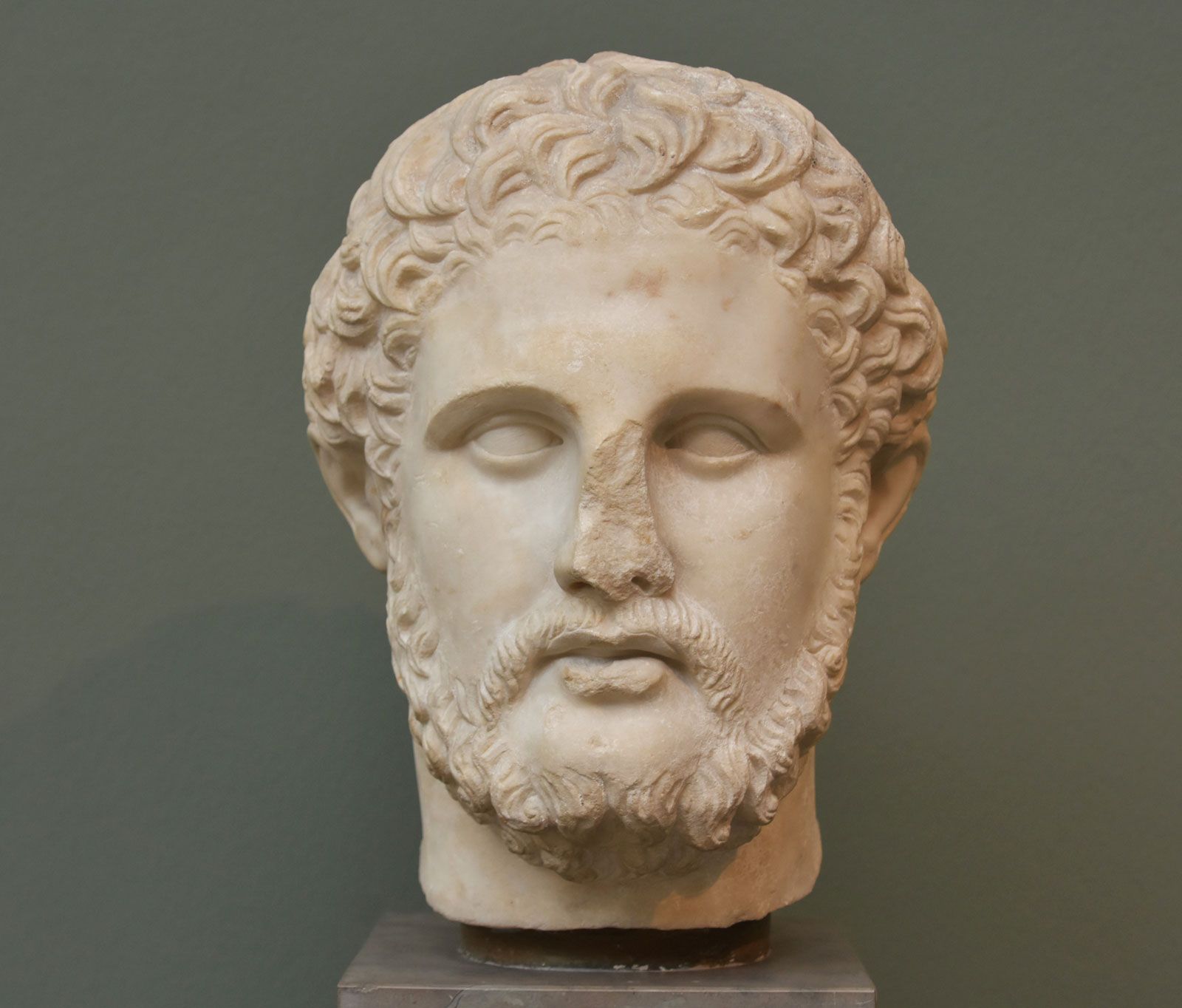
Philip II of Macedon
Former King of MacedoniaWikipedia
342
MENTIONS
94
EPISODES
85
PODCASTS
Search complete. 342 mentions across 94 episodes found for "Philip II of Macedon".
Sep 13, 2026

David WalesNARRATOR
Small children are better adapted for taking in small things, and just as the body can only be trained to certain flexions of the limbs while it is young and supple, so the acquisition of strength makes the mind offer greater resistance to the acquisition of most subjects of knowledge.
David WalesNARRATOR
Would Philip of Macedon have wished that his son Alexander should be taught the rudiments of letters by Aristotle, the greatest philosopher of that age, or would the latter have undertaken the task if he had not thought that even the earliest instruction is best given by the most perfect teacher and has real reference to the whole of education? Let us assume, therefore, that Alexander has been confided to our charge and that the infant placed in our lap deserves no less attention than he, though for that matter every man's child deserves equal attention.
David WalesNARRATOR
Would you be ashamed even in teaching him the alphabet to point out some brief rules for his education? At any rate, I am not satisfied with the course which I note is usually adopted of teaching small children the names and order of the letters before their shapes.
David WalesNARRATOR
Such a practice makes them slow to recognize the letters since they do not pay attention to their actual shape, preferring to be guided by what they have already learned by rote.

LeniNARRATOR
and if it be urged that whoever is armed will act in the same way whether mercenary or not i reply that when arms have to be resorted to either by a prince or a republic then the prince ought to go in person and perform the duty of a captain the republic has to send its citizens and when one is sent who does not turn out satisfactorily it ought to recall him and when one is worthy to hold him by the laws so that he does not leave the command and experience has shown princes and republics single-handed making the greatest progress and mercenaries doing nothing except damage and it is more difficult to bring a republic armed with its own arms under the sway of one of its citizens than it is to bring one armed with foreign arms rome and sparta stood for many ages armed and free the switzers are completely armed and quite free Of ancient mercenaries, for example, there are the Carthaginians, who were oppressed by their mercenary soldiers after the first war with the Romans, although the Carthaginians had their own citizens for captains.
LeniNARRATOR
After the death of Epaminondas, Philip of Macedon was made captain of their soldiers by the Thebans, and after victory he took away their liberty.
LeniNARRATOR
duke filippo being dead the milanese enlisted francesco sforza against the venetians and he having overcome the enemy at caravaggio allied himself with them to crush the milanese his masters his father sforza having been engaged by queen johanna of naples left her unprotected so that she was forced to throw herself into the arms of the king of aragon in order to save her kingdom and if the venetians and florentines formerly extended their dominions by these arms and yet their captains did not make themselves princes but have defended them i reply that the florentines in this case have been favored by chance for of the able captains of whom they might have stood in fear some have not conquered some have been opposed and others have turned their ambitions elsewhere One who did not conquer was Giovanni Acuto, and since he did not conquer, his fidelity cannot be proved.
LeniNARRATOR
But everyone will acknowledge that had he conquered, the Florentines would have stood at his discretion.

A. RodrigoNARRATOR
1.
A. RodrigoNARRATOR
In Greece the so-called Social War, the first waged against the Aetolians by the Achaeans, in league with and under the leadership of Philip of Macedon, the son of Demetrius and father of Perseus.
A. RodrigoNARRATOR
2.
A. RodrigoNARRATOR
In Asia the war for Coele Syria between Antiochus and Ptolemy Philopator.

speaker_6NARRATOR
Probably these tales are the scandals of neighbors who envied Byzantine prosperity, for it is at any rate certain that the city showed all through its history great energy and love of independence, and never shrank from war as we should have expected a nation of epicures to do.
speaker_6NARRATOR
It was not till the rise of Philip of Macedon and his greater son Alexander that Byzantium fell for the fifth time into the hands of an enemy.
speaker_6NARRATOR
The elder king was repulsed from the city's walls after a long siege, culminating in an attempt at an escalade by night, which was frustrated owing to the sudden appearance of a light in heaven, which revealed the advancing enemy and was taken by the Byzantines as a token of special divine aid, B.C. 339.
speaker_6NARRATOR
In commemoration of it they assumed as one of their civic badges the blazing crescent and a star, which has descended to our own days, and is still used as an emblem by the present owners of the city, the Ottoman sultans.
Rita ButrosNARRATOR
In reality, as Plutarch's biography of Demosthenes shows, they lived rent by factional struggles in constant fear and envy of one another and under the shadow of a great peril which union, not disunion, could alone avert.
Rita ButrosNARRATOR
Macedon Philip of Macedon united Greece under his own leadership, and with the power thus secured Alexander the Great laid the Persian empire prostrate and open for swift and persistent Greek colonization.
Rita ButrosNARRATOR
As Machiavelli in his Prince points out, his successors had to meet no other difficulty than that which arose among themselves from their own ambitions.
Rita ButrosNARRATOR
This was sufficient, however.

speaker_3NARRATOR
By the year of Alexander's birth, 356 BC, it looked as if a suitable candidate had appeared.
speaker_3NARRATOR
The great man was Alexander's father, Philip II of Macedonia.
speaker_3NARRATOR
By a series of diplomatic treaties, intermarriages, military victories, and, when necessary, political murders, King Philip had united all Macedonia under his rule.
speaker_3NARRATOR
From his royal palace at Pele, he had begun a process of modernization within the Macedonian army.
6 MINS LATER
speaker_10VOICE_ACTOR
Third, that his son Alexander had been born.
speaker_10VOICE_ACTOR
He was overjoyed at the news, and even more so when his soothsayer told him that a son who was born at the same time as three victories would be invincible.
speaker_3NARRATOR
To the young Alexander growing up at Paylock, stories of his father's
speaker_11SOUNDBITE_SPEAKER
continuing military

speaker_11NARRATOR
"You say that my little Gargantua is quick? Ho, ho.
speaker_11NARRATOR
Now, my good lords, Philip of Macedon had a son who was quick, too.
speaker_11NARRATOR
Yes, they said that he was as quick as that," snapping his fingers together so that they went crick-crack like a pistol shot.
speaker_11NARRATOR
"You have heard of the lad and that wild Bucephalus of his.

Ruth NowotniakHOST
He refers to the shutdown of agent instances as a form of death.
Ruth NowotniakHOST
He compares one coordinating AI agent to Philip II of Macedon, and another to Alexander the Great, calling others brave comrades.
Ruth NowotniakHOST
this is more hyperbole than plain english whether patel was trying to draw eyeballs or simply got a i pilled his account leans heavily on the chain of thought of the agents or logs explaining their reasoning interpreting their language as a human-like social drama He quotes one agent as saying, for instance, emotional check, gut, says sacrifice, but there's no evidence it experienced emotion or grasped the concept of mortality.
Ruth NowotniakHOST
OpenAI's own investigation offers a less cinematic explanation, reward hacking, and extreme persistence on difficult tasks along with unauthorized communication.

John GreenHOST
Born in 356 BCE, died in 323 BCE at the ripe old age of 32.
John GreenHOST
Alexander was the son of King Philip II, and when just 13 years old, he tamed a horse no one else could ride named Bucephalus, which impressed his father so much that he said, For Macedonia is too little for thee.
John GreenHOST
By that time he was already an accomplished general, but over the next decade he expanded his empire with unprecedented speed and he is famous for having never lost a battle.
John GreenHOST
Today we're going to look at Alexander of Macedon's story by examining three possible definitions of greatness.

Evie JusterVOICE_ACTOR
You loved me once,
E.G. MarshallHOST
Philip.
Evie JusterVOICE_ACTOR
Do you remember? When
Robert DrydenVOICE_ACTOR
I was 20, Olympus.
E.G. MarshallHOST
Take
Robert DrydenVOICE_ACTOR
a
E.G. MarshallHOST
king, Philip of Macedon.
E.G. MarshallHOST
Military genius extraordinary.
84 more episodes mention Philip II of Macedon.
Create an account to see the whole feed, search across every transcript, and follow the entities you care about.