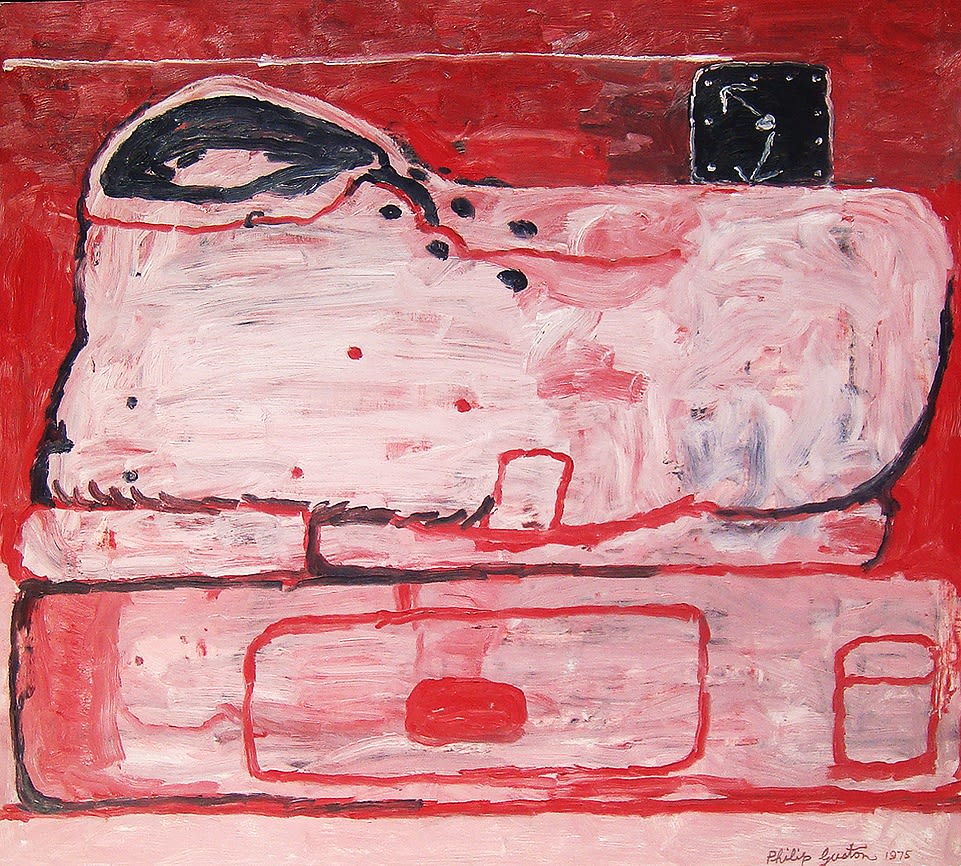
Philip Guston
Canadian-American painterWikipedia
16
MENTIONS
11
EPISODES
11
PODCASTS
Search complete. 16 mentions across 11 episodes found for "Philip Guston".
Sep 17, 2026

Mark Thomas GibsonGUEST
And using all these, like, little things that we know about Philadelphia history or some of the mythology of Philadelphia as well that kind of, like, play into the imagery.
Mark Thomas GibsonGUEST
And I wanted these figures to be women of color, but I wanted them to be in the same way that Philip Guston's gladiators mask all the children at play.
Mark Thomas GibsonGUEST
You know, they, they're kind of lost in their roles.
Mark Thomas GibsonGUEST
They become the thing, you know.

Fallon StutzmanGUEST
I had not seen...
Fallon StutzmanGUEST
And I was late to Philip Guston.
Fallon StutzmanGUEST
I still feel shame over that.
Fallon StutzmanGUEST
But...

Daniel HummGUEST
Different way of thinking, different way of expressing yourself, moving something forward.
Daniel HummGUEST
Like there's an artist, Philip Guston, for example, has really inspired me in the way he was like...
Daniel HummGUEST
Like what's true almost to any successful artist is that they're very good at their craft.
Daniel HummGUEST
So like you gotta be a really good painter to start with.
Daniel HummGUEST
No, you couldn't.
Daniel HummGUEST
And, you know, it's great because they come from such a deep knowledge and craftsmanship that eventually they decide to leave things behind or, or do their own version of it.
Daniel HummGUEST
But Philip Guston was a great painter who was like a figurative painter in the early years, had like a pretty successful career.
Daniel HummGUEST
And then...

Kristin CalabreseGUEST
And those severe breaks are really difficult.
Kristin CalabreseGUEST
But, you know, I've been telling people that, you know, I I don't I don't feel like I feel like I'm always still looking for my Guston moment, you know, and that's like Philip Guston when he was like middle aged.
Kristin CalabreseGUEST
He'd been doing, you know.
Kristin CalabreseGUEST
A lot of like.

Matthew de Kersaint GiraudeauHOST
the person painting the paint like moving the paint around and um the idea that you could get you could somehow by looking very closely you can actually get about a bit back into that you can have a kind of mirror affect a mirrored feeling of what rembrandt felt when he was painting it and maybe that is one thing that like close looking or something can do which i don't know if i literally believe that but i like the idea of trying to do that
Andrea FranckeHOST
I remember when we read Philip Guston and he said that he, I don't remember exactly the anecdote to tell it, but it was something like that, you know, that if he died in front of all these people, he will have all these things to talk about with all these different painters at different moments in history because they just they just have been having this conversation through like material and making and doing and gesture and stuff that in a sense i feel this text is about like yeah how do you get to be in those how do you learn to be a person in those conversations instead of just just see this just read these things at this specific like checkpoints that you have to command the knowledge and oh i know this command you know i know who rembrandt was i know who he is in the history of painting I know about the self-portraits, I know this and that, but it's like, oh yeah, how can you understand reading this painting by these men? You know what I mean? As reading this thing, as like this mode of communication that is coming to you from such a specific time and geography and human being, that person is giving you something and then you're receiving that, which is bonkers because I'm such a nerd.
Andrea FranckeHOST
Like I love reading all this stuff around things like that, but it's like one thing should not be, confused by the other be mistaken by the other there are different things that happen together but one does not replace the other
Matthew de Kersaint GiraudeauHOST
yeah exactly and I think that that is the other thing is that I again a bit like engaging with whatever very famous dominant ideas or something I think it's fine to theorize it's it's really important to place you know to historicize and to think about the histories of artworks and art history in relation to wider political context and stuff but That's like a really big bit of what we do in the art school as university has it.
7 MINS LATER
Andrea FranckeHOST
This thing that, you know, you're happy when you paint.
Andrea FranckeHOST
The people around love you, love your paint, your paintings.
Andrea FranckeHOST
To kind of like take a step out of that and jump into the uncertainty and... painfulness that it is to make art you know what i mean and i would say that probably i would say that most people if not everybody that i know even if what they're doing is painter and there are painters it's not fun you know what i mean it's like it's a horrible crisis again like all these texts are like why are we painting why paint is that this constant like you know challenge why why What can I, you know, what should I be painting? Should I be painting this? Does this make any sense? You know, you go to the studio, like, you know, all those videos, like Philip Guston doing that painting that to me looked amazing.
Andrea FranckeHOST
I got it to the point of being like, I throw it out.

Ajay KurianHOST
where the blood test every month is essentially binary, and the book is not yet closed.
Ajay KurianHOST
We talked about cliche as a sedimented truth, about why Drake said there has to be something wrong with a pop hit, about what Philip Guston understood that most painters don't, and we talked about what changed in the studio after cancer and what stayed the same, and about why, in the end, he couldn't stop making things, even when he had every reason to.
Ajay KurianHOST
This dude was literally ordering paper from Blick on his hospital bed.
Ajay KurianHOST
Here is my conversation with Vijay Mashrani.

Ruby TugadeHOST
How are you aware of when bravery is manifested in a piece?
Phyllis RosenblattGUEST
What a very brave artist that I know of is Philip Guston.
Phyllis RosenblattGUEST
And Philip Guston did these exquisite, quote unquote, expressionistic paintings through the late 40s.
Phyllis RosenblattGUEST
Well, he did other kinds of narrative pieces in the 40s, but in the 50s.
Phyllis RosenblattGUEST
And then all of a sudden, in 1967, he started doing these crazy paintings.

Fionna MurrayGUEST
There's a pool that reflects the people behind, and there's a sort of strangeness about his work as well.
Fionna MurrayGUEST
Like Philip Guston said something about that painting as well, that there's these angels at the side that are looking at John the Baptist putting the water over Jesus's head, and he says something about that the angels are looking as if they've just arrived.
Fionna MurrayGUEST
I think the idea that they've just arrived on Earth for the first time, and they're seeing everything for the first time.
Fionna MurrayGUEST
And you look at the angels' faces, and you sort of think, "Yeah, they have that look in their face." Maybe that's one pivotal painting when you think of when that was painted and how it still has that, affects people-

Kat RosenfieldHOST
It has always been a bad move.
Kat RosenfieldHOST
I think it was bad when they did it to Philip Guston during like peak woke.
Kat RosenfieldHOST
I think it was bad when the campaign to torpedo Yayoi Kusama over something that she wrote
Phoebe Maltz BovyHOST
in like the late 60s.

Rachel FinnGUEST
And that's how you could say this about life in a lot of ways.
Rachel FinnGUEST
And then, well, there was a very famous, one of my favorite artists of all time, Philip Guston, a painter, famous quote where he says, "When you start a painting, everybody you've ever known is in the room with you.
Rachel FinnGUEST
Every teacher, every classmate, every artist that you ever read about is in that room with you, and one by one they leave while you're making that painting.
Rachel FinnGUEST
And then eventually you even leave." And I'm like, okay, I don't think I've left the building quite completely, but I do feel like the pathetic amount of work that I do put out, most of it is very much my own, which is something that I think you can only do when you get older.
1 more episode mentions Philip Guston.
Create an account to see the whole feed, search across every transcript, and follow the entities you care about.