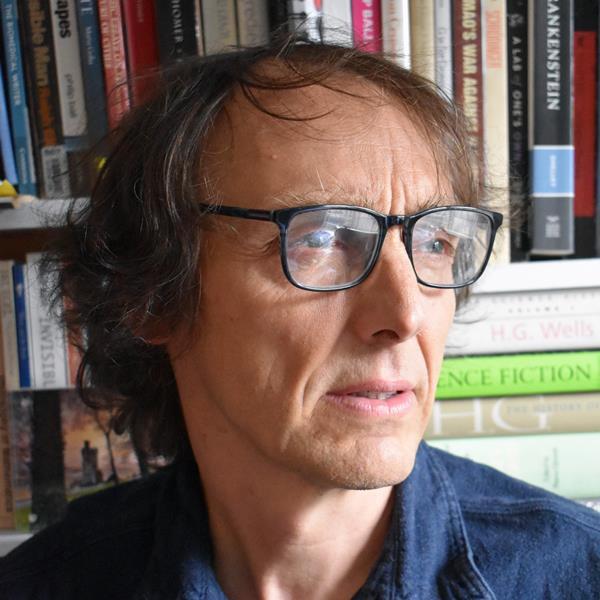
Philip Ball
Science writerWikipedia
18
MENTIONS
9
EPISODES
9
PODCASTS
Search complete. 18 mentions across 9 episodes found for "Philip Ball".
Nov 20, 2026

Giles BrownHOST
He was also engaged in a lifelong intellectual duel with Einstein and and modern experiments proved him right.
Giles BrownHOST
I'm delighted to say that joining me live, hopefully live on the line, if E equals MC squared or if it doesn't, the man behind the man who broke reality, Philip Ball.
Giles BrownHOST
Philip, good morning to you, sir.
Giles BrownHOST
Good morning.
27 MINS LATER
Philip BallGUEST
Philip Seaball on Blue Sky.
Giles BrownHOST
The book is called The Man Who Broke Reality.
Giles BrownHOST
It's by Philip Ball or Philip Seaball.
Giles BrownHOST
Philip, it's been absolutely eye-opening.

Alison MonetteHOST
Even though there's so much trying to break that down.
Alison MonetteHOST
And, you know, like we've mentioned Philip Ball's book and how life works.
Alison MonetteHOST
And I mean, there's so much out there that's trying to scream to us saying, like, we got that wrong.
NoahHOST
Yeah, how we're stuck there is kind of still mind-blowing.

Arvin AshHOST
For this episode, I collaborated with someone with a lot more expertise on this subject than me, and whom I think you're really going to enjoy listening to.
Arvin AshHOST
And that is science writer Philip Ball, a former editor at the prestigious journal Nature, who has written extensively on a variety of science subjects, not only in the biological sciences, chemistry, and science history, but also quantum mechanics.
Arvin AshHOST
So I present to you, Philip Ball.
Philip BallSOUNDBITE_SPEAKER
What's the difference between a living thing and one that's not alive? Scientists haven't yet found an answer they all agree on, but one thing we can say about living organisms is that they do things to suit themselves.
Philip BallSOUNDBITE_SPEAKER
They rearrange their surroundings for their own purposes.
18 MINS LATER
Philip BallSOUNDBITE_SPEAKER
Without calling on higher level principles of agency, a causal story of the nest can never be bottom up.
Philip BallSOUNDBITE_SPEAKER
Agents are real causes of things that happen in the universe.
Arvin AshHOST
I'd like to give a big shout out to Philip Ball for his fascinating narrative on this subject.

Shayla LoveNARRATOR
Something actually has to start dividing.
Shayla LoveNARRATOR
That shifts the focus to a tiny chemical puzzle— Writing this week in Quanta magazine, Philip Ball traces how early RNA molecules might have managed to spontaneously form and copy their own genetic instructions.
Shayla LoveNARRATOR
What's striking about placing these two angles together is the contrast, balancing the search for a protective environment against the sheer luck needed to build
speaker_1SOUNDBITE_SPEAKER
the very first biological machine.
5 MINS LATER
Shayla LoveNARRATOR
The Smithsonian piece leaves you staring at giant Martian volcanoes and underground magma, imagining the raw physical heat required to wake up dormant biology.
Shayla LoveNARRATOR
It frames the search for life as a hunt for the right real estate, specifically warm, shielded vents where organisms might thrive.
Shayla LoveNARRATOR
Turning to Philip Ball, the scale shrinks dramatically.
Shayla LoveNARRATOR
You drop from planetary fissures spanning the width of the United States down to microscopic chemical chains floating in the dark.

John VervaekeGUEST
And then you have people saying that there's no clear line between a system that is merely self-organizing and one that's auto poetic.
John VervaekeGUEST
We can distinguish them, but what's a virus, right? And the stuff that Philip Ball talks about.
John VervaekeGUEST
And we're moving into a process relational ontology rather than a substance ontology.
John VervaekeGUEST
The world's not made up of things.

Ricardo LopesHOST
I'm your host, as always, Ricardo Lopes.
Ricardo LopesHOST
And today I'm joined for a third time by Dr. Philip Ball.
Ricardo LopesHOST
And today we're going to talk about his latest book, his new book, actually, The Man Who Broke Reality, Niels Bohr and the Making of Modern Physics.
Ricardo LopesHOST
So, Dr.

Adam FrankHOST
... between biomolecules.
Adam FrankHOST
And my understanding is, you know, from reading, from reading, like Phil- I'm reading Philip Ball's book right now-
Melanie ChallengerGUEST
Yeah, fabulous Philip Ball
Adam FrankHOST
... which I find, you know, incredible.
Melanie ChallengerGUEST
Yeah, yeah.

Andrew GlesterHOST
First, we'll hear from biographer Graham Farmelo, who takes us inside Hawking's private family archives to uncover the determination that drove his genius.
Andrew GlesterHOST
Then we'll hear from Philip Ball, a science writer who joins us to confront the uncomfortable truths from credit stealing to celebrity culture.
Andrew GlesterHOST
And we ask why the science world turned a blind eye for so long.
Andrew GlesterHOST
It's time, perhaps, to see if we can find the real Stephen Hawking.
31 MINS LATER
Graham FarmeloGUEST
I didn't see any evidence of he certainly Stephen certainly needed funds because it was a huge medical bills.
Graham FarmeloGUEST
But I didn't see him making any unsavory compromises.
Andrew GlesterHOST
We'll return to Graham Farmelo later in the podcast, but I wanted to speak to Philip Ball, who's been on this podcast a number of times over the years, because he has read the book and written a review about it for The Guardian in the UK.
Andrew GlesterHOST
And in that review, Philip praised Graham for his treatment of these different sides of Stephen Hawking.

EvanHOST
Extremely cool.
EvanHOST
I've been obsessed with this idea of biology is cognition the whole way down for about 100 episodes now, inspired by the likes of Michael Levin, William Miller, Dennis Noble, Philip Ball.
EvanHOST
What does that sentence mean to you? What does biology is cognition the whole way down really mean?
František BaluškaGUEST
So for me, everything starts with the first, very first cell, which was really a full cell, which means it could self-reproduce.