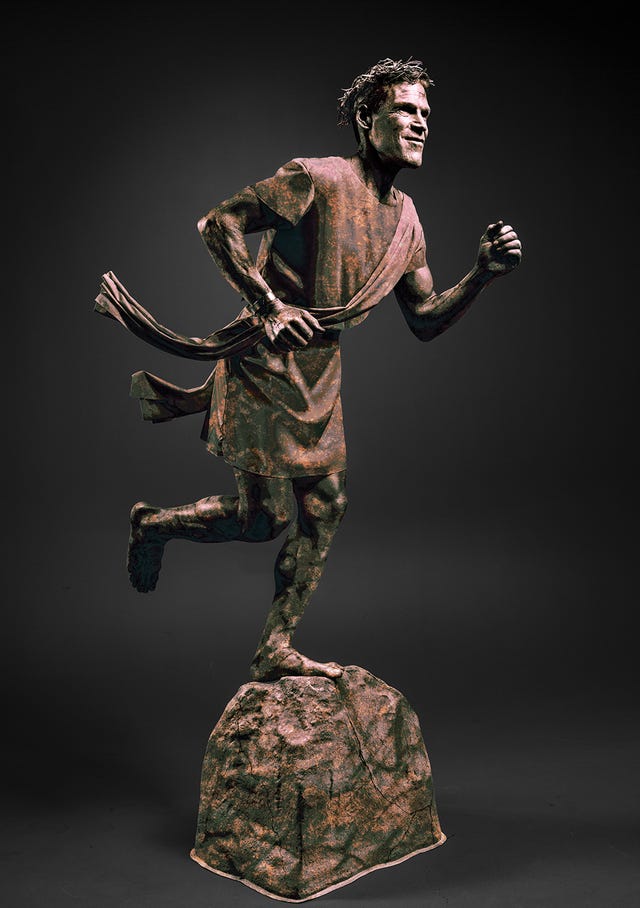
Pheidippides
CourierWikipedia
47
MENTIONS
17
EPISODES
16
PODCASTS
Search complete. 47 mentions across 17 episodes found for "Pheidippides".
Sep 15, 2026

Scott EmmonsHOST
There are a few details that might be considered supernatural.
Scott EmmonsHOST
One of those is the story that the god Pan appeared to the runner Pheidippides on his way to Sparta, a story that Herodotus attributes to Pheidippides himself.
Scott EmmonsHOST
He also tells the story of an Athenian named Epizelos, who was in the thick of the fighting when he saw a giant coming toward him with his beard covering his shield.
Scott EmmonsHOST
The giant passed him by but killed the man next to him, and at that very moment Epizelos was suddenly blinded.
Scott EmmonsHOST
And then there's the story of the runner.
Scott EmmonsHOST
I covered this at the end of the last episode, but it's worth looking at again as an example of how the legend grew over time.
Scott EmmonsHOST
Herodotus, of course, tells the story that Pheidippides, or Philippides in some manuscripts, ran 140 miles to Sparta with an urgent plea for help against the Persians, and on his way he had a vision of the god Pan.
Scott EmmonsHOST
Herodotus doesn't say anything about how he returned to Athens.

Aaron IrberHOST
Right.
Marc AraminiGUEST
And so here we do get, uh, the incursion of the divine into the actions of somebody like, uh, I think Philippides was the...
Marc AraminiGUEST
I'm trying to remember the name of that runner.
Marc AraminiGUEST
It's, it's been a long time.

ClaireHOST
at the time.
ClaireHOST
Now, the most famous messenger runner is Pheidippides.
ClaireHOST
And mom, I'm so sorry if I got that name wrong.
ClaireHOST
I really tried.
ClaireHOST
According to legend, he ran from the battlefield at Marathon to Athens in 490 B.C., The Greeks had defeated the Persian army, and Pheidippides supposedly arrived in Athens, announced the victory, and then he collapsed and died.
ClaireHOST
But there is an important detail here.
ClaireHOST
The version most people know is probably more legend than confirmed history.
ClaireHOST
That is when the Olympic Games began in Athens.

Roland RamblerHOST
The organizers were still working out their own symbolism with no idea they were inventing a visual language people would later treat as eternal.
Roland RamblerHOST
The marathon itself was manufactured for the occasion, a brand-new event in 1896, not a revival of anything ancient, engineered to tie modern athletic ambition to the legend of Pheidippides.
Roland RamblerHOST
The strategy worked.
Roland RamblerHOST
When Spyridon Louis, a local water carrier, won that first race and finished right where we now stood, he became an instant national hero, and Athens had successfully welded ancient memory onto modern nationalism, rivalry, and ceremony.

Jeff CunninghamGUEST
And yeah, I think that I'm looking forward to getting in the studio and getting those done.
Jeff CunninghamGUEST
And it's going to be everything from motivational stuff to science-y stuff to whimsical historical lessons about distance running in the marathon and, you know, everything from Fidipides to – Elliot Kipchoge and everything in between.
Jeff CunninghamGUEST
So we're going to have a good time with it.
Jeff CunninghamGUEST
I'm super pumped.

Joe McGuckinHOST
We'll sail around to Athens where there's no army now.
Joe McGuckinHOST
So some fella called Philippides or something.
Joe McGuckinHOST
I think that was his name.
Joe McGuckinHOST
He was told to leg it to the other side of the island and warned them that the Persians might be coming.
Joe McGuckinHOST
By that time, 9,000 soldiers that fought in the Battle of Marathon made the same trek covered in the same blood from earlier on.
Joe McGuckinHOST
And the distance of that trek is what we now know as a modern day marathon.
Joe McGuckinHOST
So if Philippides and 9,000 war-weary men could run a marathon 2,500 years ago, then anyone can do it now.
Joe McGuckinHOST
And so somebody said to me, if it's that easy, then why don't you do it? Says I don't want to.
Scott EmmonsHOST
One of the first things they did was to send a messenger to Sparta to plead for help.
Scott EmmonsHOST
The man they sent was an athlete by the name of Pheidippides.
Scott EmmonsHOST
Maybe.
Scott EmmonsHOST
The manuscripts of Herodotus fall into two main groups— One group gives his name as Pheidippides, the other gives Philippides, which is a much more common name.
Scott EmmonsHOST
The only other Pheidippides I know of is a character in one of Aristophanes' comedies.
Scott EmmonsHOST
Most modern commentators seem to prefer the tried-and-true name, but no one really knows, and I like Pheidippides, so that's what I'm going to call him.
Scott EmmonsHOST
Pheidippides started out before dawn and ran about 140 miles, or 225 kilometers, to arrive in Sparta late the next day, which sounds like an exaggeration, but modern distance runners have proven that it could be done.
Scott EmmonsHOST
As soon as he arrived, he asked for immediate help, emphasizing that Eretria had fallen and Athens would be next.

John S. WhiteNARRATOR
CHAPTER IV.
John S. WhiteNARRATOR
INSTANCES OF REMARKABLE AGILITY AND ACUTENESS OF SIGHT it was considered a very great thing for philippides to run one thousand one hundred and sixty stadia the distance between athens and lacedaemon in two days until amistus the lacedaemonian courier and philonidas the courier of alexander the great ran from sicyon to elise in one day a distance of thirteen hundred and five stadia Footnote.
John S. WhiteNARRATOR
Philippides must have gone one hundred and forty-two miles in two days, and the other one hundred and fifty miles in one day.
John S. WhiteNARRATOR
End of footnote.
John S. WhiteNARRATOR
In our own times, too, we are fully aware that there are men in the circus who are able to keep on running for a distance of one hundred and sixty miles, and that lately, in the consulship of Phonteus and Vipstanus, there was a child, eight years of age, who between morning and evening ran a distance of seventy-five miles we become all the more sensible of these wonderful instances of swiftness upon reflecting that tiberius nero when he made all possible haste to reach his brother drusus who was then sick in germany reached him in three stages travelling day and night on the road the distance of each stage was two hundred miles instances of acuteness of sight are to be found stated which indeed exceed all belief cicero informs us that the iliad of homer was written on a piece of parchment so small as to be enclosed in a nutshell footnote this statement must have been in some of his lost works footnote he makes mention also of a man who could distinguish objects at a distance of one hundred and twenty-five miles marcus vero says that the name of this man was strabo and that during the punic war from lilybaeum the promontory of sicily he was in the habit of seeing the fleet come out of the harbor of carthage at a distance of over fifty miles and could even count the number of the vessels callicrates used to carve ants and other small animals in ivory so minute in size that other persons were unable to distinguish their individual parts mermesides also was famous in the same line footnote his works in ivory were said to have been so small that they could scarcely be seen without placing them on a black surface this man made of similar material a chariot drawn by four horses which a fly could cover with its wings, as well as a ship which might be covered by the wings of a tiny bee.

Dean KarnazesGUEST
And this book I've just written, The Road to Sparta, is a very Greek story, a historical story.
Dean KarnazesGUEST
And my father always insisted we're from the same village as Pheidippides, who some of you marathoners might know as the first marathoner.
Dean KarnazesGUEST
Fidipides or Fidipides.
Dean KarnazesGUEST
And I went and visited this village in the hills of Greece, and all of the people looked the same.
Dean KarnazesGUEST
And then what happened? He died.
Dean KarnazesGUEST
So that was the story, the lore we've heard about.
Dean KarnazesGUEST
The actual story is much richer than that, in that he first ran, Pheidippides first ran from Athens to recruit the Spartans, which is 153 miles away.
Dean KarnazesGUEST
So that was the real story of the marathon.

DeanAUDIENCE
wise.
DeanAUDIENCE
Socrates was the man that ran the distance, that marathon.
DeanAUDIENCE
Socrates? Yeah, young Mr.
DeanAUDIENCE
Socrates.
DeanAUDIENCE
He was a
Graeme GoodingsHOST
pretty famous dude, wasn't he? Didn't he do something special other than run?
Graeme GoodingsHOST
I remember doing Greek history at school, and I think out of all the subjects I failed in, I failed Greek worst of all.
DeanAUDIENCE
Oh, okay.
7 more episodes mention Pheidippides.
Create an account to see the whole feed, search across every transcript, and follow the entities you care about.