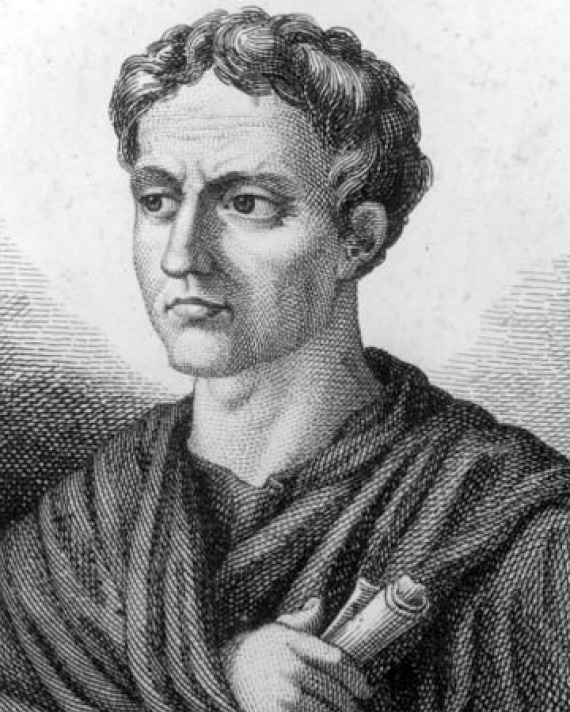
Petronius
Roman authorWikipedia
345
MENTIONS
48
EPISODES
42
PODCASTS
Search complete. 345 mentions across 48 episodes found for "Petronius".
Sep 12, 2026

Moira FogartyNARRATOR
as clement of alexandria and that eusebian book of evangelic preparation transmitting our ears through a hoard of heathenish obscenities to receive the gospel who finds not that irenus epiphanius jerome and others discover more heresies than they well confute and that oft for heresy which is the truer opinion nor boots it to say for these and all the heathen writers of greatest infection if it must be thought so, with whom is bound up the life of human learning, that they writ in an unknown tongue, so long as we are sure those languages are known as well to the worst of men, who are both most able and most diligent to instill the poison they suck, first into the courts of princes, acquainting them with the choicest delights and criticisms of sin.
Moira FogartyNARRATOR
And perhaps did that Petronius, whom Nero called his arbiter, the master of his revels, and the notorious ribald of Arezzo, dreaded and yet dear to the Italian courtiers.
Moira FogartyNARRATOR
I name not him for posterity's sake, whom Henry VIII.
Moira FogartyNARRATOR
named in merriment his vicar of hell, by which compendious way all the contagion that foreign books can infuse will find a passage to the people far easier and shorter than than an Indian voyage, though it could be sailed either by the north of Catao eastward or of Canada westward, while our Spanish licensing gags the English press never so severely.

Thomas CopelandNARRATOR
Who finds not that Irenaeus, Epiphanius, Jerome, and others discover more heresies than they well confute, and that offers for heresy which is the truer opinion? nor boots it to say for these and all the heathen writers of greatest infection, if it must be thought so, with whom is bound up the life of human learning, that they wrote in an unknown tongue, so long as we are sure those languages are known as well to the worst of men, who are both most able and most diligent to instill the poison they suck first into the courts of princes, acquainting them with the choicest delights and criticisms of sin.
Thomas CopelandNARRATOR
as perhaps did that Petronius, whom Nero called his arbiter, the master of his revels, and that notorious ribaldorezzo, dreaded and yet dear to the Italian courtiers.
Thomas CopelandNARRATOR
I name not him, for posterity's sake, whom Herod VIII.
Thomas CopelandNARRATOR
named in merriment his vicar of hell.
Thomas CopelandNARRATOR
Who finds not that Irenaeus, Epiphanius, Jerome, and others discover more heresies than they well confute, and that offers for heresy which is the truer opinion? nor boots it to say for these and all the heathen writers of greatest infection, if it must be thought so, with whom is bound up the life of human learning, that they wrote in an unknown tongue, so long as we are sure those languages are known as well to the worst of men, who are both most able and most diligent to instill the poison they suck first into the courts of princes, acquainting them with the choicest delights and criticisms of sin.
Thomas CopelandNARRATOR
as perhaps did that Petronius, whom Nero called his arbiter, the master of his revels, and that notorious Ribaldorezzo, dreaded and yet dear to the Italian courtiers.
Thomas CopelandNARRATOR
I name not him, for posterity's sake, whom Herod VIII.
Thomas CopelandNARRATOR
named in merriment his vicar of hell.

Martin GeesonNARRATOR
But the exclusive preoccupation with form, the sonorities of tone, the clangour of metals, did not entirely conceal from him the emptiness of the thought, the turgidity of those blisters which emboss the skin of the Pharsalia.
Martin GeesonNARRATOR
Petronius was the author whom he truly loved, and who caused him forever to abandon the sonorous ingenuities of Lucan, for he was a keen observer, a delicate analyst, a marvellous painter.
Martin GeesonNARRATOR
Tranquilly, without prejudice or hate, he described Rome's daily life, recounting the customs of his epoch in the sprightly little chapters of the Satyricon.
Martin GeesonNARRATOR
Observing the facts of life, stating them in clear, definite form, he revealed the petty existence of the people, their happenings, their bestialities, their passions.
Martin GeesonNARRATOR
This realistic novel, this slice of Roman life without any preoccupation, whatever one may say of it, with reform and satire, without the need of any studied end or of morality, this story without intrigue or action, portraying the adventures of evil persons, analyzing with a calm finesse the joys and sorrows of these lovers and couples, depicting life in a splendidly wrought language without surrendering himself to any commentary, without approving or cursing the acts and thoughts of his characters, the vices of a decrepit civilization, of an empire that cracks, struck desessante.
Martin GeesonNARRATOR
In the keenness of the observation, in the firmness of the method, he found singular comparisons, curious analogies with the few modern French novels he could endure.
Martin GeesonNARRATOR
Certainly, he bitterly regretted the Eustion and the Albutiae, those two works by Petronius mentioned by Planciades Fulgentius, which are forever lost.
Martin GeesonNARRATOR
But the bibliophile in him consoled the student when he touched with worshipful hands the superb edition of the Satyricon which he possessed, the octavo bearing the date 1585 and the name of J. Dousa of Leiden.

Anne BoulayNARRATOR
For more information or to volunteer, please visit LibriVox.org. Recording by Anne Boulay.
Anne BoulayNARRATOR
The Satyricon by Gaius Petronius Arbiter.
Anne BoulayNARRATOR
Translated by W.C. Firebell.
Anne BoulayNARRATOR
Preface and Introduction.
Anne BoulayNARRATOR
The change in cultured speech of a language is a process that requires years to become pronounced.
Anne BoulayNARRATOR
The evolution of slang is rapid, and its usage ephemeral.
Anne BoulayNARRATOR
For example, Stephen Gasley, in his bibliography of Petronius, calls attention to Henry Thurston Peck's rendering of bellum bonum by he's a daisy, and remarks, appropriately enough, that this was well enough for 1898, but we would now be more inclined to render it he's a peach.
Anne BoulayNARRATOR
Again, Peck renders illud erat vivere by that was life, but in the words of our lyric American jazz, we would be more inclined to render it that was the life.

AnkaSOUNDBITE_SPEAKER
I wonder what we should pick today.
AnkaSOUNDBITE_SPEAKER
How about Petronius? An interesting fellow, this one.
CoenSOUNDBITE_SPEAKER
What does he write about?
AnkaSOUNDBITE_SPEAKER
Oh, the usual.

Moira FogartyNARRATOR
Who finds not that Irenaeus, Epiphanius, Jerome, and others discover more heresies than they well confute, and that oft for heresy which is the truer opinion? Nor boots it to say for these, and all the heathen writers of greatest infection, if it must be thought so, with whom is bound up the life of human learning, that they writ in an unknown tongue, so long as we are sure those languages are known as well to the worst of men, who are both most able and most diligent to instill the poison they suck, first into the courts of princes, acquainting them with the choicest delights and criticisms of sin.
Moira FogartyNARRATOR
And perhaps did that Petronius, whom Nero called his arbiter, the master of his revels, and the notorious ribald of Arezzo, dreaded and yet dear to the Italian courtiers.
Moira FogartyNARRATOR
I name not him for posterity's sake whom Henry VIII named in merriment his vicar of hell.
Moira FogartyNARRATOR
By which compendious way all the contagion that foreign books can infuse will find a passage to the people far easier and shorter than an Indian voyage, though it could be sailed either by the north of Catao eastward or of Canada westward, while our Spanish licensing gags the English press never so severely.

Megyn KellyHOST
Um, it's-
Victor Davis HansonGUEST
We don't, we're afraid or we don't wanna talk about this whole trans phenomenon, which historically, if you look at sexologists of the 19th century, they, they coined the word gender dysphoria There's common examples in antiquity, in Catullus, uh, for example, of, or Petronius's Satyricon, of people who cross-dress and think they belong to the other sex, but it's always considered very, very rare.
Victor Davis HansonGUEST
And this idea that it's 10% of the population, and then when you inject drugs and all of these things that we talk about, hormones, these dangerous drugs that usually the left says are too dangerous and physicians are overreaching, now they have the opposite view.
Victor Davis HansonGUEST
And then you look at the percentage of trans shooters in mass shootings, it's way over-represented.

speaker_4NARRATOR
Consequently also, as may be reasonably inferred, for many of the most delightful and daring nuances of free, free-spirited thought.
speaker_4NARRATOR
And just as the buffoon and satyr are foreign to him in body and conscience, so Aristophanes and Petronius are untranslatable for him.
speaker_4NARRATOR
Everything ponderous, viscous, and pompously clumsy, all long-winded and wearying species of style, are developed in profuse variety among Germans.
speaker_4NARRATOR
Pardon me for stating the fact that even Goethe's prose, in its mixture of stiffness and elegance, is no exception, as a reflection of the good old time to which it belongs, and as an expression of German taste at a time when there was still a German taste, which was a rococo taste in moribus et artibus.
speaker_4NARRATOR
Lessing loved also free-spiritism in the tempo and flight out of Germany.
speaker_4NARRATOR
But how could the German language, even in the prose of Lessing, imitate the tempo of Machiavelli, who in his Principe makes us breathe the dry, fine air of Florence, and cannot help presenting the most serious events in a boisterous allegrissimo, perhaps not without a malicious artistic sense of the contrast he ventures to present? Long, heavy, difficult, dangerous thoughts, and a tempo of the gallop and of the best, wantonest humor.
speaker_4NARRATOR
Finally, who would venture on a German translation of Petronius, who, more than any great musician hitherto, was a master of presto in invention, ideas, and words? What matter in the end about the swamps of the sick, evil world, or of the ancient world, when, like him, one has the feet of a wind, the rush, the breath, the emancipating scorn of a wind, which makes everything healthy by making everything run? And, with regard to Aristophanes, that transfiguring, complementary genius, for whose sake one pardons all Hellenism for having existed, provided one has understood in its full profundity all that there requires pardon and transfiguration.
speaker_4NARRATOR
There is nothing that has caused me to meditate more on Plato's secrecy and sphinx-like nature than the happily preserved petit fait that under the pillow of his deathbed there was found no Bible, nor anything Egyptian, Pythagorean, or Platonic, but a book of Aristophanes.

speaker_5NARRATOR
Consequently also, he may be reasonably inferred for many of the most delightful and daring nuances of free, free-spirited thought.
speaker_5NARRATOR
And just as the buffoon and satyr are foreign to him in body and conscience, so Aristophanes and Petronius are untranslatable for him.
speaker_5NARRATOR
Everything ponderous, viscous, and pompously clumsy, all long-winded and weary species of style, are developed in profuse variety among Germans.
speaker_5NARRATOR
Pardon me for stating the fact that even Goethe's prose, in its mixture of stiffness and elegance, is no exception, as a reflection of the good old time to which it belongs, and an expression of German taste at a time when there was still a German taste, which was a rococo taste in moribus et artibus.
speaker_5NARRATOR
Lessing is an exception, owing to his histrionic nature, which understood much and was versed in many things.
speaker_5NARRATOR
He who was not the translator of Baal to no purpose, who took refuge willingly in the shadow of Diderot and Voltaire, and still more willingly among the Roman comedy writers, Lessing loved also free-spiritism in the tempo and flight out of Germany.
speaker_5NARRATOR
But how could the German language, even in the prose of Lessing, imitate the tempo of Machiavelli, who in his Principa makes us breathe the dry, fine air of Florence, and cannot help presenting the most serious events in a boisterous allegresimo, perhaps not without a malicious artistic sense of the contrast he ventures to present—long, heavy, difficult, dangerous thoughts, and a tempo of the gallop and of the best wantonous humor? Finally, who could venture on a German translation of Petronius, who, more than any great musician hitherto, was a master of presto in invention, ideas, and words? What matter in the end about the swamps of the sick, evil world, or of the ancient world, when like him one has the feet of the wind, the rush, the breath, the emancipating scorn of a wind which makes everything healthy by making everything run? And with regard to Aristophanes, that transfiguring, complementary genius, for whose sake one pardons all Hellenism for having existed, provided one has understood in its full profundity all that there requires pardon and transfiguration, there is nothing that has caused me to meditate more on Plato's secrecy and sphinx-like nature than the happily preserved petit fait that under the pillow of his deathbed there was found no Bible, nor anything Egyptian, Pythagorean, or Platonic.
speaker_5NARRATOR
but a book of Aristophanes.
38 more episodes mention Petronius.
Create an account to see the whole feed, search across every transcript, and follow the entities you care about.