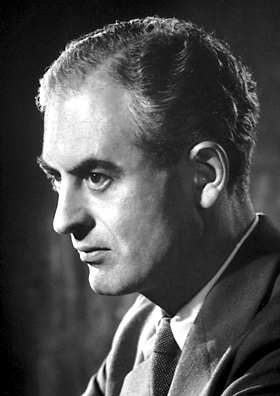
Peter Medawar
Brazilian biologist and writerWikipedia
5
MENTIONS
5
EPISODES
5
PODCASTS
Search complete. 5 mentions across 5 episodes found for "Peter Medawar".
Sep 30, 2026

Josh MezrichGUEST
So he jokes that he's still, like, a third-year resident, and he's, like, an R60 or what- [laughs] whatever he would be.
Josh MezrichGUEST
Um, but, um, he, uh, became fascinated with transplant, with, you know, reading about the work of Peter Medawar, and became fascinated with tolerance and, you know, th-this idea of trying to make transplants work without immunosuppression, trying to trick the immune system into accepting, uh, foreign organs.
Josh MezrichGUEST
But at around the same time, he also got interested in xenotransplantation, and he was a believer that if you could demonstrate something in nature, even at the l- uh, uh, in a small animal, you could eventually make it work in humans.
Josh MezrichGUEST
And, um, that's why he thought transplant intolerance should work, because of Medawar's work in mice, and it's why he thought xeno could work, because of some mouse work where they were able to get mice to accept, um, you know, foreign organs, and he figured if it can be done in mouse, it can be done in humans.

Nico McCartyNARRATOR
In his autobiography, Burnett ultimately stated, "...I regard the development of the clonal selection theory of immunity as my most important scientific achievement." When a biologist considers a theory his main contribution to science, that says something.
Nico McCartyNARRATOR
Indeed, the clonal selection theory of immunity laid the foundations for understanding immunological memory and immunological tolerance, and it was for its discovery that Burnett shared a Nobel Prize in medicine with Peter Medawar in 1960 and eventually made the development of monoclonal antibodies possible.
Nico McCartyNARRATOR
Its organizing force in immunology was akin to what Mendeleev's periodic table did in chemistry, or what indeed Darwinian evolution did in biology as a whole.
Nico McCartyNARRATOR
To discern order in a dizzying complexity of nature is theoretical thinking at its finest.

John LennoxGUEST
In other words, what they've seen positively is that science is limited.
John LennoxGUEST
As Sir Peter Medawar, the Nobel Prize winner at Oxford, wrote, it's very easy to see that the natural sciences are limited in that they cannot answer the simple questions of a child.
John LennoxGUEST
Where do I come from? Where am I going? What is the meaning of life? You have to turn to literature and philosophy, and I would add, and to theology and religion to learn about that.
John LennoxGUEST
Now that limitation, realizing it, is extremely important.

Ryan SafferNARRATOR
If, in addition to all that it implicitly delivers, belief also finally provides what it explicitly promises.
Ryan SafferNARRATOR
Paraphrasing a reflection made by Nobel Prize in Medicine, Peter Medawar, when condemning the idea that culturally rooted healing myths should be placed on the same epistemic plane as medical science, person with a toothache may prefer a treatment that actually eliminates the problem to a ritual of profound, poetic, social, and spiritual significance, which will do nothing to alleviate their suffering.
Ryan SafferNARRATOR
At dawn, hours after the end of the ceremony, when adrenaline is low and everything is quiet, it is the sufferer who continues to endure alone and in silence.
Michael MarshallHOST
That was The Persistence of Error, Why Longevity Doesn't Equate to Veracity, written by Carlos Orsi, first published in June 2023, and read here by Ryan Saffer.

Gary ArndtHOST
The breakthrough came largely from experiments during and after World War II.
Gary ArndtHOST
British biologist Peter Medawar studied skin grafts, partly because severe burns suffered by wartime casualties created an urgent interest in skin transplantation.
Gary ArndtHOST
Medawar demonstrated that graft rejection was not simply the result of poor surgery.
Gary ArndtHOST
It was an immune response.