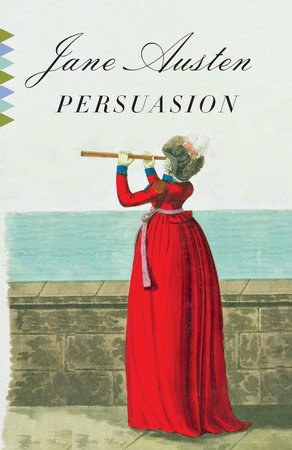
Persuasion
Novel by Jane AustenWikipedia
751
MENTIONS
46
EPISODES
38
PODCASTS
Search complete. 751 mentions across 46 episodes found for "Persuasion".
Sep 17, 2026

Annie JonesHOST
i love an alliteration the staff knows it's a real problem um okay i'll i'll see you in the winter nice knowing you This week, I'm listening to The Four Wives and Five Deaths of Richard Milford by Nafissa Thompson Spires.
Annie JonesHOST
Ashley, what are you reading? I'm reading Persuasion by Jane Austen.
Annie JonesHOST
From the Front Porch is a weekly podcast production of The Bookshelf, an independent bookstore in Thomasville, Georgia.
Annie JonesHOST
You can follow The Bookshelf's daily happenings on Instagram at bookshelftvill, and all the books from today's episode can be purchased online through our store website.

speaker_1ADVERTISER
Veuillez jouer de manière responsable.
Moira FogartyNARRATOR
Persuasion by Jane Austen.
Moira FogartyNARRATOR
Chapter 1.
Moira FogartyNARRATOR
This is a LibriVox recording.
Moira FogartyNARRATOR
All LibriVox recordings are in the public domain.
Moira FogartyNARRATOR
For more information and to find out how you can volunteer, please visit LibriVox.org. Recording by Moira Fogarty.
Moira FogartyNARRATOR
Persuasion by Jane Austen.
Moira FogartyNARRATOR
Chapter 1.

speaker_1ADVERTISER
Third Lady, read by Marian Carwin.
Bob NeufeldNARRATOR
Persuasion by Jane Austen.
Bob NeufeldNARRATOR
Chapter one.
Bob NeufeldNARRATOR
Sir Walter Elliot of Kellynch Hall in Somersetshire was a man who, for his own amusement, never took up any book but the Baronetage.
17 MINS LATER
Bob NeufeldNARRATOR
The Kellynch estate should be transmitted whole and entire, as he had received it.
Bob NeufeldNARRATOR
Their two confidential friends, Mr Shepherd, who lived in the neighbouring market town, and Lady Russell, were called to advise them, and both father and daughter seemed to expect that something should be struck out by one or the other to remove their embarrassments and reduce their expenditure without involving the loss of any indulgence of taste or pride.
Bob NeufeldNARRATOR
End of chapter 1 of Persuasion by Jane Austen.
Bob NeufeldNARRATOR
Chapter 2 of Persuasion by Jane Austen.

Vanessa ZoltanHOST
Mm-hmm.
Stephanie PaulsellHOST
Elizabeth Bowen describes the novel Persuasion as a masterpiece of delicate strength.
Vanessa ZoltanHOST
Mm.
Stephanie PaulsellHOST
And that's what Anne is.
29 MINS LATER
Vanessa ZoltanHOST
Yeah, yeah, yeah.
Vanessa ZoltanHOST
It's social mores and decorum more than religion.
Claudia JohnsonSOUNDBITE_SPEAKER
The passage that you mentioned to me in chapter 10 of Persuasion was so interesting.
Claudia JohnsonSOUNDBITE_SPEAKER
You asked, "Well, if a little fever of admiration isn't love, then, then what is?" And I so reread the passage, and it seems to me that Austen tips her hand with the adjective "little."

Jonathan ThomasHOST
Robert Morrison is a literary historian and biographer, Queen's National Scholar at Queen's University in Ontario, Canada, and from 2019 to 2024 was the British Academy Global Professor at Bath Spa University.
Jonathan ThomasHOST
And he is the author of The Regency Years, named by The Economist as one of its books of the year and shortlisted for the Historical Writers Association Crown Award as well as a prize-winning biography of Thomas De Quincey and the acclaimed annotated edition of Austin's Persuasion.
Jonathan ThomasHOST
There is nobody better to walk us through what the Regency era was, what it was really like, and why it still grips us 200 years later.
Jonathan ThomasHOST
Robert, welcome to the Angletopia podcast.
22 MINS LATER
Robert MorrisonGUEST
Shelley writes one of the most famous ghost stories, monster stories of the world, Frankenstein.
Robert MorrisonGUEST
And it happens during a ghost story competition when a man named John Polidori, who's Byron's physician, writes a story called The Vampire.
Robert MorrisonGUEST
So you've got to imagine Jane Austen sitting, writing Persuasion at the same time that Mary Shelley's writing Frankenstein and John Polidori's writing The Vampire.
Robert MorrisonGUEST
The two most famous horror myths of the 19th century, 20th century, 21st century, come out of the same circle.

EthanHOST
That would've been, uh, Wrinkle in Time, I think.
KarenGUEST
No, I believe that was Persuasion.
EthanHOST
Oh, no, no, that was Persuasion.
EthanHOST
Okay.
KarenGUEST
'Cause Sarah was on that one, too.

Margaret H. WillisonGUEST
And it is an incredible podcast with two Austen academics, where what they do is they just dive into the material history and context around various different things in various different Austen novels.
Margaret H. WillisonGUEST
Like, does it mean anything about Captain Wentworth that he's carrying around an umbrella in Bath, in Persuasion? They're like, "It sure does," and you can listen to the thing about Captain Wentworth's umbrella.
Linda HolmesHOST
[laughs]
Margaret H. WillisonGUEST
These are great episodes because they're pretty short.
Margaret H. WillisonGUEST
... that they were like, "Come on up."
Linda HolmesHOST
[laughs]
Margaret H. WillisonGUEST
"Chat about Captain Wentworth's letter in Persuasion," and I was like, "I would love to." Just look for the one that's gonna catch your eye.
Margaret H. WillisonGUEST
If you are someone who would be inclined to listen to a podcast like this, you would never find a better version of it than this one.
Vanessa ZoltanHOST
We are dropping into your feed today with a little bonus conversation.
Vanessa ZoltanHOST
So as you may or may not know, as much as I love Jane Austen and Persuasion, and I really, really do, my all-time favorite novel is Actually, Jane Eyre by Charlotte Bronte, although my darling Charlotte does betray me by sometimes trash talking Jane Austen.
Vanessa ZoltanHOST
And I think she was way off about that.
Vanessa ZoltanHOST
But as we've been reading Persuasion, Jane Eyre keeps coming up in my mind, even though they are very different tonally.
Vanessa ZoltanHOST
Both Anne and Jane are women who grew up without loving parents.
Vanessa ZoltanHOST
Both Anne and Jane are young women who are alone in the world and yet have really strong senses of self, and those senses of self deteriorate and sort of have those fans flamed again in conversation with a man.
Vanessa ZoltanHOST
And I am lucky enough, I'm going on a Jane Eyre pilgrimage with the wonderful author Paula Lafferty in 2027.
Vanessa ZoltanHOST
And so I wanted to get Paula's thoughts on on some of these themes, on why we think that these are recurring themes in romantic literature.

speaker_0ADVERTISER
Terms apply.
Karen SavageNARRATOR
Chapter one of Persuasion.
Karen SavageNARRATOR
This is the LibriVox recording.
Karen SavageNARRATOR
All LibriVox recordings are in the public domain.
Karen SavageNARRATOR
For more information or to volunteer, please visit LibriVox.org. Recording by Karen Savage.
Karen SavageNARRATOR
Persuasion by Jane Austen.
Karen SavageNARRATOR
Chapter one.
Karen SavageNARRATOR
Sir Walter Elliot of Kellynch Hall in Somersetshire was a man who, for his own amusement, never took up any book but the Baronetage.

speaker_5NARRATOR
a last criticism on anna's book is worth quoting for its direct bearing on the critic's own method you describe a sweet place but your descriptions are often more minute than will be liked you give too many particulars of right hand and left jane's estimate of her own manner of work is modest enough the little bit two inches wide of ivory on which i work with so fine a brush as produces little effect after much labor she says with this phrase of her own as a text she has been called a miniaturist but if artists and authors are to be compared there is quite as much of the selection and the richness of a gainsborough in her work as of the minuteness of a metsu or a meissonier in her reply to the amazing proposal of the librarian at carlton house that she should compose an historical romance founded on the records of the saxe-coburg family she writes not without a touch of her gentle satire i am fully sensible that such a romance might be much more to the purpose of profit or popularity than such pictures of domestic life in country villages as i deal in but i could no more write a romance than an epic poem i could not sit seriously down to write a serious romance under any other motive than to save my life and if it were indispensable for me to keep it up and never relax into laughing at myself or any other people i am sure i should be hung before i had finished the first chapter no i must keep to my own style and go on in my own way and though i may never succeed again in that i am convinced that i should totally fail in any other her limitations of subject are clear in her own mind even of the domestic life in villages she would only deal with the side where the daily bread was provided out of income not out of retail profits or weekly wages it is a suggestive fact to which i have already alluded that she never even tried to draw a peasant's family her heroines may on the rarest occasions call at a cottage to inquire after a sick child or leave a charitable gift but of the conditions under which the laboring classes lived during the hard times of the french wars we learn nothing at all from her writings the nearest approaches to such subjects are the account of the prices home at portsmouth a sordid interior which has been held i think not unjustly to be as vivid in its suggestion of impecuniosity and discomfort as anything written by zola and the similar but far less effective picture of the watsons family life her literary style seems to be spontaneous and so in comparison with that of stylists it certainly is she had stored her mind with good literature while still in her teens and no doubt most of her limpid sentences flowed freely from her pen but the consistent absence of superfluous epithets and other redundancies is evidence that she had consciously formed an ideal of composition and that she thought out the means of producing her effects as clear from several passages in her letters to her niece who addressed her as dear miss darcy and wanted her to answer in that character jane replied even had i more time i should not feel at all sure of the sort of letter that miss d would write she had studied her art till she could analyse its qualities as we may see from a letter written from chawton in eighteen thirteen miss austen had been reading pride and prejudice aloud to jane and martha lloyd who lived with the austens and jane tells cassandra that though she perfectly understands the characters herself she cannot speak as they ought upon the whole however i am quite vain enough and well satisfied enough the work is rather too light and bright and sparkling it wants shade to be stretched out here and there an essay on writing a critique on walter scott or the history of bonaparte or something that would form a contrast and bring the reader with increased delight to the playfulness and epigrammatism of the general style Happily, she did not provide the conventional shade which would have been on a par with the brown tree that, according to Sir George Beaumont, was an indispensable feature of every properly composed landscape painting.
speaker_5NARRATOR
Shade, however, did appear in several chapters of Persuasion, which, for a certain suggestion of melancholy, stands apart from the other novels, though not as markedly as Northanger Abbey stands apart for its exuberant frivolity.
speaker_5NARRATOR
macaulay declared of fanny burney's later style that it was the worst that has ever been known among men jane austen's style in its happy hours is so admirably adapted to its purpose that while we may not call it the best a term which advertisement has rendered meaningless as a standard of excellence it has never been surpassed as a means to a desired end it seems trite to say that the first point to consider in any question of style is the intended result but it is a point so frequently overlooked that much criticism about art and letters as about politics or agriculture is vitiated by the hopeless effort to set up an abstract ideal applicable to all cases like a universal watch-key the result for which jane austen worked can scarcely be put in question she was impelled to make her little world live in fiction not precisely as she saw it and heard it but as she could most attractively present it to minds possessing the indispensable modicum of humour without which the charm is lost at least as nearly as the charm of a turner's sunset by a person whose optic nerve is irresponsive to red rays apart from her prevailing humour the modesty of her style is a continual beauty there is none of that florid eloquence which depends more on sound than sense for its effect nor of that forcing of strange phrases which in these days so often passes for literary excellence there is no precociousity about her books the narrative is easy the incidents are probable the dialogue with few exceptions is natural the bright people being differentiated from the dull by their talk and not as in most novels by the author's assurances if mr meredith was right when he declared that it is unwholesome for men and women to see themselves as they are if they are no better than they should be there must be many unwholesome pages in jane austen's work for the tolerably large class to which he referred neither in real life nor in the life of her books did she suffer fools gladly and so far as the men of her creation are concerned she is on the whole more successful in representing the foolish than the wise her chief failure is in the realization of such a young man as one of her heroines would have been likely to admire most of the younger men are sketchily drawn and we who are men would fain believe that she did not understand the nature of a man's heart seeing that she never found one worth accepting knightley and bertram seem to have been favourites of hers but they are not lively people nor sufficiently wanting in priggishness the liveliest of them all is henry tilney whatever his qualities of mind the jane austen touch is charmingly varied and it is felt in some of its happy strokes in the talk between this mercurial young rector and the girl whose early budding affections he so speedily returns have you been long in bath madam about a week sir replied katherine trying not to laugh really with affected astonishment why should you be surprised sir why indeed said he in his natural tone but some emotion must appear to be raised by your reply and surprise is more easily assumed and not less reasonable than any other this bit of dialogue recalls a remark in a letter written by jane to cassandra benjamin portal is here how charming that is i do not exactly know why but the phrase followed so naturally that i could not help putting it down mr collins is one of the most finished of jane's studies of men he comes near to the impossible at times but she makes him a living creature the speech in which he offers his hand and advantages to his cousin elizabeth has often been quoted and its charms can never fade only a page of it is necessary to tempt the reader to turn again or for the first time to pride and prejudice in order that he may find the rest of the inimitable scene My reasons for marrying are, first, that I think it is a right thing for every clergyman in easy circumstances like myself to set the example of matrimony in his parish.
speaker_5NARRATOR
Secondly, that I am convinced it will add very greatly to my happiness, and, thirdly, which perhaps I ought to have mentioned earlier, that it is the particular advice and recommendation of the very noble lady whom I have the honour of calling patroness.
1 HR 3 MINS LATER
speaker_6NARRATOR
The General has got the gout, and Mrs. Maitland the jaundice.
speaker_6NARRATOR
The ball to which Jane Austen went in 1808, her thirty-fourth year, was rather more amusing than she expected.
speaker_6NARRATOR
the melancholy part was to see so many dozen young women standing by without partners and each of them with two ugly naked shoulders it was the same room in which we danced fifteen years ago i thought it all over and in spite of the shame of being so much older felt with thankfulness that i was quite happy now as then we paid an additional shilling for our tea this letter is but one of many bits of evidence that no memory of a captain wentworth troubled jane's own life the shame such a woman could have felt in being older one can scarcely imagine and the context shows it was not seriously felt The most pathetic dancing incident in the novels was the impromptu affair at Uppercross in Persuasion, where Anne saw her old lover apparently losing his heart elsewhere.
speaker_6NARRATOR
The evening ended with dancing.
36 more episodes mention Persuasion.
Create an account to see the whole feed, search across every transcript, and follow the entities you care about.