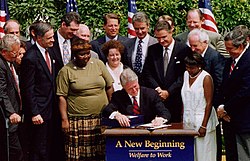
Personal Responsibility and Work Opportunity Reconciliation Act of 1996
14
MENTIONS
13
EPISODES
13
PODCASTS
Search complete. 14 mentions across 13 episodes found for "Personal Responsibility and Work Opportunity Reconciliation Act of 1996".
Oct 3, 2026

Dan NewmanHOST
Current law generally requires a valid Social Security number for the Earned Income Tax Credit, while eligibility for the other one, the Additional Child Tax, Tax Credit, varies based upon statutory requirements.
Dan NewmanHOST
The Trump administration's proposal would further limit eligibility by applying standards under the Personal Responsibility and Work Opportunity Reconciliation Act.
Dan NewmanHOST
These names kill me.
Dan NewmanHOST
That's to certain refundable tax credits.

John GreenHOST
However, Clinton did actually shrink parts of the government with policies like the Telecommunications Act of 1996, which deregulated broadcasting.
John GreenHOST
But Clinton's signature economic policy was welfare reform, AKA the Personal Responsibility and Work Opportunity Act of 1996.
John GreenHOST
This law replaced the Aid to Families with Dependent Children program, which had given money directly to poor mothers.
John GreenHOST
But with Clinton's welfare reform, states received block grants that came with strings attached, including work requirements and time limits for total benefits.

Adam JohnsonHOST
i do like god bless whoever changed ceos to business leaders
Nima ShiraziHOST
business leaders that's right now the piece ended with a quote from one of these concerned quote-unquote real americans who grumbled quote something needs to be done some more programs to try and get people off welfare end quote The piece didn't bother to counter this by citing the potential benefits of social programs, nor did it explain that welfare programs had already been under severe assault by the Clinton administration in its first term, which just months later would pass the Personal Responsibility and Work Opportunity Reconciliation Act of 1996, thus further burdening people in need of government assistance.
Nima ShiraziHOST
Nor did this article note that as of 1992, only 5.5% of the US population was on welfare, a number that had decreased by 1996, thanks in large part to Clinton's law.
Nima ShiraziHOST
But nevertheless, what the article does is it launders the anti-welfare posture of, say, I don't know, the Toledo, Ohio business leaders with the

Jeanne SparrowHOST
Capitol News Illinois reports a federal judge in Rhode Island has struck down an effort by the administration to require states to verify citizenship or lawful immigration status before people can access services like Head Start, homeless shelters, and mental health crisis programs.
Jeanne SparrowHOST
The legal fight centers on the Personal Responsibility and Work Opportunity Reconciliation Act, the landmark 1996 welfare reform law.
Jeanne SparrowHOST
While that law restricts non-citizens from receiving major federal benefits like Medicaid and TANF, federal agencies historically created exceptions for vital community and emergency services.
Jeanne SparrowHOST
However, following a 2025 executive order aimed at curbing federal spending on non-citizens, several federal agencies, including Health and Human Services and the Department of Justice, revoked those long-standing exceptions.

Zak PaineHOST
We initially spoke about it at the time that they proposed it.
Zak PaineHOST
But if finalized and appears that it will be finalized, it would classify the refunded portions of four tax credits as federal public benefits under the Personal Responsibility and Work Opportunity Reconciliation Act of 1996.
Zak PaineHOST
Now, under that law, illegal immigrants are generally prohibited from receiving federal public benefits.
Zak PaineHOST
So the proposed rule would apply to the child tax credit, the earned income tax credit, the American Opportunity Tax Credit, and the adoption tax credit.

Ben WaterhouseHOST
[upbeat music]
Lee VinselHOST
So Lily, on August 22nd, 1996, Bill Clinton signed the welfare reform bill, the Personal Responsibility and Work Opportunity Reconciliation Act, if that isn't a mouthful, which, uh, many see as the high watermark of his betrayal of older liberal and progressive values.
Ben WaterhouseHOST
But we should also point out that on August 22nd, 1996, Lee Vinsel turned 17 years old, um, and celebrated-
Lee VinselHOST
[laughs]

Ben WaterhouseHOST
[gentle music]
Lee VinselHOST
So Lilli, on August 22nd, 1996, Bill Clinton signed the welfare reform bill, the Personal Responsibility and Work Opportunity Reconciliation Act, if that isn't a mouthful, which, uh, many see as the high watermark of his betrayal of older liberal and progressive values.
Ben WaterhouseHOST
But we should also point out that on August 22nd, 1996, Lee Vinsel turned 17 years old, um, and celebrated-
Lee VinselHOST
[laughs]

Ben WaterhouseHOST
Now, given that we were all teenagers, including her, but not including you, Joe, when that happened, we were especially surprised and very impressed by the answer that she gave.
Lee VinselHOST
So, Lily, on August 22nd, 1996, Bill Clinton signed the Welfare Reform Bill, the Personal Responsibility and Work Opportunity Reconciliation Act, if that isn't a mouthful, which many see as the high watermark of his betrayal of older liberal and progressive values.
Ben WaterhouseHOST
But we should also point out that on August 22nd, 1996, Lee Vinsel turned 17 years old and celebrated his birthday.
Ben WaterhouseHOST
I was 18, I think, in either finishing summer camp or already back from summer camp.

Ben WaterhouseHOST
Now, given that we were all teenagers, including her, but not including you, Joe, when that happened, we were especially surprised and very impressed by the answer that she gave.
Lee VinselHOST
So, Lily, on August 22nd, 1996, Bill Clinton signed the Welfare Reform Bill, the Personal Responsibility and Work Opportunity Reconciliation Act, if that isn't a mouthful, which many see as the high watermark of his betrayal of older liberal and progressive values.
Ben WaterhouseHOST
But we should also point out that on August 22nd, 1996, Lee Vinsel turned 17 years old and celebrated his birthday.
Ben WaterhouseHOST
I was 18, I think, in either finishing summer camp or already back from summer camp.

Ben WaterhouseHOST
Now, given that we were all teenagers, including her, but not including you, Joe, when that happened, we were especially surprised and very impressed by the answer that she gave.
Lee VinselHOST
So, Lily, on August 22nd, 1996, Bill Clinton signed the Welfare Reform Bill, the Personal Responsibility and Work Opportunity Reconciliation Act, if that isn't a mouthful, which many see as the high watermark of his betrayal of older liberal and progressive values.
Ben WaterhouseHOST
But we should also point out that on August 22nd, 1996, Lee Vinsel turned 17 years old and celebrated his birthday.
Ben WaterhouseHOST
I was 18, I think, in either finishing summer camp or already back from summer camp.
3 more episodes mention Personal Responsibility and Work Opportunity Reconciliation Act of 1996.
Create an account to see the whole feed, search across every transcript, and follow the entities you care about.