Perseids
Meteor showerWikipedia
46
MENTIONS
27
EPISODES
20
PODCASTS
Search complete. 46 mentions across 27 episodes found for "Perseids".
Oct 26, 2026

DianaHOST
That's called the radiant.
DianaHOST
For the Perseids, that radiant lies in Perseus.
DianaHOST
The meteoroids aren't actually coming from Perseus.
DianaHOST
The stars have nothing to do with them.
DianaHOST
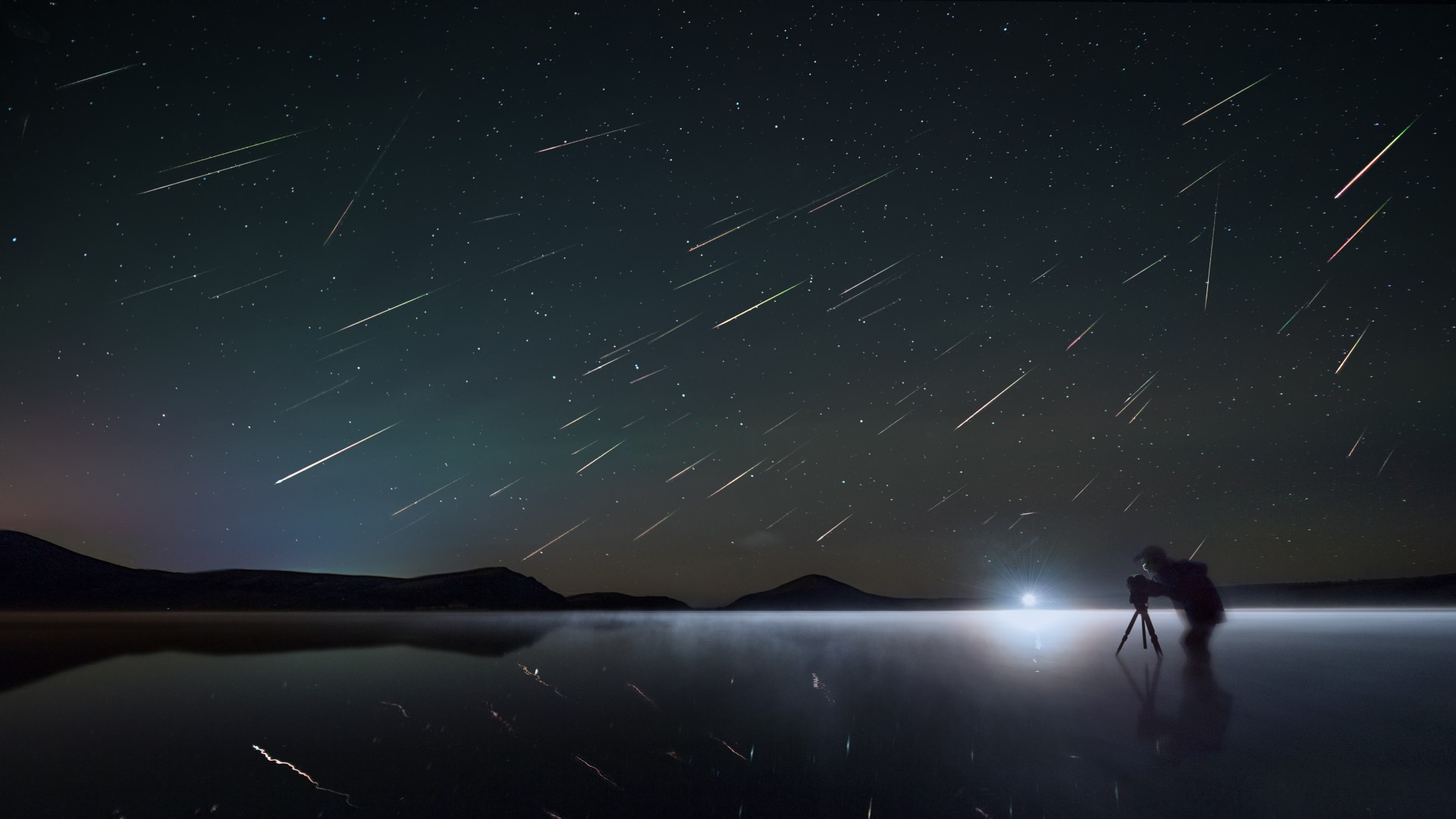
But from Earth? Every August, Perseus appears to throw sparks.
DianaHOST
That shower usually reaches its maximum around August 12th or 13th.
DianaHOST
Under good rural skies, you might see several dozen Perseids an hour near the peak.
DianaHOST
The standardized zenithal hourly rate, the theoretical rate under ideal conditions with the radiant directly overhead, can reach 100.

Billy NewmanHOST
So you get kind of further down the road.
Billy NewmanHOST
But I wanted to talk a little bit about the Perseid meteor shower that had come up a while back now in early August.
Billy NewmanHOST
And it was cool getting to see that.
Billy NewmanHOST
Hopefully you guys got to get out and make some observations of some meteors that were going by i got to do a couple camping trips during that time i think like at the end of july when comet neo eyes was cruising over some of you guys probably got to see that that was cool but during like the end of july is when the perseus start kind of ramping up and then uh it's pretty light it's like it's a chance that you'll see a meteorite or you know a meteor streak across the sky during the evening sky during those weeks but it really starts to kick up and peak I think it's August 10th, 11th, and 12th, sort of in that range, 9th, 10th, 11th, 12th.
Billy NewmanHOST
There's another good one.
Billy NewmanHOST
I think it's like the Leonid... maybe it's a Leonid shower that's in November.
Billy NewmanHOST
Um, but for a lot of us in the Northern hemisphere, by that time, it's just like clouded over enough or the, the way that the weather's working just makes it so that you're not really able to make the kind of observations of, uh, of the meteor showers you'd like to, I suppose, even when, uh, like I was in, uh, Hawaii a while back and um I was trying to make observations of some of those things that I hadn't been able to do during the winter months here in Oregon and a lot of that stuff I really wasn't able to see uh in the way that I would have hoped to um or yeah just like the observations of it like we're just I don't know kind of kind of difficult to make so really like yeah the Perseid meteor shower was always one of the coolest ones because it's uh it's kind of it's It's right there, kind of right in a good season where you get to check it out and in a good location for a lot of us here in the Northern Hemisphere and stuff.
speaker_2HOST
I want to say thank you very much for listening to this episode of the Night Sky Podcast.

Ryan PriceHOST
By the way, these are not uncommon because at this time, late October every year, the Orionids.
Ryan PriceHOST
But of course, in August, we went through the Perseids.
Ryan PriceHOST
That's
Lisa BestHOST
it.

ThatchHOST
Yeah.
LinianHOST
Because that's when we get the Perseids.
LinianHOST
That's when they fall.
LinianHOST
Yeah.

Mark NelsonNARRATOR
Feeling a little creaky about falling a couple of stories to the ground, I lay down on my back on the narrow parapet with my hands behind my head to soften the concrete a little, and looked straight up into the night sky.
Mark NelsonNARRATOR
A dawdling, honest Perseid scratched a thin mark of light across the blackness.
Mark NelsonNARRATOR
I heard a coyote howl.
Mark NelsonNARRATOR
This was the desert.

Tony of PrideHOST
Uh, we have Southern Delta Aquarids, which is gonna be July 28th until August 2nd at 11:59 PM local time.
Tony of PrideHOST
Uh, Perseids.
Tony of PrideHOST
Is that how you say it? Perseids?
CedricHOST
Yeah.
RicarioHOST
Yeah, it kinda sounds like Poseidon, so like-
CedricHOST
Yeah
RicarioHOST
...
RicarioHOST
Perseids.

DPhiE250HOST
Um, the Eta Aquariids is in May.
DPhiE250HOST
The Southern Delta Aquariids are in Ju- like July to August, and then the Perseids is in August, mid-August.
DPhiE250HOST
And yeah, during that time, you can get a different color Minior, and during the Geminids or the Gemin- yeah, the Geminids, um, one color will debut in the North Hemisphere and one in the South.
DPhiE250HOST
So there will be...

speaker_2NARRATOR
The Persid meteor shower is the most beloved and popular meteor shower of the year, especially for viewers in the Northern Hemisphere.
speaker_2NARRATOR
The Perseids are active from approximately July 17th through August 24th, with peak activity occurring around August 12th or 13th, depending on the year.
speaker_2NARRATOR
At maximum, under dark skies far from city lights, observers frequently report seeing 30 to 50 meteors per hour.
speaker_2NARRATOR
In exceptional years with clear dark skies and no moon, the rate can climb to 90 meteors per hour or even higher.
speaker_2NARRATOR
The warmth of August nights and the reliability of the Perseid shower make it a favourite time for stargazers to gather and watch the sky together.
speaker_2NARRATOR
Many people create annual traditions around the Perseids, planning vacations or outings specifically to witness the show.
speaker_2NARRATOR
The shower peaks gradually, then falls off quickly, so the night or two around the peak date offer the most abundant displays.
speaker_2NARRATOR
For 2026, the moonless sky will provide nearly optimal viewing conditions, with predictions suggesting the peak will occur on August 13th.

speaker_12NARRATOR
Also the orbital velocity of the meteors in perihelion, and by comparing this with the Earth's velocity, the latitude of the radiant enabled the inclination to be determined, while the longitude of the Earth that night was the longitude of the node.
speaker_12NARRATOR
In such a way, Schiaparelli was able to find first the elements of the orbit of the August meteor shower, Perseids, and to show its identity with the orbit of Tuttle's Comet 1862.
speaker_12NARRATOR
Then in January 1867, La Verrier gave the elements of the November meteor shower, Leonids, and Peters of Altona identified these with Oppulser's elements for Temple's Comet 1866.
speaker_12NARRATOR
Schiaparelli having independently attained both of these results.
17 more episodes mention Perseids.
Create an account to see the whole feed, search across every transcript, and follow the entities you care about.