Permian
Geologic periodWikipedia
112
MENTIONS
28
EPISODES
23
PODCASTS
Search complete. 112 mentions across 28 episodes found for "Permian".
Nov 8, 2026

DeanGUEST
That's the Mesozoic Age of Dinosaurs.
DeanGUEST
Goes down into that band you see, the cream-colored, that's probably the phosphoria formation of the Permian.
DeanGUEST
So that's Paleozoic rock, so a huge mass extinction right there.
DeanGUEST
on earth biggest one known in earth history was the end permian kind of thing and below that is all the paleozoic sequence so 540 million years ago till the end of to a permian and i don't know the age of that up top my head right now so everything we're seeing here is all paleozoic And that's going to end up into the Archean.

speaker_8HOST
So much is preserved by the cold.
Hal RobinsHOST
In some strange way, there were reptilian versions of things which later appeared as mammals, and these were abroad in the pre-dinosaur age, the Permian and so on.
Hal RobinsHOST
So there actually was a reptile dog called Procynosuchus.
Hal RobinsHOST
Extremely dog-like.
Hal RobinsHOST
On the other hand, it's a reptile.
Hal RobinsHOST
I got a copy of one from the Berlin Museum.
Hal RobinsHOST
So where did it wind up? Probably in Texas it came from the Permian Basin, which is where the Permian era is named from, and that is the deposit with these creatures in it.
Hal RobinsHOST
Of course, that's also the terminus when almost all life on the planet died out.

PaulCORRESPONDENT
While our continent has gradually become hotter and drier as we've drifted north, and we've had sea level changes from ice ages, But we haven't had the large thick snow and ice sheets like those covering much of the northern hemisphere continents in prolonged ice ages.
PaulCORRESPONDENT
In fact, Brisbane hasn't been covered by ice sheets since the Permian Age, long before dinosaurs existed.
PaulCORRESPONDENT
Australia's drying climate did result in the extinction of many species, including the largest marsupials.
PaulCORRESPONDENT
But relative stability compared to many parts of the world has enabled eastern Australian forests to remain one of the most mega diverse areas on the planet.

Stephen C. StearnsHOST
And the way that the geologists could tell around the world, looking at different rocks, that they were dealing with the same rocks, is that there are characteristic fossils found in them that disappeared all over the world at a certain time.
Stephen C. StearnsHOST
And so, for example, the disappearance, the trilobites appear in the Cambrian and they disappear at the end of the Permian.
Stephen C. StearnsHOST
Any rock in the world that you see that has a trilobite in it is going to be in the Paleozoic.
Stephen C. StearnsHOST
The ammonites, you'll see in a few minutes, appear and disappear a number of times, but they finally disappear at the end of the Cretaceous.
17 MINS LATER
Stephen C. StearnsHOST
So they appear in the early Carboniferous and they undergo continuing evolution up to the present day.
Stephen C. StearnsHOST
So they keep getting diversifying and becoming more sophisticated, but there are recognizable gymnosperms 350 million years ago.
Stephen C. StearnsHOST
And when the flowering plants evolve, it depends on whether you're looking at molecules or fossils, the molecules suggest that it might be as old as Carboniferous Permian Triassic, that is 200 to 300 million years ago.
Stephen C. StearnsHOST
Some people don't believe that.

CecilHOST
And now the Paleozoic era has several periods.
CecilHOST
The most famous are the bookends, the Cambrian and the Permian.
CecilHOST
But near the end, right before the Permian, there was a period where some truly weird shit happened.
CecilHOST
And that's the Carboniferous Period.
CecilHOST
And it started on this day, 359 million years ago.
7 MINS LATER
CecilHOST
not.
CecilHOST
For the entire Carboniferous period, the Earth was technically in an ice age.
CecilHOST
It starts in the period before, the late Devonian, and it continues the whole time until it finally ends in the middle to late Permian.

SebastianHOST
Of course though, that said, there was also the radical option of not fighting getting eaten, but rather giving into it.
SebastianHOST
as we are aware certain types of medulla sales that possessed seeds that were covered by extremely large and fleshy tissue riling the size of avocados and this was perhaps an adaptation to incentivize an animal to actually eat the seed and therefore disperse it a tactic which would become much more common later down the road Now, for basically the entirety of the Carboniferous, these swampy forests were the norm, and even in the earlier parts of the Permian, such forests still existed.
SebastianHOST
However, that said, the nature of vegetation, no pun intended, started to shift towards the middle Permian.
SebastianHOST
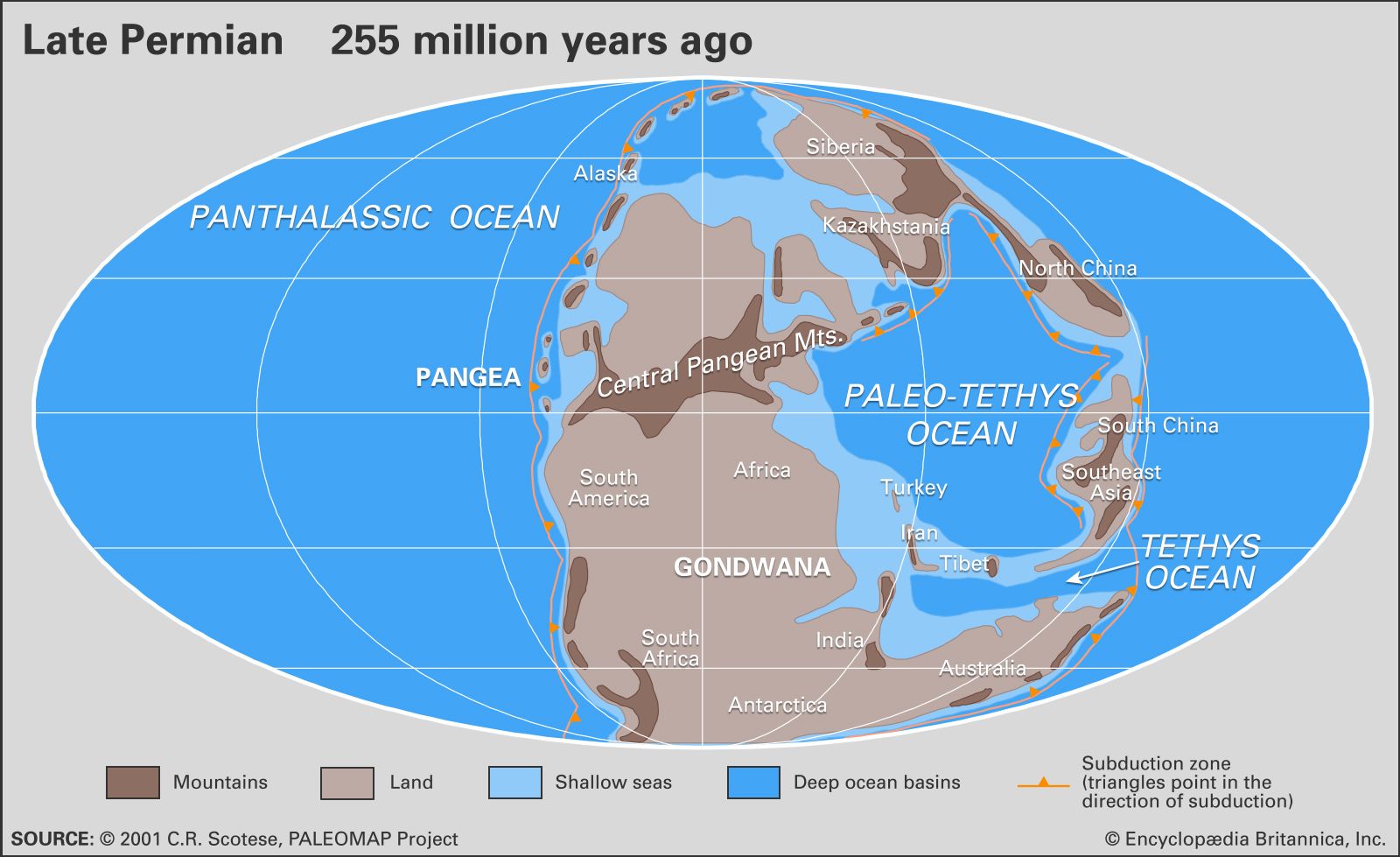
A drier climate, lower sea levels, and more arid interiors of Pangea forced a change in forests and plants.
SebastianHOST
In places that were still moist, like certain parts of China, coal swamps persisted.
SebastianHOST
Yes, you've probably heard of this one, as they are widely present even now.
SebastianHOST
Conifers are cone-bearing trees that also evolved needle-like leaves that are extremely thin and coated in a thick, waxy material known as a cuticle.
SebastianHOST
And it's this reduced surface area and waxy exterior that allowed conifers to conserve their water better and survive in drier climates, which in turn allowed them to spread rapidly, with the group becoming the dominant player in the Permian's second half alongside something else known as Glossopteris.

Lauren VogelbaumHOST
But some researchers have their doubts.
Lauren VogelbaumHOST
Dimetrodon lived in the early part of Earth's Permian period, which lasted from around 298 to 251 million years ago.
Lauren VogelbaumHOST
And one of its closest relatives from around the same time was another carnivore with a similar build overall, except it lacked a massive sail on its back.
Lauren VogelbaumHOST
So why would one of these creatures need a solar panel if the other got along fine without it? Sexual selection could be the X factor here.
Lauren VogelbaumHOST
It probably gets lumped in there because of toy companies mislabeling it in playsets and bags of plastic figurines.
Lauren VogelbaumHOST
And Hollywood is no help.
Lauren VogelbaumHOST
Fantasia and The Land Before Time both have this Permian synapsid brushing shoulders with actual dinosaurs.
Lauren VogelbaumHOST
Again, Dimetrodon died out tens of millions of years before the first dinosaurs even showed up.

John BatchelorHOST
And we're headed farther back in time.
John BatchelorHOST
Now we go from the Triassic to the Permian, 253 million years ago.
John BatchelorHOST
And one of my favorite creatures, the Buenos Stegos, an apex predator.
John BatchelorHOST
Thomas will introduce us.
John BatchelorHOST
I'm John Batchelor.
John BatchelorHOST
This is CBS Eye on the World.
John BatchelorHOST
I'm John Batchelor and I'm traveling backwards in time with Thomas Halliday, the author of Other Lands, A Journey Through Earth's Extinct Worlds, a new book that allows you to go back and back and back and always asking yourselves, how did we get here from there? We go now to the Permian.
John BatchelorHOST
253 million years ago, which is right before an extinction event.
Stephen C. StearnsHOST
And so basically this allows you to plot and estimate a curve.
Stephen C. StearnsHOST
And it looks like there was massive withdrawal of carbon dioxide from the atmosphere, from the Ordovician through the Permian, right here.
Stephen C. StearnsHOST
And then there was a reinjection here, going into the Triassic.
Stephen C. StearnsHOST
And when we come to the Permian mass extinction I want you to remember this dip here, and this reinjection.
Stephen C. StearnsHOST
And then there's been a more gradual withdrawal down to the current level.
Stephen C. StearnsHOST
The Earth was much more of a greenhouse in the past than it is today.
16 MINS LATER
Stephen C. StearnsHOST
This is about 600 million years, and there's evidence for one which is deeper at about a billion years.
Stephen C. StearnsHOST
So this is an ice age, this is an ice age.
PaulCORRESPONDENT
They evolved leaves that hang vertically with a tough outer coating, reducing water loss by evaporation.
PaulCORRESPONDENT
Unlike many rainforest trees, eucalyptus could thrive in thin, dry soils because they have deep vertical roots that could reach water by growing down through cracks in the eroding phyllite and shale hills formed from uplifted Permian Age seafloor, the bedrock across much of Brisbane.
PaulCORRESPONDENT
But it was the partnerships Eucalyptus developed that ensured their success, first with termites, who surprisingly were not this tree's natural enemies, as you might assume.
PaulCORRESPONDENT
Termites eat the dead heartwood inside eucalypt trunks and branches, but leave the living growing outer tissue, so that over hundreds of years the trunk and limbs become largely hollow.
18 more episodes mention Permian.
Create an account to see the whole feed, search across every transcript, and follow the entities you care about.