Peripatetic school
70
MENTIONS
26
EPISODES
24
PODCASTS
Search complete. 70 mentions across 26 episodes found for "Peripatetic school".
Oct 29, 2026

Marianne Coleman HipkinsNARRATOR
Wherefore it appears to them that they can justly conclude and declare that contrasting the difficulties of the sculptors with their own, the labours of the body with those of the mind, the imitation of the mere form with the imitation of the impression, both of quantity and of quality, that strikes the eye, the small number of the subjects wherein sculpture can and does demonstrate its excellence with the infinite number of those which painting presents to us, not to mention the perfect preservation of them for the intellect and the distribution of them in those places wherein nature herself has not done so; and finally, weighing the whole content of the one with that of the other, the nobility of sculpture as shown by the intellect, the invention, and the judgment of its craftsmen does not correspond by a great measure to that which painting enjoys and deserves—and this is all that on the one side and on the other has come to my ears that is worthy of consideration.
Marianne Coleman HipkinsNARRATOR
But because it appears to me that the sculptors have spoken with too much heat and the painters with too much disdain, and seeing that I have long enough studied the works of sculpture and have ever exercised myself in painting, however small, perhaps, may be the fruit that is to be seen of it; nonetheless, by reason of that which it is worth and by reason of the undertaking of these writings, judging it my duty to demonstrate the judgment that I have ever made of it in my own mind—and may my authority avail the most that it can!—I will declare my opinion shortly and briefly over such a dispute, being convinced that I will not incur any charge of presumption or of ignorance, seeing that I will not treat of the arts of others, as many have done before to the end that they might appear to the crowd intelligent in all things by means of letters; and as has happened among others to Phormio the Peripatetic of Eupheus, who in order to display his eloquence, lecturing and making disputation about the virtues and parts of the excellent captain, made Hannibal laugh not less at his presumption than at his ignorance.
Marianne Coleman HipkinsNARRATOR
I say, then, that sculpture and painting are in truth sisters, born from one father, that is, design, at one and the same birth, and have no precedence one over the other save inasmuch as the worth and the strength of those who maintain them make one craftsman surpass another [page 34], and not by reason of any difference or degree of nobility that is in truth to be found between them.
Marianne Coleman HipkinsNARRATOR
And although by reason of the diversity of their essence they have many different advantages, these are neither so great nor of such a kind that they do not come exactly into balance together and that we do not perceive the infatuation or the obstinacy rather than the judgment of those who wish one to surpass the other.

DerekHOST
I noticed a lot of quests and moments that are directly linked to small references in the sources.
DerekHOST
A quest involving the killing of an Alexandrian cat by a Roman soldier, as recounted by Diodorus, the plagiarism lawsuit of Eudorus and Aristotle the Peripatetic on the Treatise of the Nile, as mentioned by Strabo, and Cleopatra saying, a reference to the papyrus fragment that may bear her signature with the same expression.
DerekHOST
They clearly did their homework when it came to capturing Hellenistic Egypt, and for what it is worth, I think Origins is the single best attempt yet done by major media to illustrate it in a believable and engaging manner.
DerekHOST
Leaning into its strength as a historical simulator, Origins introduced a new feature to enhance the educational value of the game.

Geoffrey EdwardsNARRATOR
Then there are three kinds of goods; the greatest being those of the mind; the next best those of the body; the third are external goods, as the Peripatetics call them; and the old Academics differ very little from them.
Geoffrey EdwardsNARRATOR
Deinomachus and Califon have coupled pleasure with honesty; but Diodorus the Peripatetic has joined indolence to honesty.
Geoffrey EdwardsNARRATOR
These are the opinions that have some footing.
Geoffrey EdwardsNARRATOR
For those of Aristo, Pyrrho, Herillus, and of some others are quite out of date.
Geoffrey EdwardsNARRATOR
Now let us see what weight these men have in them, excepting the Stoics, whose opinion I think I have sufficiently defended.
Geoffrey EdwardsNARRATOR
And indeed I have explained what the Peripatetics have to say, excepting that Theophrastus and those who followed him dread and abhor pain in too weak a manner.
Geoffrey EdwardsNARRATOR
The others may go on to exaggerate the gravity and dignity of virtue, as usual; and then, after they have extolled it to the skies, with the usual extravagance of good orators, it is easy to reduce the other topics to nothing by comparison, and to hold them up to contempt.
Geoffrey EdwardsNARRATOR
They who think that praise deserves to be sought after, even at the expense of pain, are not at liberty to deny those men to be happy who have obtained it.

Bill BoerstNARRATOR
it approves itself says tobias to zeno and the stoic philosophers who came after him that there are two kinds of men one good the other bad the good all their life display the virtues and the bad the vices whence one kind are always right in all that they purpose the other always wrong and inasmuch as the good avail themselves of the arts of life and their conduct they do all things well as doing them wisely and temperately and in accordance with the other virtues whereas the bad on the contrary do all things ill The good are great and well grown and tall and strong, great because they are able to attain the objects which they set on before themselves, and which are dependent on their own will, well grown because they find increase from every quarter, tall because they have reached the height which befits a noble and good man, and strong because they are endowed with the strength that befits them.
Bill BoerstNARRATOR
the good man is not to be vanquished or cast in a combat seeing that he is neither compelled by any one nor does he compel another he is neither hindered nor does he hinder he is neither forced by any one nor does he himself force any man he neither does ill nor is himself done ill to nor falls into ill nor is deceived nor deceives another nor is he mistaken or ignorant nor does he forget nor entertain any false supposition but is happy in the highest degree and fortunate and blessed and wealthy and pious and beloved of god and worthy of everything fit to be a king or general or statesman and versed in the arts of managing a household and making money whereas the bad have all the attributes that are opposite to these and generally to the virtuous belong all good things and to the bad all evils The good man of the Stoics was variously known as the sage or the serious man, the latter name being inherited from the Peripatetics.
Bill BoerstNARRATOR
We used to hear it said among ourselves that a person had become serious when he or she had taken to religion.
Bill BoerstNARRATOR
Another appellation which the Stoics had for the sage was the urbane man, while the fool in contradistinction was called a boor.
39 MINS LATER
Bill BoerstNARRATOR
To say, as he did, that the exercise of virtue was the highest good was no merit in their eyes, unless they were added to the confession that there was none beside it.
Bill BoerstNARRATOR
The Stoics tried to treat man as a being of pure reason.
Bill BoerstNARRATOR
the peripatetics would not shut their eyes to his mixed nature and contended that the good of such a being must also be mixed containing in it elements which had reference to the body and its environment the goods of the soul indeed they said far outweighed those of body and estate but still the latter had a right to be considered That virtue is the one thing needful would have been acknowledged by the Peripatetics as well as by the Stoics, but in a different sense.
Bill BoerstNARRATOR
The Peripatetics would have meant by it that such things as health and wealth and honor and family and friends and country, though good in their way, were not yet to be compared with goods of the soul, whereas the Stoics meant literally that there were no other goods.

Idiot MysticHOST
Anyway, I think even philosophy has a long association with walking.
Idiot MysticHOST
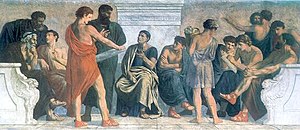
Aristotle's school became known as the Peripatetic School, a name connected with the covered walkways where teaching took place.
Idiot MysticHOST
I like imagining these people discussing crazy questions about existence while having to occasionally watch where they were stepping, because that really is actually what life is like.
Idiot MysticHOST
can be thinking about the nature of God and suddenly realize there's dog poop in front of you.

speaker_3NARRATOR
Education had, then, a mighty influence over the minds of men, and was almost equal and forced to the suggestions of the senses and common understanding, by which the most determined skeptic must allow himself to be governed.
speaker_3NARRATOR
But at present, when the influence of education is much diminished, and men from a more open commerce of the world have learned to compare the popular principles of different nations and ages, our sagacious divines have changed their whole system of philosophy, and talked the language of Stoics, Platonists, and Peripatetics, not that of Peronians and academics.
speaker_3NARRATOR
If we distrust human reason, we now have no other principle to lead us into religion.
speaker_3NARRATOR
Thus, skeptics in one age, dogmatists in another.

Leon MireNARRATOR
In the days of Epictetus, under the Flavian emperors, the only schools that could be regarded as serious rivals of Stoicism in the capital were the Academics and the Epicureans.
Leon MireNARRATOR
Peripatetics, the disciples of Aristotle, were, he tells us, few and fainthearted.
Leon MireNARRATOR
Plato himself was hardly read at all.
Leon MireNARRATOR
The Epicureans were atomists in science and utilitarians in morals.
1 HR 2 MINS LATER
speaker_3ADVERTISER
A message from CUPE twenty four eighty four.
Leon MireNARRATOR
preserved by Eusebius in his Preparatio Evangelica, fifteen, four to nine, will show the reader the attitude of Platonism towards another great system of thought.
Leon MireNARRATOR
Atticus belongs probably to the middle of the second century, and he is writing against the Peripatetics, the school of Aristotle.
Leon MireNARRATOR
The main charge which he presses against Aristotle is that his morality is commonplace, and the causes of this defect he finds in deism and in the vagueness of his teaching as to the immortality of the soul.

Morgan ScorpionNARRATOR
It is easy for anyone to know.
Morgan ScorpionNARRATOR
For Clearchus, who was the scholar of Aristotle, and inferior to no one of the Peripatetics whomsoever, in his first book containing sleep, says that Aristotle his master related what follows of a Jew, and sets down Aristotle's own discourse with him.
Morgan ScorpionNARRATOR
The account is this, as written down by him.
Morgan ScorpionNARRATOR
Now for a great part of what this Jew said, it would be too long to recite it, but what includes in it both wonder and philosophy, it may not be amiss to discourse of.
Bill BoerstNARRATOR
Hence we find Aristotle maintaining that the state is a natural product, because it is evolved out of social relations which exist by nature.
Bill BoerstNARRATOR
Nature indeed was a highly ambiguous term to the Greeks no less than to ourselves; but in the sense with which we are now concerned, the nature of anything was defined by the Peripatetics as the end of its becoming.
Bill BoerstNARRATOR
Another definition of theirs puts the matter still more clearly: 'What each thing is when its growth has been completed, that we declare to be the nature of each thing.' Following out this conception the Stoics identified a life in accordance with nature with a life in accordance with the highest perfection to which man could attain.
Bill BoerstNARRATOR
Now as man was essentially a rational animal, his work as man lay in living the rational life; and the perfection of reason was virtue.
9 MINS LATER
Bill BoerstNARRATOR
For after the death of Theophrastus, the library of the Lyceum is said to have been buried underground at Sepsis until about a century before Christ, so that the Organon may actually have been lost to the world during that period.
Bill BoerstNARRATOR
At all events, under Strato, the successor of Theophrastus, who specialized in natural science, the school had lost its comprehensiveness.
Bill BoerstNARRATOR
Cicero even finds it consonant with dramatic propriety to make Cato charge the later Peripatetics with ignorance of logic.
Bill BoerstNARRATOR
On the other hand, Chrysippus became so famous for his logic as to create a general impression that if there were a logic among the gods, it would be no other than the Chrysippian.
16 more episodes mention Peripatetic school.
Create an account to see the whole feed, search across every transcript, and follow the entities you care about.