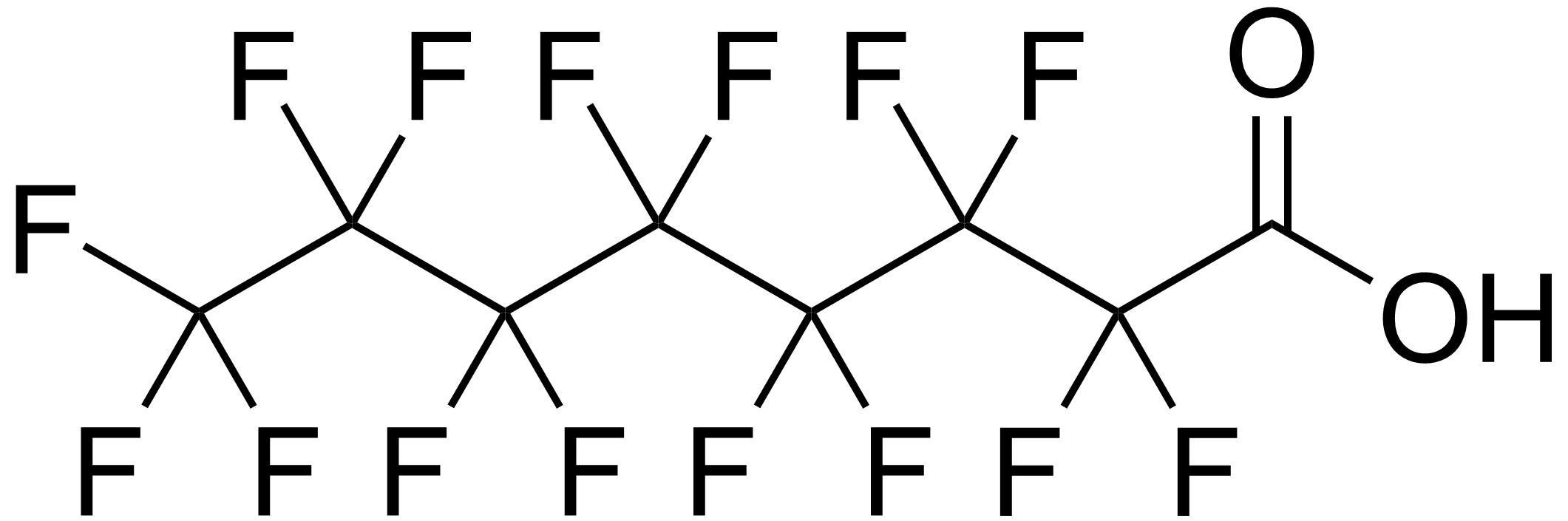
Perfluorooctanoic acid
Chemical compoundWikipedia
43
MENTIONS
17
EPISODES
17
PODCASTS
Search complete. 43 mentions across 17 episodes found for "Perfluorooctanoic acid".
Sep 17, 2026

speaker_0HOST
Narrowed to veterans ages 20 to 39, the picture changed.
speaker_0HOST
That group showed PFOA levels 13% higher, PFOS 19% higher, and PFHXS 24% higher than civilians the same age, with a combined measure of seven clinically tracked PFAS running 17% higher overall.
speaker_0HOST
Younger veterans were also 18% more likely than similarly-aged civilians to have combined PFAS concentrations at or above 20 nanograms per milliliter, the threshold at which the National Academies of Sciences, Engineering, and Medicine recommends additional clinical monitoring.
speaker_0HOST
Lead author Christian Hoover, a pre-doctoral fellow in Brown's School of Public Health, said the finding comes with a direct recommendation attached—male veterans between 20 and 39 should consider asking a doctor about PFAS testing.
speaker_0HOST
Brown epidemiologist Joseph Braun added that the age pattern likely reflects how recently younger veterans left active service, since PFOA's roughly 18- to 24-month half-life means blood concentrations decline for years after exposure ends.
speaker_0HOST
The study cannot say where exposure happened, only that a gap exists.
speaker_0HOST
NADNS does not record a veteran's occupation, branch, or years since service, so the researchers could not tie elevated levels to a specific installation or duty.

Craig MigliaccioHOST
However, over in Europe, they do designate it as a PFAS.
Craig MigliaccioHOST
Like in that category, there's also PFOA, PFOS, and those are some of those like scary, you know, dangerous things.
Craig MigliaccioHOST
I mean, we've had different coatings for years, like even on cooking ware and stuff like that.
Craig MigliaccioHOST
And you're getting that on their food, and you're eating it.

Michael LuuGUEST
Regulations will keep evolving.
Michael LuuGUEST
If you look at the water quality side of the business, we're talking about PFAS, PFOA.
Michael LuuGUEST
The next thing that's probably gonna be on the docket will be microplastics.
Michael LuuGUEST
So how do you treat the water and make it safe for customers to consume, but keep the rates affordable, right? So that's a new conundrum that we have to solve, and we got to solve it quickly, and we have to do it diligently because the infrastructure improvement plan has to move forward.

speaker_4HOST
So he effectively flips on his own ecosystem.
speaker_5HOST
He does, because he discovers that DuPont had contaminated an entire town's water source in West Virginia with a chemical called PFOA, perfluorooctanoic acid.
speaker_4HOST
Which is just a terrifying phrase to even say.
speaker_5HOST
It is.

Darin OlienHOST
Even though there's thousands, they made a step.
Darin OlienHOST
PFOA, PFOSs, the two old workhorses that were the backbone of the Teflon and Scotchgard chemicals, capped at four parts per trillion each.
Darin OlienHOST
And then there's of course many others, PFNA's, PFHxS's, the Gen X, the ones that keep being created.
Darin OlienHOST
But they also capped that at ten parts per trillion and created a hazardous index, which is a s- smart tool that says these chemicals show up together, so we're gonna regulate this mixture of craziness.
Darin OlienHOST
Deadline: April twenty twenty-nine.
Darin OlienHOST
Then the administration changed.
Darin OlienHOST
May fourteenth, two thousand and twenty-five, new EPA administrator Lee Zeldin announces the agency will keep the PFOA and PFOS limits but push the compliance deadline from twenty twenty-nine to twenty thirty-one and rescinded the limits on the other four, the PFHxS's, the PFNA's, the Gen X, all of these things.
Darin OlienHOST
And the hazard index mixtures completely changed.

Zack GrahamHOST
Instead, I found 3M.
Zack GrahamHOST
The company's chemo-like facility in Cottage Grove had begun commercially producing PFOA in 1951.
Zack GrahamHOST
For years, waste-containing PFAs had been disposed of at sites around East Metro, when, through the chemicals in a plant well in 2002, Minnesota didn't even have health guidance for them.
Zack GrahamHOST
Regulators had to develop it after the contamination was already in the ground, and by then, people were heavily affected.

Ty HoskinsGUEST
So one thing is regulations, right? So years ago, these chemicals were completely flying under the regulatory radar.
Ty HoskinsGUEST
They were being used kind of unlimited... unknowingly by a lot of industries and just released in large amounts right that's not true anymore we've the EPA has set enforceable standards for drinking water for a subset of these chemicals now so that will reduce exposure a lot There have been things that have happened, like some of the worst offenders in this class, um, in particular PFOS and PFOA.
Ty HoskinsGUEST
So two of the P two specific P P I'm already tripping over acronyms myself.
Ty HoskinsGUEST
Two long chain PFAS in this larger class of thousands.

Ruth HattonHOST
PFOs were detected in approximately 99% of both species.
Ruth HattonHOST
PFOA was detected in 68.5% of dogs and 96% of cats.
Ruth HattonHOST
This is not surprising because of the, what I'm saying is not surprising 68.5 versus 96 when we're talking about dogs and cats is because of how much cats groom themselves and how that's an important factor to take into account.
Ruth HattonHOST
in addition to food sources of these chemicals.

Jeffrey WarrenGUEST
You know, let's put this in context.
Jeffrey WarrenGUEST
The EPA maximum contamination level, the MCLs that are coming out for PFOS and PFOA are four parts per trillion, four nanograms per milliliter.
Jeffrey WarrenGUEST
We have one well in Wake County, which is our capital county.
Jeffrey WarrenGUEST
Raleigh is in Wake County in the center part of the state.

Shumita BasuHOST
Michael began to suspect that these deaths had something to do with the local Teflon factory, where his father had worked for many years.
Mariah BlakeGUEST
So he typed Teflon and cancer into Google, and he called up this large health study that had taken place in West Virginia, and it showed that this particular chemical called PFOA, it's a type of forever chemical, had been linked to kidney cancer.
Shumita BasuHOST
He worried that the town's drinking water might be contaminated with this chemical, and he tried to get local authorities to test the water, but he wasn't getting anywhere.
Mariah BlakeGUEST
Michael eventually ordered a testing kit, and he tested the water himself, and it turned out that, yes, the drinking water had very high levels of this chemical PFOA in it.
Shumita BasuHOST
PFOA is a type of PFAS, which is the name for a broad group of synthetic chemicals often called forever chemicals because of how long they take to break down.
Shumita BasuHOST
For Michael and his community, many were being exposed to high levels of PFAS, but they're also, to a lesser degree, in so many household goods, things that we all use every day, from food wrappers to cleaning products to shampoo.
Shumita BasuHOST
In her new book, They Poisoned the World: Life and Death in the Age of Forever Chemicals, Mariah takes a deep and expansive look at this class of compounds.
Shumita BasuHOST
Hmm.
7 more episodes mention Perfluorooctanoic acid.
Create an account to see the whole feed, search across every transcript, and follow the entities you care about.