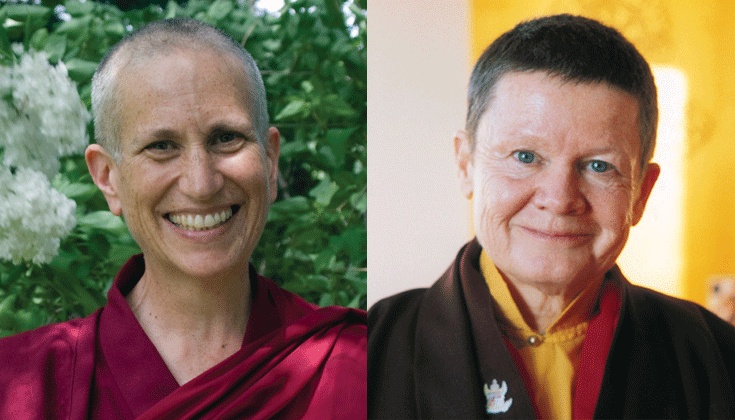
Pema Chödrön
American nunWikipedia
79
MENTIONS
61
EPISODES
60
PODCASTS
Search complete. 79 mentions across 61 episodes found for "Pema Chödrön".
Oct 31, 2026

Joe ConniffHOST
You know, and this idea that when things are going well, it's easy to get complacent, right? Well, shit's going the way I want it to be.
Joe ConniffHOST
Why do I have to look at anything else, right? We were talking about this the other night, and somebody was reading from the book by Pema Chodron, when things fall apart.
Joe ConniffHOST
And I got called on and I said, it's funny, they don't have a book about when shit's going great.
Joe ConniffHOST
They don't need to write one of those.

Clayton OlsonGUEST
And I will come back a more loving, fearless person.
Clayton OlsonGUEST
Pema Chodron has a quote that I've brought into my conversations with clients again and again because there's so much death in some of the work that I do with people's relationships.
Clayton OlsonGUEST
And it's, only through being exposed to continued disaster can that which is permanent be found within us.
Clayton OlsonGUEST
Will

David NichternGUEST
It's a strong practice.
David NichternGUEST
You know, Pema Chodron teaches it quite a lot, if you know who she is.
Sue HitzmannHOST
Yeah.
David NichternGUEST
She's a very famous woman Buddhist teacher who studied also with Trungpa Rinpoche.

Pat CroceGUEST
And I fell in love with seeking out the truth.
Pat CroceGUEST
And my Fab Four that first year were Pemachodron, Alan Watts, Ram Dass, and Eckhart Tolle.
Pat CroceGUEST
Now, Amy, Eckhart Tolle.
Pat CroceGUEST
Diane, 10 years prior, was trying to get me to read, I guess it was Be Here Now.

Brigid LowryGUEST
And I know that we know all this, but I'm just still going to read a few of the, read this out in very brief.
Brigid LowryGUEST
This is Pema Chodron's book, Living Beautifully with Uncertainty and Change.
Brigid LowryGUEST
And she's one of the teachers that I really value.
Brigid LowryGUEST
So she's adapted her precepts from Thich Nhat Hanh, who wrote some really beautiful long ones.

Matthew MGUEST
You know, and there's all this examples of this in my life.
Matthew MGUEST
There's a great Buddhist teacher, Pema Chodron.
Matthew MGUEST
And she says what Bill says.
Matthew MGUEST
If you read in the big book about fear, Bill has this beautiful thing in the four step.
Matthew MGUEST
The fabric of our existence was shot through with it.
Matthew MGUEST
It set in motion trains of circumstances which brought us to misfortune we felt we didn't deserve.
Matthew MGUEST
But did we not ourselves set the ball rolling? Pema Chodron, the Buddhist teacher says, because we are afraid, we develop all kinds of habits which turn into addictions.
Matthew MGUEST
We look for strength in things that weaken us.

Margaret WheatleyGUEST
They're just the basis.
Margaret WheatleyGUEST
I mean, at one point I heard Pema Chodron say to someone, I'm so sad.
Margaret WheatleyGUEST
And she just said, warriors are always sad.
Sarah WilsonHOST
You
35 MINS LATER
Sarah WilsonHOST
That's the phrase.
Sarah WilsonHOST
I like that.
Sarah WilsonHOST
It's interesting because one of the phrases that you use in the book is this idea of edge walking, which immediately makes me think of your friend, Pema Chodron, who... um you know often talks about how the edge is is where we need to be you know that's that's where we need to be in all of this and so when we're talking about the uncertainty it is the uncertainty that is the most terrifying in all of this particularly because we're all coming from a I'd say post-neoliberal world, which was all about eradicating uncertainty and making us think that we should be eradicating uncertainty.
Sarah WilsonHOST
Anything that makes us uncomfortable, we complain about it, we go and fix it, we throw money at the situation.

Mark MillerGUEST
But it's wonderful to see right out of the science that without the kind reconsideration, it doesn't move the marker, doesn't make depression better, doesn't change relapse, sometimes exacerbates the issue.
Mark MillerGUEST
Now, did we know that as practitioners? You look at Pema Chodron, she's so clear, attention, awareness, and kindness.
Mark MillerGUEST
I love Pema for that.
Mark MillerGUEST
That's her opening triad.

Vanessa BennettHOST
And at some point when that charge softens, she registers that it's not because she decided it should, right? It's because something in her processed it and the alarm bells quieted on their own.
Vanessa BennettHOST
Pema Chodron uses the Tibetan word shenpa for this, which is often translated as attachment, but it's closer to the charge or the hook that I'm talking about in kind of a closer translation.
Vanessa BennettHOST
That immediate tightening when something touches a wound, right? We all know that feeling.
Vanessa BennettHOST
And children's teaching is not that chenpa is wrong or should be eliminated, but that we can learn to notice it, stay with it rather than act from it, and then kind of watch it pass on its own, not as a decision, but as a practice.

Marianne PaventiHOST
So if we can stay with our body and inhabit it, we can be better connected to the different waves of experience, of thought, of emotion, of sensation that are always moving through us.
Marianne PaventiHOST
Pema Chodron said, It is helpful to realize that this very body that we have, that is sitting here right now, with its aches and its pleasures, is exactly what we need to be fully human, fully awake, fully alive.
Marianne PaventiHOST
Last week we talked about the part of you that is aware, this awareness with a capital A.
Marianne PaventiHOST
Your spirit, your soul, your inner guru, your higher self, And my favorite, as you know, the one who knows.
51 more episodes mention Pema Chödrön.
Create an account to see the whole feed, search across every transcript, and follow the entities you care about.