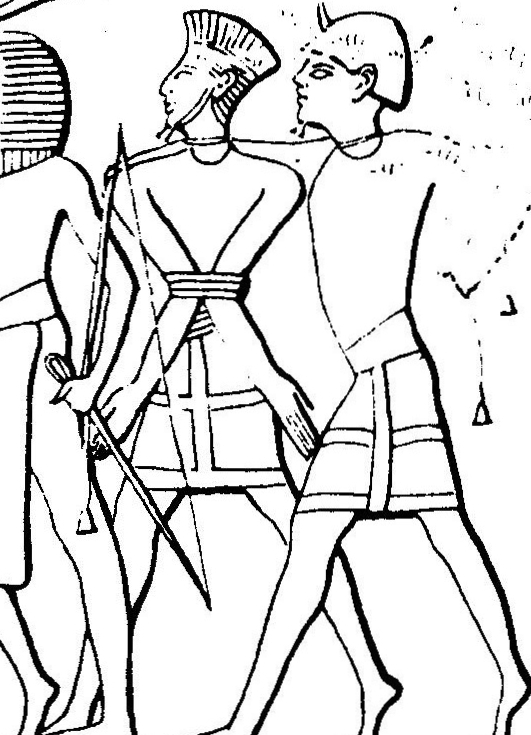
Peleset
14
MENTIONS
9
EPISODES
9
PODCASTS
Search complete. 14 mentions across 9 episodes found for "Peleset".
Nov 1, 2026

Eric H. ClineGUEST
The Egyptians actually tell us the name of the groups, they say.
Eric H. ClineGUEST
The Shardana or the Sherdan, the Shekelesh, the Ekwesh, the Peleset.
Eric H. ClineGUEST
And we've been playing guessing games for 100 years.
Eric H. ClineGUEST
The Peleset are probably the biblical Philistines.
Eric H. ClineGUEST
But the Shekelesh, the Shardana, they're probably related to Sicily and Sardinia.
Eric H. ClineGUEST
But did they come from that area and invade Egypt? Or did they go to those areas in the western Mediterranean after Egypt had defeated them? The Egyptians leave records 30 years apart.

Dave FarinaHOST
Its most active king was Ramses III, who fended off another invasion from Libya and fought a group of sea peoples in both land and sea battles, some of whom he then settled in Canaan to protect Egypt's northern border.
Dave FarinaHOST
One of these groups, called the Peleshet, may be identical with the Philistines of the Bible.
Dave FarinaHOST
These campaigns, together with the cost of the building projects that Ramses had taken on in order to compete with his predecessors, may have strained the government's resources, judging by the fact that in 1159, the workers hired to refurbish a tomb complex went on strike because their monthly rations had been held up for weeks.
Dave FarinaHOST
The later kings of this period, who were also called Ramses, were faced with growing resistance from the priests of the Theban god Amun, who controlled a great deal of the country's wealth and were limited to the members of a few elite families.

William DalrympleGUEST
People, I don't think, realize that the first references... to the palisade which is the root behind the word that became palestine is in egypt in the the temples of medina tabu in the luxor rameses iii he talks about defeating the palisade now the earliest reference to the israelites is just a little before that the merneptah stupa The Merneptah Stella, which is about 30 years earlier, and out of the same moment of civilizational catastrophe, which is called the Bronze Age collapse.
William DalrympleGUEST
So Israel and Peleset, Palestine, appears almost as twins conjoined at birth.
William DalrympleGUEST
They're within, you know, in the great expanse of...
William DalrympleGUEST
Middle Eastern history.

speaker_0HOST
In the midst of this chaotic movement, groups sailed across the Mediterranean toward the coasts of Egypt and the Levant.
speaker_0HOST
In Egyptian records, one of these peoples is called the Peleset, a name that echoes that of the Philistines in scripture.
speaker_0HOST
The evidence of their arrival does not come from myths, but from tangible objects, fragments of pottery, artistic patterns, and food remains, all preserved beneath the sands of the Canaanite coast.
speaker_0HOST
The earliest excavations in Philistine cities revealed bowls and jars painted with designs reminiscent of the Aegean world.

Andrew M. HenryHOST
They were coming, forward toward Egypt.
Andrew M. HenryHOST
Their confederation was the Peleset, Tjekkeru, Shekelesh, Denyen, and Weshesh, lands united.
Andrew M. HenryHOST
Their hearts, confident and trusting, 'Our plans will succeed!'" This is describing an alliance of peoples who attacked the Eastern Mediterranean in the late Bronze Age.
Andrew M. HenryHOST
The Bronze Age of the Eastern Mediterranean lasted about 2,000 years.
10 MINS LATER
Andrew M. HenryHOST
It's also more accurate to think of them as loosely or poorly organized groups of migrants composed of different peoples from many different places.
Andrew M. HenryHOST
The available evidence mentions several names, but not all have been matched with ancient places of origin.
Andrew M. HenryHOST
The prominent names given are the Luka, Denyen, Shekelesh, Shardana, Ekwesh, Tijukru, Teresh, and Peleset.
Andrew M. HenryHOST
Luka most certainly refers to southwestern Anatolia and the area of Lycia, and had long been an enemy of Cyprus and Egypt.

Kenny CurtisHOST
What we know about these people, the Sea People, mainly comes from the writings of Egyptian pharaohs, like Ramses III, who give the names of the bands of people who are raiding and destroying places.
Kenny CurtisHOST
He says they are Peleset, Tjekker, Shekelesh, Denyana, and Weshesh.
Jillian HughesHOST
Do we know anything about these people?
Kenny CurtisHOST
[laughs]

Simon Sebag MontefioreGUEST
But, um, uh ...
Simon Sebag MontefioreGUEST
And, and, and they are described in various inscriptions and Egyptian inscriptions a- a- as Peleset or other La- words that are linked to Philistine.
Simon Sebag MontefioreGUEST
But the Philistines themselves were obliterated by the Assyrians and vanished from history.
Simon Sebag MontefioreGUEST
But the word Palestine or Philistine survived in various forms as, as, as a word for part of th- the Holy Land.