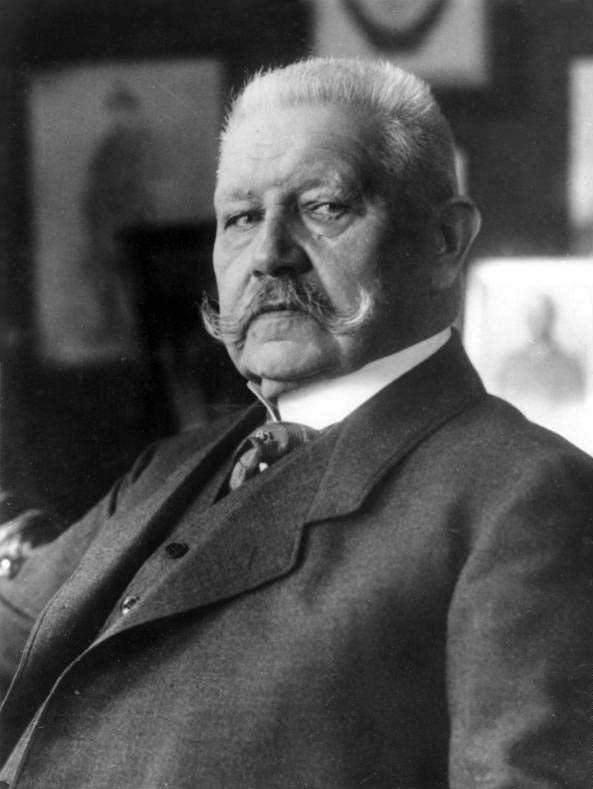
Paul von Hindenburg
Former President of GermanyWikipedia
439
MENTIONS
26
EPISODES
22
PODCASTS
Search complete. 439 mentions across 26 episodes found for "Paul von Hindenburg".
Sep 20, 2026

Margaret TalbotMODERATOR
The Nazi party has won a bunch of seats in the Reichstag, but they don't have a majority.
Margaret TalbotMODERATOR
President Hindenburg, the octogenarian President Hindenburg has appointed Hitler chancellor.
Margaret TalbotMODERATOR
And in 53 days, he will effectively dismantle a 14-year-old parliamentary democracy and many institutions of civil society.
Margaret TalbotMODERATOR
However, there is an election coming up that you talk about in the book in March.
Timothy W. RybackGUEST
He would be out by the summer.
Timothy W. RybackGUEST
He would be out by December.
Timothy W. RybackGUEST
Hindenburg, the president who appointed him, said, this guy's going to burn himself out in six weeks.
Timothy W. RybackGUEST
What the election was supposed to do was be a referendum on Hitler's government.

Hank GreenHOST
The Hindenburg annoyed Hitler and the Nazis.
Hank GreenHOST
For one thing, it was named for Paul von Hindenburg, the president of Germany before Hitler took over.
Hank GreenHOST
Propaganda minister Joseph Goebbels tried to make them name it the Hitler, but they refused, thankfully.
Hank GreenHOST
And second, the Hindenburg was fancy new technology that the Nazis wanted to use both militarily and as propaganda.

Cody JohnstonHOST
By all accounts, McConnell was obsessed with the power of politics from a young age.
Cody JohnstonHOST
As a quiet, introverted kid, McConnell was infatuated with the student council president, who, to quote his memoir, "Had the envy of everyone." Yeah, Mitch, you know how everyone loves the class president? Yeah, Mitch.
Cody JohnstonHOST
From that point on, McConnell was driven by winning over anything else.
Cody JohnstonHOST
His ideology bent with the political winds of the times, as long as they led him into a favorable position.
12 MINS LATER
Cody JohnstonHOST
RIP, probably.
Cody JohnstonHOST
But lucky for this medium glass of room temperature water, Mitch didn't need any of that, um, personality.
Cody JohnstonHOST
In fact, his lack of personality made him the perfect heel for a certain president who had an abundance of personality.
Cody JohnstonHOST
Barry O., Mr. Tan Suit himself.

Jared DiamondGUEST
Not only did Hitler deceive Neville Chamberlain at Munich, Hitler deceived other German politicians.
Jared DiamondGUEST
He deceived Hindenburg.
Jared DiamondGUEST
He deceived German generals.
Jared DiamondGUEST
He deceived German business leaders.
Michael ShermerHOST
"The Führer was a man who was possible in Germany only at that very moment.
Michael ShermerHOST
He came at exactly this terrible transitory period when the monarchy had gone and the republic had not yet, uh, was not yet secure." Close quote.
Michael ShermerHOST
According to historian Timothy Ryback, who builds on Frank's acute awareness of the contingent nature of Hitler's takeover, "Had Hitler's predecessor in the chancellory, Kurt von Schleicher, remained in office another six months, or had German President Paul von Hindenburg exercised his constitutional powers more judiciously, or had a faction of moderate conservative Reichstag delegates cast their votes differently, then history may well have taken a very different turn.
Michael ShermerHOST
Both Hitler's ascendancy to chancellor and his smashing of the constitutional guardrails once he got there, I have come to realize, are stories of political contingency rather than historical inevitability." Close quote from him.

speaker_0NARRATOR
Economic crisis and political instability followed, and by the early 1930s, the country was in turmoil.
speaker_0NARRATOR
On the 30th of January, 1933, Adolf Hitler was appointed chancellor of Germany by President Paul von Hindenburg.
speaker_0NARRATOR
By that time, Alfried Krupp had already been a supporting member of the Nazi paramilitary organization, the SS, for two years.
speaker_0NARRATOR
He was also a member of the National Socialist Flyers Corps, a paramilitary aviation organization of the Nazi Party in which he ultimately held the rank of Standartenführer, an equivalent to a colonel in the US Army.

Thomas777GUEST
I think National Socialism ossified into what it truly was.
Thomas777GUEST
When Hindenburg told Hitler that Ernst Romm and all of his fellows in Strasser had to die, and then Hitler gave the order, and then Himmler and Sepp Dietrich... and the rest of them not just carried it out, but they also murdered guys like Kurt Von Schleicher.
Thomas777GUEST
I mean, that was, that's kind of like what turned national socialism into like a, a pretty conventional right wing tendency, honestly.
Thomas777GUEST
Like I, uh, not, not in the sense of, you know, not, not, not, not right wing in terms of like Donald Trump or not even right wing in terms of like Robert Taft, but by European standards, um, the third right was more conventionally right wing than people will acknowledge.
Thomas777GUEST
That wasn't, that wasn't just like so much talk.
Thomas777GUEST
And a lot of them were frankly psychopaths, but they, they, um, that, that, that, that came to an end in June, 1934.
Thomas777GUEST
And if, if, If you're killing people because a man like Hindenburg is telling you that, like, you know, these men are a red revolutionary rabble who have to be stopped, like, you're a lot of things, but you're not left-wing, okay, when you're executing that order.
Thomas777GUEST
So, I mean, that's my opinion.

Ted LinhartNARRATOR
General Pershing arrived in the middle of a splendid illustration of the evil effect upon the Allied cause of this lack of coordination.
Ted LinhartNARRATOR
He arrived just at the time when nearly three years of failing to fight the war with a single object of beating the Germans was commencing to bear fruit for the Allies in the discouragement and pessimism which culminated about a year later when Hindenburg and Ludendorff delivered the tremendous blows which not only the Germans confidently expected, but the Allies almost admitted meant victory for Germany.
Ted LinhartNARRATOR
The chiefs of the Allies had met in November 1916 to plan the campaign for 1917.
Ted LinhartNARRATOR
The idea was that all of them would attack the Central Powers at the same time.
Ted LinhartNARRATOR
Having agreed upon the general idea, the chiefs had to decide upon when to start the attacks.
Ted LinhartNARRATOR
Immediately, there was that divergence of opinion which always characterized Allied councils.
Ted LinhartNARRATOR
The French maintained they should be started early, as otherwise Hindenburg, the new German commander-in-chief, might start something first, thus wrecking their plans.
Ted LinhartNARRATOR
As it turned out, this was exactly what happened.

ThomasGUEST
I think what really, like, I think National Socialism, like, ossified into what it truly was.
ThomasGUEST
When Hindenburg told Hitler that Ernst Romm and all of his fellows in Strasser had to die, and then Hitler gave the order, and then Himmler and Sepp Dietrich and the rest of them not just carried it out, but they also murdered guys like Kurt von Schleicher.
ThomasGUEST
I mean, that's kind of like what turned National Socialism into, like, a pretty conventional right-wing tendency, honestly.
ThomasGUEST
Like, not in the sense of, you know, not right-wing in terms of, like, Donald Trump or not even right-wing in terms of, like, Robert Taft, but by European standards.
ThomasGUEST
And a lot of them were, frankly, psychopaths.
ThomasGUEST
But they... that came to an end in June 1934.
ThomasGUEST
And if you're killing people because a man like Hindenburg is telling you that, like, you know, these men are a red revolutionary rabble who have to be stopped, like, you're a lot of things, but you're not left-wing, okay, when you're executing that order.
ThomasGUEST
So, I mean, that's my opinion.

Heather Delaney ReeseHOST
And maybe it has never felt as close as it did last night.
Heather Delaney ReeseHOST
Because on August 2nd, 1934, the day German President Paul von Hindenburg The German military oath was rewritten.
Heather Delaney ReeseHOST
Before Hitler's rise, German soldiers had sworn loyalty to the Constitution and its institutions, never any single leader.
Heather Delaney ReeseHOST
Hitler had already begun reshaping that oath after taking power, but Hindenburg's death gave him the opening to finish the job.

Wolfgang MunchauHOST
It wasn't the fact that institutions were weak and had only The German constitution had safeguards like the old German constitution, the Weimar constitution, safeguards like a 5% clause or a weakening of the power of the presidency.
Wolfgang MunchauHOST
If Hindenburg hadn't been able to appoint Hitler the way he did, I don't think it would have made a difference.
Wolfgang MunchauHOST
This didn't happen because of some technical deficiency, because of an underlying failure of a central system.
Wolfgang MunchauHOST
I see that in place too, again.
16 more episodes mention Paul von Hindenburg.
Create an account to see the whole feed, search across every transcript, and follow the entities you care about.