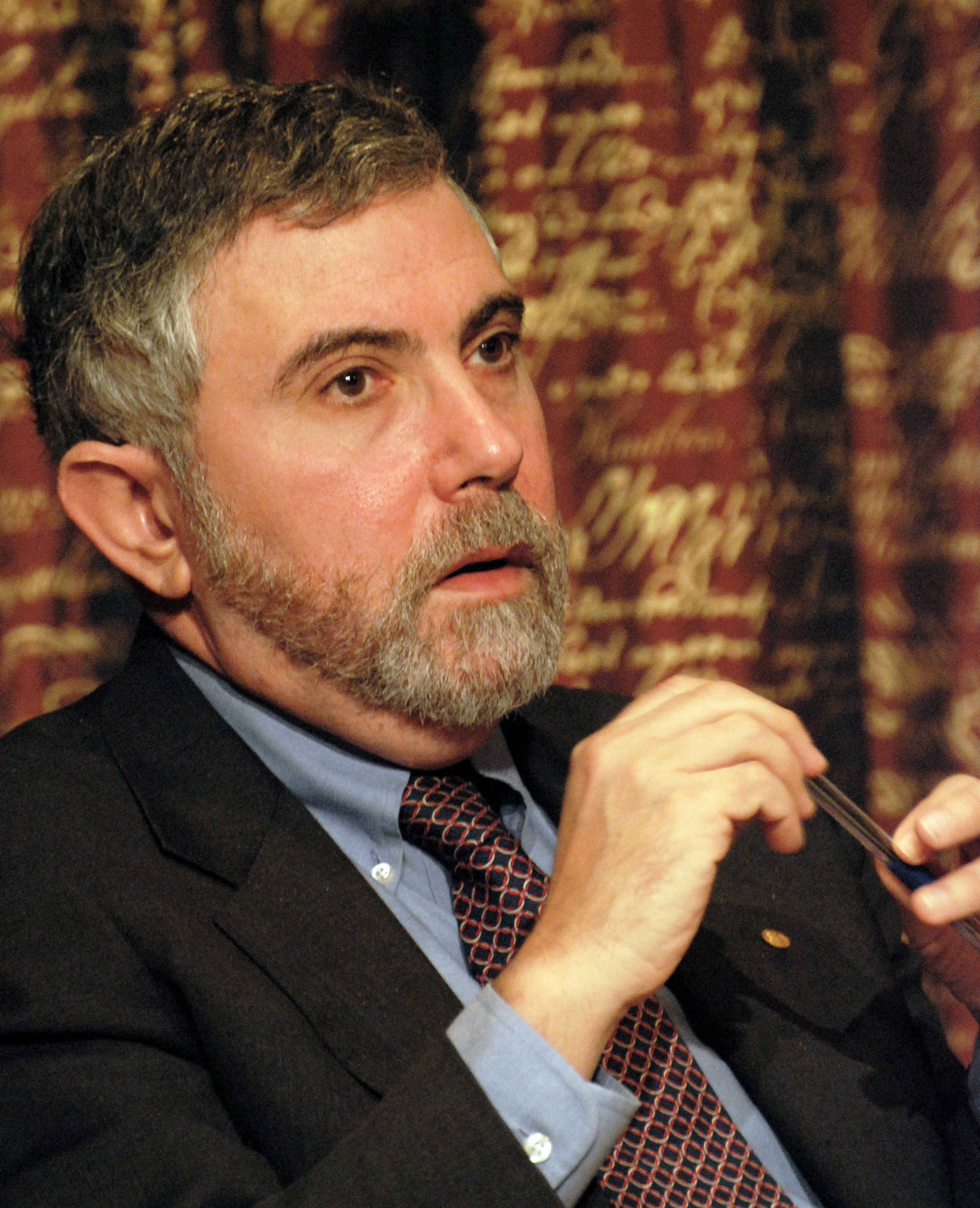
Paul Krugman
American economist
87
APPEARANCES
35
PODCASTS
Sep 8, 2026


Katy TurHOST
Maybe there you tell me this, actually, if there was not an Iran war with gas prices on the rise, if there were not already the effects of the tariffs that Donald Trump previously imposed, if we were not dealing with inflation, would these tariffs by Canada be as big of a deal?

Paul KrugmanGUEST
How much can it matter to an economy as big as the United States? But once you start to go into the details, you discover that there's a lot of industries in which Canada is a really, really important supplier.
Paul KrugmanGUEST
Something like half of the aluminum that we use in the United States comes from Canada.
Paul KrugmanGUEST
Canada is only a fraction of the softwood lumber market, but it turns out the Canadian trees are different.
16 MINS LATER


Greg SargentHOST
Paul, can you just walk us through the basics of how those developments are tied to the Strait of Hormuz remaining closed?
Paul KrugmanGUEST
Other stuff too, natural gas, helium, fertilizer, but right now let's focus on the oil.
Paul KrugmanGUEST
So 15% of the world's oil goes through that narrow passageway, which is extremely easy for Iran to block.

Greg SargentHOST
Paul, can you just walk us through the basics of how those developments are tied to the Strait of Hormuz remaining closed?
Paul KrugmanGUEST
So, uh, before this war, about 15% of the world, world's oil flowed through that strait, uh, and it's, um, uh, other stuff too, uh, natural gas, helium, uh, fertilizer, but, you know, right now let's focus on the oil.
Paul KrugmanGUEST
So 15% of the world's oil goes through that narrow passageway, which is extremely easy for Iran to block.
Paul KrugmanGUEST
Um, that 15%, [lip smacks] there's really not much of an exit-- There, there's no real way around the, the block- the Iranian blockade.
Paul KrugmanGUEST
It's a little bit of stuff can go by pipeline, but not much, and, um, [lip smacks] that's a lot of oil being denied to the world market.
Paul KrugmanGUEST
Um, and of course, the price of oil has gone way up, but if this continues, you ain't seen nothing yet.


Paul KrugmanGUEST
So, um, everybody, I... and Marcus, my apologies, I ended up unintentionally pulling a kinda bait and switch.
Paul KrugmanGUEST
I thought I was gonna do second China shock, and that's certainly part of the story.
Paul KrugmanGUEST
But as I was getting my act together for this talk, I ended up, uh, veering off in a related but different direction, um, which is partly it's a request.
Paul KrugmanGUEST
Uh, people, um, have been asking me to, uh, uh, particularly Arvind Subramanian, uh, at, uh, Peterson, has been asking me for a response to some of the new views that we've been hearing about trade imbalances.
Paul KrugmanGUEST
And of course, that very much relates to the China shock, and China is at the heart of a lot of this stuff.
33 MINS LATER
Paul KrugmanGUEST
I mean, there, you know, the first question is, "Where's the beef?" Or actually, where's the beef coming from? This is an amazing thing where, you know, he says we're gonna bring in 300,000 metric tons of beef, but won't say from where.
Paul KrugmanGUEST
And, you know, that's, uh, among other things with our, with all of these food safety scares, uh, you know, I think people would like to know, uh, who's, who's supplying this beef.
11 MINS LATER
Greg SargentHOST
Can you talk about that? Because I think it's something that a lot of people don't know.
Paul KrugmanGUEST
I mean, there, y- you know, the first question is, where's the beef? Or actually, where's the beef coming from? This is an amazing thing where, you know, he says we're gonna bring in 300,000 metric tons of beef but won't say from where.
Paul KrugmanGUEST
And, you know, that's, uh, among other things with our, with all of these food safety scares, uh, you know, I think people would like to know, uh, who's, who's supplying this beef.
12 MINS LATER
Greg SargentHOST
Can you talk about that? Because I think it's something that a lot of people don't know.


Paul KrugmanGUEST
Probably there's a little bit, though probably not mostly, Peve, that the markets are starting to get concerned about the debt.
Paul KrugmanGUEST
But the deficit, you know, which is the deficit is the amount that you add to debt each year.


Antonia HyltonHOST
So is Wall Street rallying precisely because the news for your average American worker isn't so good?
Paul KrugmanGUEST
So if you have an economy in which profits are rising at the expense of wages, which is what we have to an important extent, yeah, stocks would be going up, but that's, you know, uh, uh...
Paul KrugmanGUEST
Stocks are mostly owned by a relatively small part of the population, and the rest of the population lives on wage in- income, so that's actually bad.
Paul KrugmanGUEST
So, you know, in many cases, what's good for stocks is actually bad for workers.
Antonia HyltonHOST
W- what do you see in the future here? Do you expect them to rise at some point again, even further from this current point, given the fact that Trump's plan is to, I guess, just keep low-keying it for the time being?


Paul KrugmanGUEST
That was clear to, if you were paying attention right then, and it's been ever clearer.
9 MINS LATER

Paul KrugmanGUEST
Trump would surely try to cook the books if he could, but that would vary the size of the process involved.

Paul KrugmanGUEST
That was clear to, if you were paying attention right then, and it's been ever clearer, and now he, you know, now we're...
8 MINS LATER

Nahlah AyedNARRATOR
Economist Paul Krugman.
Paul KrugmanGUEST
When we try to talk about the history of inequality, the first thing that you need to know is that the middle class society that we had, the one that I grew up in, did not gradually evolve as the country developed economically and so on.
Paul KrugmanGUEST
As of 1939, as far as we can tell, we were still, uh, an economy almost as unequal as we were during the Gilded Age.
Paul KrugmanGUEST
And what happened? Well, what happened was there was a lot of pressure for equalization, for shared burdens during World War II, so was the war, and the controls that were established during the war, and also a public policy that strongly favored unions.
16 MINS LATER
speaker_17UNKNOWN
And

Paul KrugmanGUEST
And roughly speaking, every three barrels of oil gets turned into two barrels of gasoline.
Paul KrugmanGUEST
Uh, and then, you know, then there's 42 gallons in a barrel, which is one of those weird things.
33 MINS LATER
Jonathan V. LastHOST
I'm not holding out on you because, uh, I'm trying to be coy or something." [laughs] Um.
0:53
What are the implications for emerging market economies and other aspects? So Paul, the floor is yours, I think, uh, to outline your views on, you know, how the last year went and how the outlooks look forward.
Paul KrugmanGUEST
Uh, [clears throat] great risk of running way long, but let me try to hit just a few main points.
Paul KrugmanGUEST
The first thing I-- one needs to say, I, I think most of our audience here, at least the economists, remember, uh, the big debates over QE, um, at, you know, early in, in the last decade, uh, and the-- all of the economists who predicted, uh, dangerous inflation and then refused to admit that they'd been wrong.
Paul KrugmanGUEST
So I need to start out by saying that when we had our last discussion, I was relaxed about the inflationary outlook, and, uh, [chuckles] I was wrong.
18 MINS LATER
19:43
Do you think this played a role, uh, besides the fiscal stimulus that the markets realized, you know, the monetary policy regime is now different, or do you think that's, uh, not the core element why we have so high inflation these days?
Katy TurHOST
What is the problem with our taxes, and is it as simple as the rich aren't paying enough?
Paul KrugmanGUEST
Well, basically, it's that they aren't paying enough, but a lot of the, the biggest factor...
Paul KrugmanGUEST
Look, I, I have this, you know, still stunning to me, uh, look at the Forbes 400, the 400 richest people in America.
Paul KrugmanGUEST
In 1982, the combined wealth of those 400 was $92 billion, which is a very small number by, you know, today's standards.
Paul KrugmanGUEST
Uh, yeah, there's been some inflation, but that's still more than a 20-fold increase in wealth at the top.
Greg SargentHOST
How bad is this self-inflicted wound, and, and what, um, what can, what can be done about it?
Paul KrugmanGUEST
You know, on Wednesday, um, uh, the Interior Department announced it was paying another $765 million to an, uh, an energy company not to build wind farms, right? We're actually not, not only refusing to follow pro-green energy policies, but actually spending taxpayer money to block it.
Paul KrugmanGUEST
The, uh, Pentagon is, is using spurious national security concerns to block development of, of wind farms.
Paul KrugmanGUEST
Um, so this is a aggressively anti-renewable energy administration, and, you know, that's s- and we can talk, I, I will be talking shortly on, in, on the Substack about the motivations.
Paul KrugmanGUEST
But the, um, the, you know, at, at a fundamental level, again, this is one of these things where US influence was k- kind of fated to decline.
Greg SargentHOST
[chuckles] How bad is this self-inflicted wound and, and what, and what can, what can be done about it?
Paul KrugmanGUEST
You know, on Wednesday, um, uh, the Interior Department announced it was paying another $765 million to an, uh, an energy company not to build wind farms, right? We're actually not, not only refusing to follow pro-green energy policies, but actually spending taxpayer money to block it.
Paul KrugmanGUEST
The, uh, Pentagon is, is using spurious national security concerns to block development of, of wind farms.
Paul KrugmanGUEST
Um, so this is a aggressively anti-renewable energy administration and, you know, that's s- and we can talk, I, I will be talking shortly on, in, on the Substack about the motivations.
Paul KrugmanGUEST
But the, um, the, you know, at, at a fundamental level, again, this is one of these things where US influence was k- kind of fated to decline.
Paul KrugmanGUEST
And, um, the US does have oil and gas in a way that other advanced countries do not, and so that gave us something of a special position, but with the incredible progress in renewable energy, that matters a lot less than it, it used to.


Stephanie RuhleGUEST
And what has it done for the American people? I think it was Mark Zandi who said this war thus far has cost the American household a thousand bucks.
Paul KrugmanGUEST
I mean, I just want to say that the attempt to somehow, you know, the ever-changing justifications of the war is basically it's a barometer, among other things, of the fact that we lost the war.
Paul KrugmanGUEST
I mean, that Trump took us to war against a third-rate military power and lost.

Dean BakerGUEST
But if that's really true, it's going to be a while before those prices come back down all the way.
15:58
And, uh, I'm sure that Paul has his own perspective, and I'm curious to find out, we all are curious to find out what his, uh, perspective is on this Biden stimulus.
Paul KrugmanGUEST
Um, I found myself remembering some physics history as getting ready for this, uh, discussion.
Paul KrugmanGUEST
Um, uh, a very young Wolfgang Pauli, after hearing a presentation by Albert Einstein, said, uh, "What Professor Einstein has to say is not entirely stupid." Uh, so what Larry had to say is not entire- no.
Paul KrugmanGUEST
I, I think there's a, there's a very serious point, uh, which is that we should indeed be thinking about the macroeconomics of this big program.
32 MINS LATER
48:22
So do you see any threat of the inflation anchor breaking at some point, or do you think that's, we're far away from this because it's now so ingrained in people's beliefs, uh, that inflations will stay around 2%? Do you see any-

Paul KrugmanGUEST
I mean, Trump has done a lot of, uh, threatening and, and tariffs and so on, and they've been mostly ineffectual at achieving what he wanted, but he was at least able to, you know, make good on the threats.
Paul KrugmanGUEST
We can go into at l- some length the, the reasons why even with Trump, you know, bypassing a lot of the normal rules of, of, of law in the United States, this is not gonna happen.
49:33
What do you think the consequences are of that, economically or otherwise?


Nick HanauerHOST
So take us through some of the other zombie ideas, the landscape of economic zombieism.
Paul KrugmanGUEST
Maybe 30 years ago you could argue, "Okay, I don't really, I'm not fully convinced," even though even then the evidence was, was starting to get clear.
Paul KrugmanGUEST
But at this point, to deny man-made climate change is, it's basically impossible to pay any attention to the facts.
Paul KrugmanGUEST
And yet, I just saw as, as of, uh, just before the midterms, uh, 73% of Republicans in the Senate denied that man-made climate change is happening and basically viewed it as some kind of giant hoax by the scientific community.
Paul KrugmanGUEST
So that just keeps on going and, and the, the, you know, every time there's a, there's a cold snap, they say, "See? Global warming is a, is, is, is fake." So that's a zombie that, again, that's, that, that's an existential threat zombie that can not only eat our brains, but can eat civilization.
Paul KrugmanGUEST
The idea that government debt is the most important, critical, scariest thing there is, that everything else has to take second place to, uh, to holding down the level of government debt, of course, uh, unless there's a Republican in power who wants to cut taxes.
speaker_4UNKNOWN
Is that a zombie?
Paul KrugmanGUEST
Well, I mean, it's not just the biggest corruption scandal in American history.
Paul KrugmanGUEST
I mean, we always used to say Teapot Dome under Warren Harding was the vast example of corruption.
Paul KrugmanGUEST
Trump and his family getting more than 200 times that last year and presumably a lot more this year.
Paul KrugmanGUEST
T- the question of whether crypto is actually good for anything except crime is, is still very much, uh, up in the air, or I would say even, you know, is, is very questionable.
Paul KrugmanGUEST
But what is certainly true is that when you have a lot of people buying Trump coins and Melania coins, which are nothing but ways of transferring money to the, to the president's family, that is, uh, making a mockery of markets.

Paul KrugmanGUEST
Okay, the reason for 15 versus 5 is that the U.S. population is more than three times what it was in 1918.
Paul KrugmanGUEST
And the reason for looking at that narrower group is partly that it's just so extreme.
Paul KrugmanGUEST
We look at a narrower group because an amazing amount of wealth is in the hands of this very small group.
Paul KrugmanGUEST
And there's a weird thing, okay, a weird thing about trying to track wealth at the very top.
10 MINS LATER

Paul KrugmanGUEST
Hypocrisy used to be a much stronger force than it is now and is, uh, and was, you know, had, had, was beneficial because it's, you know, the tribute that vice pays to virtue.
Paul KrugmanGUEST
Used to be that the ultra-wealthy, you know, pretended to be public-spirited because we...
9 MINS LATER
Scroll for more appearances