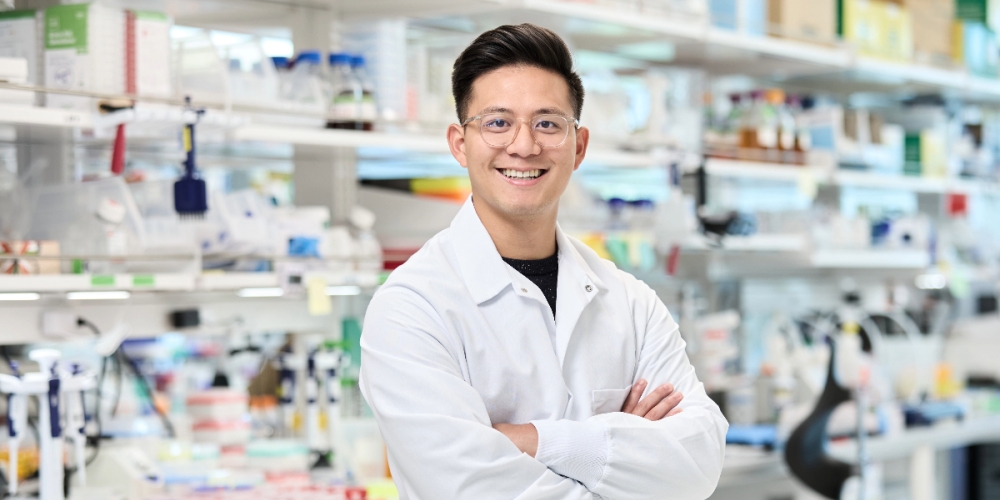
Patrick Hsu
American bioengineer and entrepreneur
4
APPEARANCES
4
PODCASTS
Oct 15, 2026


Patrick HsuGUEST
I think I learned about the importance of infinite games pretty early on, right? I think...
Patrick HsuGUEST
school, like the reason I went and did a PhD was because I wanted to do something really hard.
Patrick HsuGUEST
I wanted to go from cosplaying being a scientist and working on parts of a research problem and learning how to actually take an idea end to end to, you know, at the time a paper.
34 MINS LATER


Eric TopolHOST
Um, what did you think of those two, um, papers when they came out, you know, just weeks ago?
Patrick HsuGUEST
I think they're very exciting applications of models that can reason over the entire scientific literature, right? I think the idea that the human context li- uh, window is limited, and we can only read so many papers and think about so many ideas at a given time.
Patrick HsuGUEST
But an AI that is able to create hundreds or thousands of its instances and become an expert in different scientific fields and then coordinate discussions across all those different subfields is a really exciting one.
Patrick HsuGUEST
So you could have someone who's an expert in, you know, drug target ID, someone in-- who's an expert in genetics, uh, another, uh, who's an expert in hepatocyte biology, and then you can essentially simulate in silico conversations and scientific debates and hypothesis generation across all these different fine-tuned AI models, right? And so one of the things that these people could do is design new scientific projects.
Patrick HsuGUEST
They can, you know, make figures the way that you do in BioRender or Fathom or Excel or R today.
Patrick HsuGUEST
And the question is really, how do you orchestrate all of these into workflow to actually do something useful? And so I think these, the sort of the initial work from Google and Future House, um, you know, has really focused around the idea of can we do a proof of concept around end-to-end target discovery and then discovering or repurposing a molecule that already exists, maybe has even been tested in humans, that will work for this net new target.


Erik TorenbergHOST
Where are you excited? Where are you spending time? Where are you looking forward to?
Patrick HsuGUEST
We really try to figure out ways that we can improve the human experience in our lifetime.
Patrick HsuGUEST
I kind of think of, like, if I think about the future that we're going to leave to our children, right? There are a few things that if we get them right in our lifetime will fundamentally change the world, right? And, you know, how we live in it.
Patrick HsuGUEST
I think synthetic biology is obviously one, right? You know, think, you know, GLP-1s, right? Things that improve sleep, right? Things that can, you know, improve longevity, right? These are all things that are kind of easy to get excited about.
Patrick HsuGUEST
I think brain-computer interfaces is another area where we're going to see really important breakthroughs over the decades to come.
Erik TorenbergHOST
If not too difficult, I want to ask Jorge a question adopted to these additional spaces, robotics, sort of BCIs and longevity, if appropriate, in terms of three questions, I believe, were what's overhyped, where do you see opportunity or path, and what's got heft already?


Patrick HsuGUEST
So we're pretty bad at making drugs, right? And I think that implies two things.
Patrick HsuGUEST
The first is maybe our drug matter is not very good in the sense that its potency, its ability to bind the target, its toxicity, its pharmacokinetic profiles, all of those things.
6 MINS LATER

Sarah GuoHOST
For the core members of the research community here, is that a threat? How do you think of it?