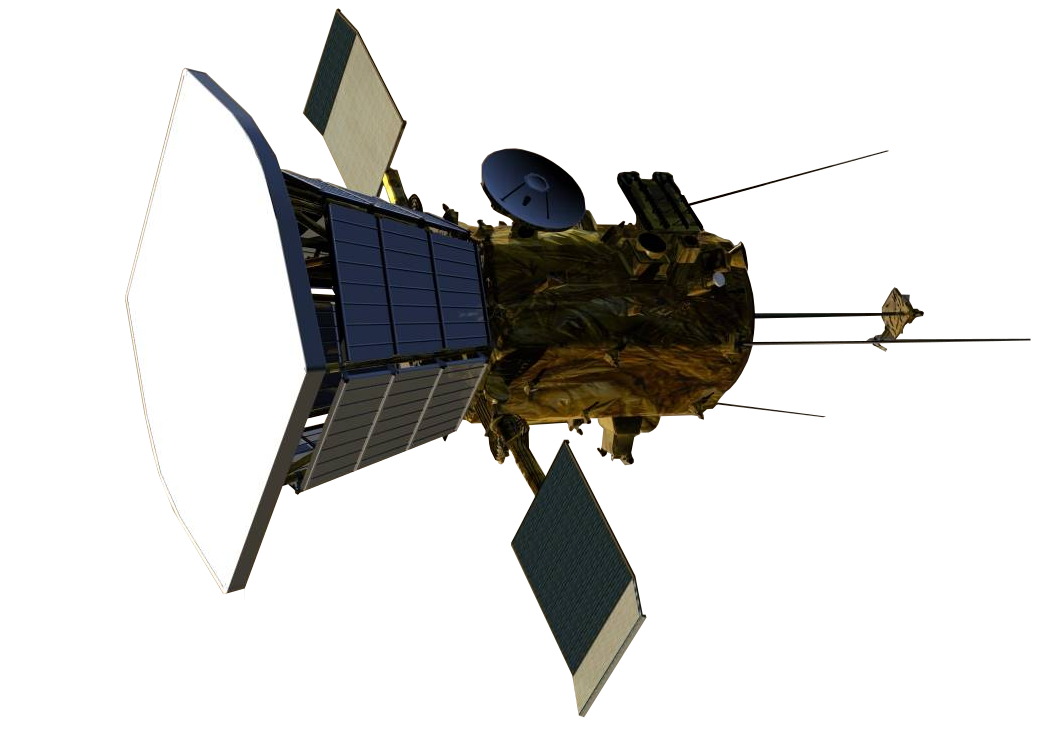
Parker Solar Probe
Space probeWikipedia
152
MENTIONS
48
EPISODES
23
PODCASTS
Search complete. 152 mentions across 48 episodes found for "Parker Solar Probe".
Sep 21, 2026

Matt O'DowdHOST
The sun, an entity worshiped as a god throughout time and across cultures, the source of all life and sustenance for our little blue space rock, and also a force of unthinkable destructive power.
Matt O'DowdHOST
But soon humanity will reach out its collective hand and come closer to touching the sun than we ever have before with the launch of the Parker Solar Probe.
Matt O'DowdHOST
NASA put humans on the moon, sent probes throughout and even beyond the solar system, and drove a minivan-sized rover across the surface of Mars.
Matt O'DowdHOST
And now NASA will once again attempt the impossible, reaching for the one place in the solar system we've never dared approach.
Matt O'DowdHOST
The Parker Solar Probe will fly within a hair's breadth of the sun itself.
Matt O'DowdHOST
Will NASA succeed where Icarus failed? The sun, a vast ball of incandescent gas 100 times Earth's diameter powered by the giant nuclear furnace of its core.
Matt O'DowdHOST
The energy it pumps out equivalent to a few hundred quadrillion nuclear power stations provides essentially all of the energy to sustain Earth's biosphere.
Matt O'DowdHOST
Okay, so maybe it's a good idea to learn more about the sun's surface.

speaker_0NARRATOR
The engineering challenges justify the investment in studying Mercury, as innovations developed for Mercury missions benefit many applications and advance the boundaries of what humanity can accomplish in space.
speaker_0NARRATOR
The Parker Solar Probe has begun making flybys near the Sun, approaching closer to the solar surface than any previous spacecraft, following a trajectory that will eventually bring it deeper into the Sun's radiation environment than Mercury orbits.
speaker_0NARRATOR
The Parker Solar Probe's mission is to study the Sun's corona and the solar wind close to their sources, but the spacecraft's path occasionally brings it into the vicinity of Mercury's orbit.
speaker_0NARRATOR
These near-Sun passes by the Parker Solar Probe produce observations and measurements relevant to understanding the environment near Mercury, including the properties of the solar wind and the Sun's magnetic field.
speaker_0NARRATOR
Future spacecraft designed to study the Sun will likely pass even closer to the solar surface than the Parker Solar Probe, eventually approaching within the orbit of Mercury and experiencing conditions similar to those that Mercury endures continuously.
speaker_0NARRATOR
The lessons learned from engineering and operating the Parker Solar Probe will directly transfer to the design of future Mercury missions, as both must overcome similar thermal and radiation challenges.
speaker_0NARRATOR
The engineering developments driven by the Parker Solar Probe will make it progressively easier and less expensive to send spacecraft to Mercury, thus advancing the ultimate goal of understanding this mysterious inner planet.
speaker_0NARRATOR
The proximity of Mercury to the Sun means that studying Mercury's environment requires technologies that are also necessary for studying the Sun itself.

Nicola FoxGUEST
So that excites me.
Nicola FoxGUEST
And so seeing, you know, the images from Mars and seeing, you know, the images from Parker Solar Probe of the, like the sort of the sun from the inside out as the, you know, you're looking out into the solar system.
Nicola FoxGUEST
And so I don't tend to sit and look at data and make predictions.
Nicola FoxGUEST
Amazing discoveries anymore.

Will RogersHOST
We begin this week's edition in solar orbit.
Will RogersHOST
NASA's Parker Solar Probe successfully checked in following its 29th perihelion, transmitting a normal system beacon tone on September 7, 2026.
Will RogersHOST
During the close approach on September 4th, the spacecraft matched its record-breaking performance, sweeping within 3.8 million miles of the solar surface at a top speed of 430,000 miles per hour.
Will RogersHOST
Operating autonomously during the intense nine-day encounter window, the probe trained its cameras on structures near the sun's north pole and sampled nearly 40% of the solar circumference while diving deep into the corona.

Will RogersHOST
We begin this week's edition in solar orbit.
Will RogersHOST
NASA's Parker Solar Probe successfully checked in following its 29th perihelion, transmitting a normal system beacon tone on September 7, 2026.
Will RogersHOST
During the close approach on September 4th, the spacecraft matched its record-breaking performance, sweeping within 3.8 million miles of the solar surface at a top speed of 430,000 miles per hour.
Will RogersHOST
Operating autonomously during the intense nine-day encounter window, the probe trained its cameras on structures near the sun's north pole and sampled nearly 40% of the solar circumference while diving deep into the corona.

Will RogersHOST
We begin this week's edition in solar orbit.
Will RogersHOST
NASA's Parker Solar Probe successfully checked in following its 29th perihelion, transmitting a normal system beacon tone on September 7, 2026.
Will RogersHOST
During the close approach on September 4th, the spacecraft matched its record-breaking performance, sweeping within 3.8 million miles of the solar surface at a top speed of 430,000 miles per hour.
Will RogersHOST
Operating autonomously during the intense nine-day encounter window, the probe trained its cameras on structures near the sun's north pole and sampled nearly 40% of the solar circumference while diving deep into the corona.

Andrew DunkleyHOST
There's a pair of spacecraft called Stereo, uh, that are in, uh, in orbit around the sun, uh, at slightly different positions, so they get a stereo view of the sun.
Andrew DunkleyHOST
Um, I'm wondering if the one that he's thinking of, though, is the Par- Parker Solar Probe, and that's because that one of all those, uh, solar spacecraft is the one that c- goes closest to the sun.
Fred WatsonHOST
Yeah.
Andrew DunkleyHOST
Uh, and indeed, as that mission has evolved, I think they've, um, they've, you know, thrown caution to the winds and, and got closer and closer to the sun.
Andrew DunkleyHOST
The surface is at about five, five and a half thousand Celsius, and yet you've got this, you know, region above-
Fred WatsonHOST
above-Uh, and, and we, we tend to think of heat rising by convection.
Fred WatsonHOST
Uh, why is the surface so cool compared with the, the heat of the, of the corona? And the clues that come from the Parker Solar Probe and other spacecraft seem to relate it directly to the magnetic activity of the Sun.
Fred WatsonHOST
The Sun is a hotbed of magnetism-

Fred WatsonHOST
There's a pair of spacecraft called Stereo, uh, that are in, uh, in orbit around the sun, uh, at slightly different positions, so they get a stereo view of the sun.
Fred WatsonHOST
Um, I'm wondering if the one that he's thinking of, though, is the Par- Parker Solar Probe, and that's because that one of all those, uh, solar spacecraft is the one that cl- goes closest to the sun.
Andrew DunkleyHOST
Yeah.
Fred WatsonHOST
Uh, and indeed, as that mission has evolved, I think they've, um, they've, you know, thrown caution to the winds and, and got closer and closer to the sun.
Fred WatsonHOST
The surface is at about five, 5,500 Celsius, and yet you've got this, you know, region above.
Fred WatsonHOST
Uh, and, and we, we tend to think of heat rising by convection.
Fred WatsonHOST
Uh, why is the surface so cool compared with the, the heat of the, of the corona? And the clues that come from the Parker Solar Probe and other spacecraft seem to relate it directly to the magnetic activity of the sun.
Fred WatsonHOST
The sun is a hotbed of magnetism-

Krishna ChoudharyHOST
Yeah.
Krishna ChoudharyHOST
Like the Parker Solar Probe, which is named after Eugene Parker, who we, um, cover in the America 250.
Krishna ChoudharyHOST
He's the one who, um, postulated that something like the solar wind should exist.
Krishna ChoudharyHOST
So again, plugging that episode.

Mark RattermanPANELIST
And I'll bring up some highlights of how unique this was, at least for me.
Mark RattermanPANELIST
Previously, Gene and I had talked about the Parker Solar Probe launch, which I didn't get to participate in, but Gene was there.
Mark RattermanPANELIST
And I remember how... how excited he was, how memorable it was, how big a deal it was.
Mark RattermanPANELIST
And I didn't get it.
Mark RattermanPANELIST
So here, for Nancy Grace Roman, I was there.
Mark RattermanPANELIST
I got it.
Mark RattermanPANELIST
In fact, Nikki Fox, who is the Associate Administrator of the Science Mission Directorate at Headquarters, she made the comment that, that she was not as excited as she was currently since the Parker Solar Probe launch.
Mark RattermanPANELIST
And I thought, oh, now I get why Gene was so excited and why he talked about the Parker Solar Probe in such sincere and full... excitement of being there.
38 more episodes mention Parker Solar Probe.
Create an account to see the whole feed, search across every transcript, and follow the entities you care about.